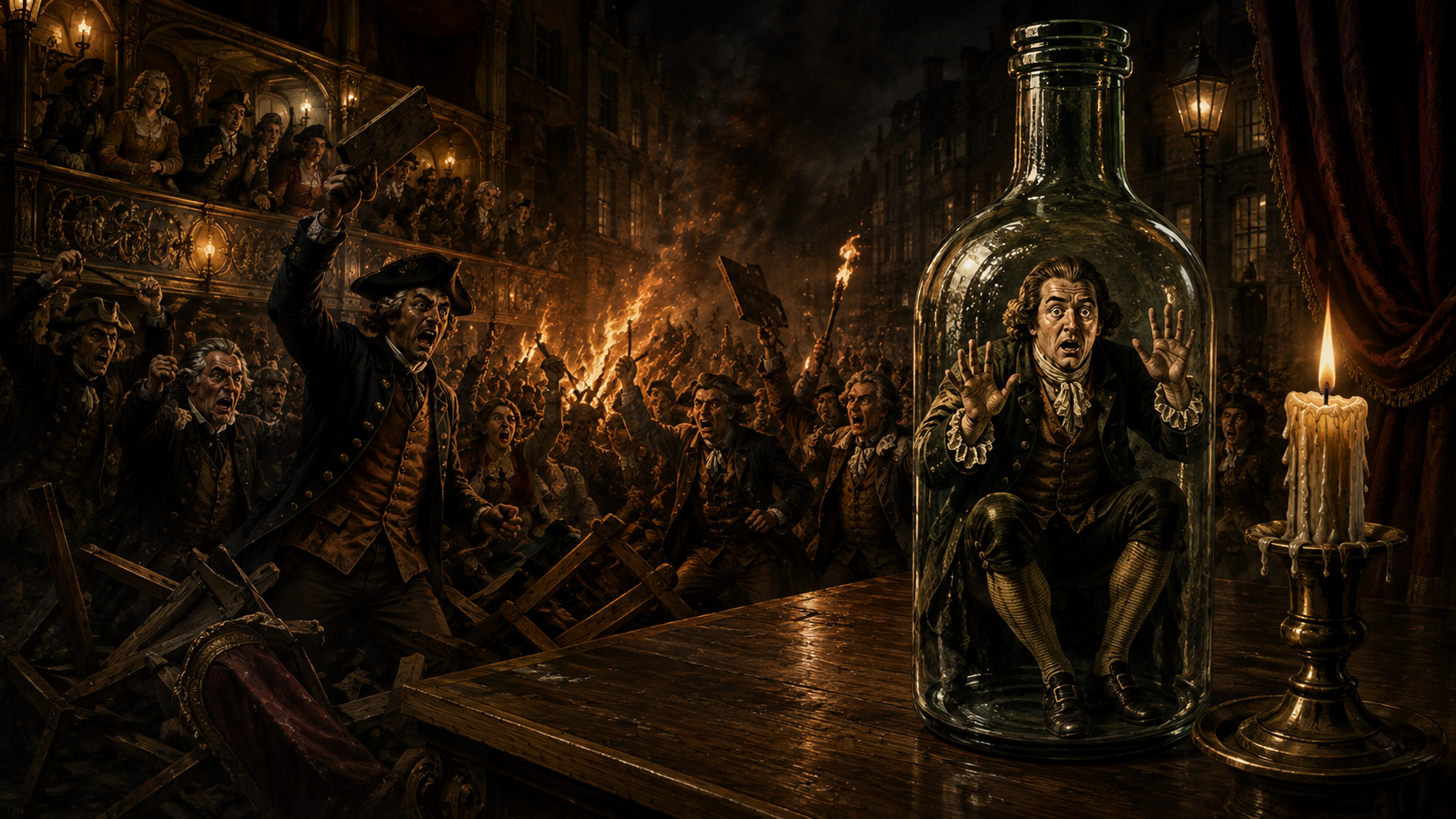
On Monday 16 January 1749, Londoners gathered at the New Theatre in the Haymarket to watch a man climb into a bottle.
Not a barrel. Not an enormous theatrical prop conveniently shaped like a bottle. An ordinary wine bottle.
The advertisement had been quite specific. The performer would present the audience with a common bottle which spectators could examine themselves. It would be placed on a table in the middle of the stage and then, “without any equivocation”, the man would enter it in full view of everybody present. Once inside, he would sing. Spectators would even be allowed to handle the bottle while he was in it, just to make absolutely certain that it was no larger than the sort of thing found in an ordinary tavern.
But this was not the entirety of the promised entertainment.
The mysterious performer would apparently take a walking cane from a member of the audience and somehow use it to reproduce the sounds of various musical instruments. He would perform other astonishing feats and, if sufficiently encouraged, might even reveal the identity of any dead person selected by a member of the audience and communicate with them.
But frankly, nobody was buying a ticket for the musical stick. London wanted to see the bloke get into the bottle.
The advertisement appeared in several newspapers during the first weeks of January and caused a sensation and by the evening of the performance, the theatre was packed. This was not merely an audience of drunken idiots who had wandered in from nearby taverns. People from across London society attended. Contemporary satires gleefully depicted aristocrats, intellectuals and fashionable society alongside everybody else. Prince William Augustus, Duke of Cumberland, the king’s son, was reportedly among the audience. There was only one small problem.
There was no Bottle Conjuror.
As the appointed hour approached, the audience waited. And waited. Eventually somebody appeared on stage. The performer had not yet arrived, the audience was told. If he failed to appear shortly, their money would be returned.
This did not improve matters.
According to accounts published afterwards, somebody in the pit offered to pay double if the performer would climb into a pint bottle instead. The audience laughed. Then somebody threw a lighted candle onto the stage and things deteriorated rather rapidly from there. People began tearing apart the theatre. Benches were ripped up. Boxes and fittings were demolished. Curtains came down. Timber was carried outside and piled into the street. Then somebody set fire to it.
By the time guards arrived, much of the damage had already been done. The Bottle Conjuror had failed to get inside a bottle. His audience had responded by attempting to dismantle the theatre around it.
Almost immediately, London began asking the obvious question.
Who the hell had done this?
Suspicion naturally fell upon people connected with the theatre.
Samuel Foote, the actor, playwright and theatrical impresario associated with the Haymarket, looked like an obvious candidate. He was famous for satire, unconventional entertainments and finding creative ways around the restrictions imposed upon theatres by the Licensing Act. John Potter, proprietor of the theatre, also came under suspicion. Both men publicly denied responsibility the following day. And this is where one of the most frequently repeated parts of the Bottle Conjuror story becomes rather less certain than it usually appears.
The Duke of Montagu is often named as the mastermind. According to the familiar version, John Montagu, 2nd Duke of Montagu – an enthusiastic practical joker – was discussing human gullibility with friends and wagered that he could fill a theatre simply by advertising something completely impossible.
A man climbing into a bottle would do nicely. It is a wonderful story. Unfortunately, contemporary evidence connecting Montagu directly to the hoax is very thin. The attribution appears in later accounts rather than the immediate reports of January 1749, and versions of the story disagree even over which duke supposedly made the wager.
Another candidate was Dudley Bradstreet, adventurer, government agent and professional maker of trouble, who later claimed involvement himself. Maybe he was telling the truth. Perhaps claiming responsibility for one of the most famous practical jokes in London was simply another good story.
The safest answer remains considerably less satisfying.
We don’t know who organised the Bottle Conjuror hoax, but whoever did it understood their audience extremely well. Because there is a problem with the traditional interpretation of what happened that night.
Were the people who filled the Haymarket actually stupid enough to believe that a full-grown human being could physically squeeze himself into an ordinary wine bottle? Contemporary observers were already asking exactly that question. One pamphlet published after the affair pointed out the contradiction rather beautifully.
The audience had included philosophers, mathematicians, astrologers, authors and other supposedly intelligent people. Many openly declared beforehand that the advertised feat was impossible… and then they bought tickets and went to see it. That isn’t necessarily gullibility. It’s curiosity.
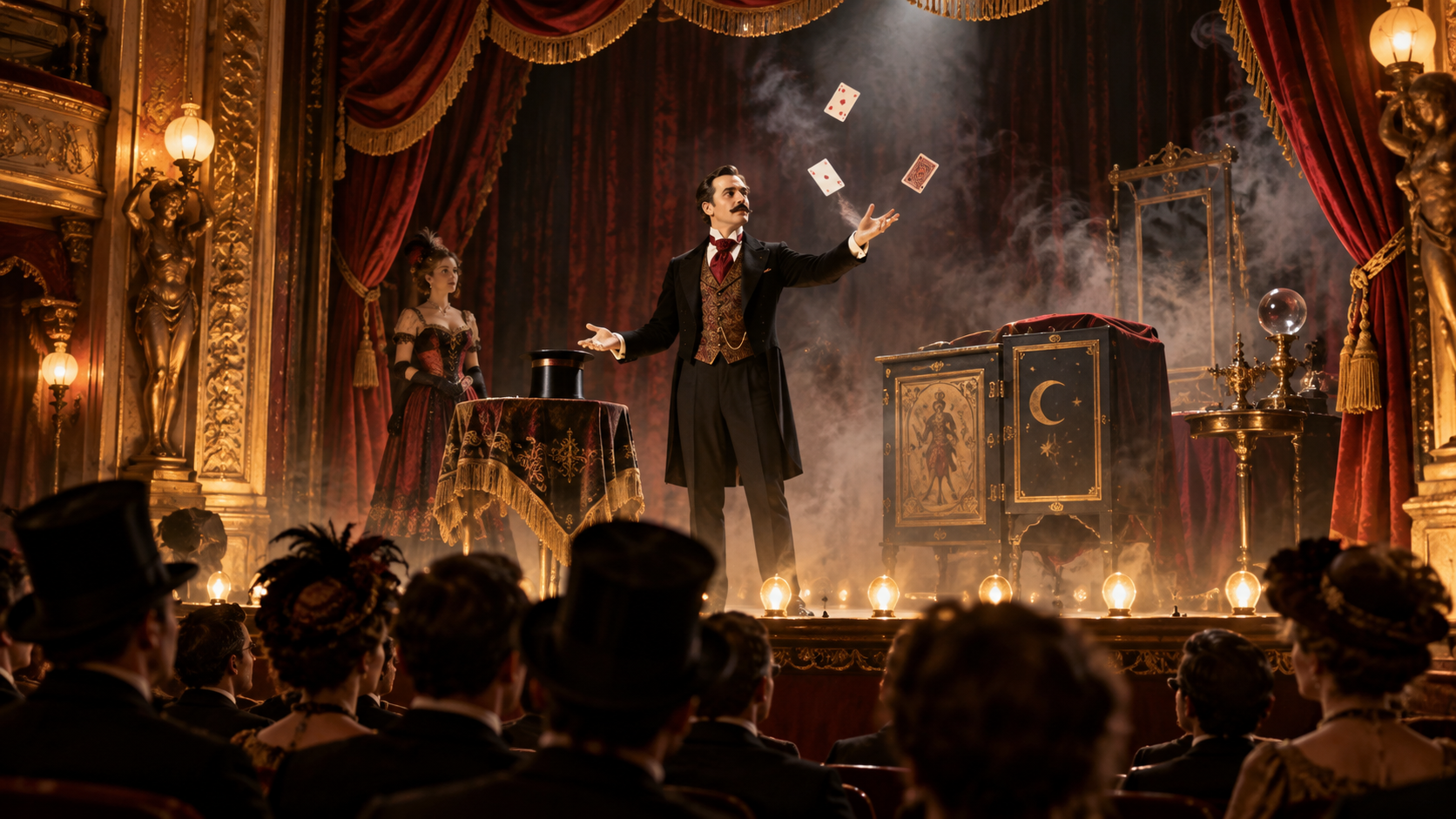
Eighteenth-century audiences were already accustomed to conjurors, illusionists, automata, scientific demonstrations and performers advertising apparently impossible feats. Nobody attending a modern magic show believes the magician genuinely possesses supernatural powers when a woman is apparently sawn in half. They go because they want to discover how the impossible thing will be made to appear possible.
The Bottle Conjuror advertisement practically challenged its readers. Here is an ordinary bottle. You can examine it. You can hold it. There are no tricks. The man will go inside it.
The more impossible the claim became, the more intriguing the performance became. Perhaps London’s audience did not think: ‘A man can fit inside a wine bottle.’
Perhaps they thought: ‘There is absolutely no way he can do that.’
Followed almost immediately by: ‘But I’d bloody love to see him try.’
And that changes the story considerably. Because the anger that followed makes rather more sense if the audience did not believe it had paid to witness a supernatural miracle. It had paid to witness an extraordinary trick. They expected deception, but they expected to be deceived skilfully. Instead, they got an empty stage.
There is a peculiar contract between a conjuror and an audience. The audience knows it is being lied to. The performer knows the audience knows. Everybody agrees to participate anyway. The pleasure comes from being unable to discover exactly where the lie occurs and the Bottle Conjuror broke that contract. There was no ingenious apparatus. No sleight of hand. No hidden compartments. No brilliant illusion. Just an advertisement. The trick had already happened before anyone entered the theatre. The audience itself was the performance. And eighteenth-century London showed absolutely no mercy once it realised that. The aftermath was glorious.
Printmakers and pamphleteers descended upon the affair.
Satirical engravings mocked what they called English credulity. Pamphlets appeared purporting to have been written by the missing Bottle Conjuror himself. One anonymous “apology” explained that he really had intended to climb into a bottle – just a very, very large one. Another joke claimed that the performer had been intercepted before the show by a gentleman wanting a private demonstration. The conjuror duly climbed into the bottle. The gentleman corked it, put it in his pocket and walked away. Problem solved.
The event became an instant cultural reference.
A 1749 print titled ‘English Credulity; or, Ye’re All Bottled’ depicted the affair as a national humiliation. Britannia herself was shown despairing over the foolishness of her children.
Another engraving, ‘The Bottle Conjurer, from Head to Foot, without Equivocation’, condemned both sides of the affair.

The hoaxer had lied. The audience had behaved like idiots. Nobody emerged particularly well.
Maybe that’s why the Bottle Conjuror survives nearly three centuries later.
It wasn’t really a trick involving a bottle. It was a trick involving expectation. The advertisement offered something physically impossible, but it placed that impossibility in precisely the environment where people routinely paid to watch impossible things apparently happen. A theatre. The audience knew there would be a trick. They just misunderstood where the trick was.
The mysterious Bottle Conjuror never needed to squeeze himself inside anything. He had already performed his impossible feat. He had convinced hundreds of people who knew perfectly well that a man could not climb into a wine bottle to pay money because they couldn’t resist finding out how he was going to do it.
And if I’m honest…
I’d have bought a ticket too.





That last sentence absolutely nails it. They were perfectly willing to be fooled – they just expected the fella to have the decency to show up and do it properly! 🙂