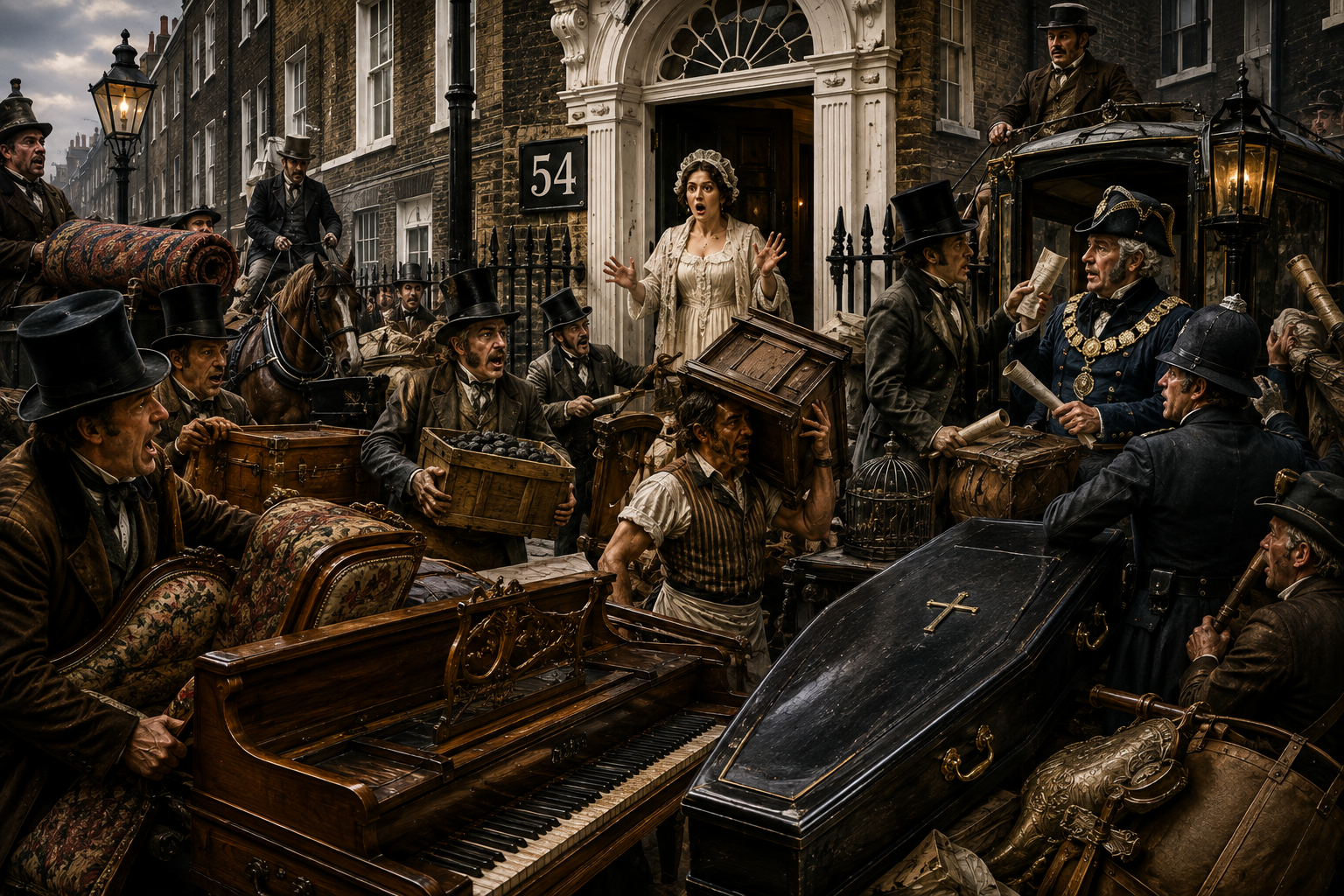
On the morning of 27 November 1810, somebody knocked at the door of 54 Berners Street.
There was nothing particularly remarkable about that. Berners Street, just north of Oxford Street in London, was a respectable address, and Number 54 was occupied by a woman named Mary Tottingham. The person at the door had come because somebody had asked him to. Unfortunately, Mary hadn’t.
Then somebody else arrived. And somebody else. Before long, it must have become apparent that something had gone very badly wrong.
By the end of the day, Berners Street would be clogged with tradesmen, carts, servants, professionals, expensive goods, bewildered dignitaries, police officers and enormous numbers of people who had turned up simply to watch the chaos. Someone had weaponised London’s postal system against one house and they had done it magnificently.
The earliest visitors are traditionally said to have been chimney sweeps, beginning at around five in the morning. One arrived to clean Mrs Tottingham’s chimneys. He was informed that nobody had requested him. Then another arrived. Then another… the later story gives twelve of them in total. Soon the scale of the operation became apparent. Coal wagons came from the Paddington wharves. Upholsterers arrived with cartloads of goods.
There were organs. Pianofortes. Linen. Jewellery. Furniture. Tradesmen attempted to reach the house while those who had already discovered they had been duped tried to leave. Spectators began gathering. And still they came…
We don’t have to rely upon a Victorian retelling for this.
Jackson’s Oxford Journal, reporting within days of the event, described Number 54 as being beset by so many tradespeople that the crowds made the street impassable. It reported wagons of coal, cartloads of upholstery, organs, pianofortes, linen, jewellery and enough assorted furniture seemingly to stock the street. ([Grub Street Project][1]) Then the Lord Mayor of London arrived.
This bit requires some explanation. He had not decided that an unprecedented quantity of furniture being delivered to one woman constituted a civic emergency. He had received a letter. Purporting to come from Mrs Tottingham, it explained that she had been summoned to appear before him but was confined to her room through illness. Would his Lordship be kind enough to call upon her instead?
Well, of course he would. So into the chaos came the Lord Mayor’s carriage and liveried servants.
His visit was brief. Having discovered that Mrs Tottingham knew nothing about the letter, he proceeded to the Marlborough Street Police Office and told the sitting magistrate what had happened. Officers were dispatched to Berners Street.
They didn’t stand much chance.
When they arrived, according to the contemporary report, they encountered six men carrying an organ, surrounded by coal heavers, barbers carrying wigs, mantua-makers with bandboxes, opticians and an extraordinary crush of other tradespeople.
By four o’clock the street was still in uproar. Police officers were eventually stationed at the ends of Berners Street in an attempt to intercept new arrivals before they reached Number 54 but it still wasn’t over. At around five, people seeking employment as servants began arriving. Somebody had apparently advertised or written offering them positions.
Imagine being Mary Tottingham. You’ve spent an entire day explaining that:
No, you didn’t order the coal.
No, you don’t want the piano.
No, you didn’t summon the Lord Mayor.
No, you don’t require an optician.
No, you aren’t hiring a new servant.
And no…
you definitely did not order your own coffin…
Because somebody sent one of those too. The contemporary newspaper account says that a coffin arrived made according to measurements supplied in the fraudulent order – five feet six inches. Whoever organised this had not merely ordered random merchandise. They had thought about it.
There were accoucheurs – practitioners of midwifery. Tooth-drawers. Miniature painters. Artists. Other accounts describe doctors and lawyers summoned on fabricated emergencies.
The point was apparently not simply to have a lot of deliveries arrive simultaneously. It was to make each individual recipient of a letter believe there was a perfectly legitimate reason why they specifically were required at Number 54. And that required work. Potentially a staggering amount of it.
This is where one of the most famous numbers in the story appears. Four thousand letters. You’ll find it everywhere. Somebody supposedly spent weeks writing four thousand letters ordering goods, summoning tradespeople and enticing important figures to Berners Street.
Four thousand is possible. But it isn’t securely established.
Older biographical accounts say “upwards of four thousand”; other retellings say thousands; some suggest hundreds. A nineteenth-century description even reduced the operation to about two hundred orders. ([Grub Street Project][1])
We simply don’t know.
And given what we can prove happened, we don’t really need the biggest number, hundreds would already represent an extraordinary undertaking. I mean, think about the logistics-
No email. No photocopier. No mail merge. Every letter had to be composed and physically written. Different businesses required different requests. Important people needed plausible stories. The timing had to be coordinated sufficiently well for arrivals to overlap. And the correspondence had to look convincing enough that recipients acted upon it.
– this wasn’t somebody knocking on a door and running away. It was project management. Malicious project management, admittedly, but project management nonetheless. And the person generally credited with organising it was only twenty-two years old.
His name was Theodore Edward Hook.
Hook was almost purpose-built for this story. Born in London in 1788, he was the son of composer James Hook and had entered the theatrical world remarkably young. By sixteen he was already involved in successful comic opera, and he became known not merely as a writer and performer but as an extraordinarily quick improviser and enthusiastic practical joker. ([Grub Street Project][1]) Later descriptions portray a man who could improvise songs at the piano, produce jokes almost continuously and turn social gatherings into performances. Some of his jokes were harmless. Others decidedly weren’t. And the Berners Street hoax became the one that followed him forever.
The traditional story begins with Hook walking through London with his friend, the architect and playwright Samuel Beazley. Hook supposedly made a wager that he could make any house in London the most famous address in the city. The stake is usually given as one guinea. Number 54 Berners Street was selected. Then Hook went to work. For weeks, according to the familiar account, he and accomplices wrote letters.
On 27 November, Hook and Beazley supposedly rented or occupied a room directly opposite Number 54, stocked themselves with refreshments and watched the consequences unfold.
It’s irresistible. Unfortunately, it is also the part of the story where we need to put the brakes on.
The contemporary newspaper reports describe the chaos. They describe Mrs Tottinghamhey and the deliveries. They describe the Lord Mayor and the police intervention. They even report that a reward was offered to identify the culprit. But they do not give us the complete Hook-and-Beazley wager story.
At the time, the perpetrator wasn’t caught. The newspaper report said there was reason to suspect a writer connected with a monthly publication but stopped short of naming him. ([Grub Street Project][1])
Hook subsequently became widely suspected and decades later, he came remarkably close to admitting it. In his semi-autobiographical novel ‘Gilbert Gurney’, published in the 1830s, Hook put an unmistakable boast into his protagonist’s mouth concerning the effect created in Berners Street:
he was the man who did it.
That is fairly persuasive. But even so, things refuse to remain tidy.
After Hook’s death, an acquaintance reportedly claimed that Hook wasn’t actually responsible for Berners Street and attributed it instead to another young gentleman who later became a respectable churchman. According to that version, Hook had performed a similar prank previously in Bedford Street – which may explain how the stories became tangled. ([Wikipedia][2])
So was Theodore Hook responsible?
Probably.
Can we prove every detail of the famous wager story?
Nope.
Did Samuel Beazley definitely sit opposite drinking and watching the mayhem with him?
Again, the evidence is much shakier than the confidence with which that scene is usually repeated.
But somebody certainly did organise the hoax. Because unlike some famous historical practical jokes, the central event itself isn’t folklore. The newspapers were reporting it immediately. Better still, artists were drawing it.
On 6 December 1810 – barely more than a week after the event – publisher S. W. Fores issued William Heath’s satirical print ‘The Berners Street Hoax’.
It shows the unfortunate woman at the centre of an invasion of tradespeople and goods, with the Lord Mayor prominently among them. The Library of Congress dates the engraving firmly to 1810. ([Library of Congress][3])

Another surviving depiction, by John Augustus Atkinson and now held by the London Museum, dates from roughly 1811-15 and again shows the bewildered resident confronted by tradespeople, a coffin and assorted chaos. ([London Museum][4]) The joke had become part of London culture almost immediately.
But there’s something uncomfortable hiding beneath the comedy. Mary Tottingham hadn’t agreed to participate. Neither had the tradespeople.Some businesses transported expensive or perishable goods across London only to discover that nobody wanted them. Workers lost time. Horses and carts were tied up. Police resources were required. People looking for employment were sent on a pointless journey. And an unsuspecting woman spent an entire day with strangers attempting to enter her home.
Even the contemporary press wasn’t universally amused. The Jackson’s Oxford Journal account called it a “contemptible piece of humour” and hoped the culprit would be identified and forced to compensate the victims. ([Grub Street Project][1]) That’s the part worth remembering when the story gets presented as the greatest practical joke in history.
It was funny.
Provided you were watching.
The brilliance of Berners Street wasn’t really the number of letters. It was the way the hoax exploited trust. Every victim received something that looked like an ordinary piece of correspondence.
A customer wants coal.
A household requires furniture.
A sick woman needs a doctor.
Someone wants a portrait painted.
A wealthy lady needs a legal consultation.
A servant is required.
The Lord Mayor receives a polite explanation from a respectable woman unable to attend him personally.
Nothing about those individual requests necessarily looked extraordinary. The impossibility only became visible when they all converged upon the same doorstep.
Nobody had to believe in rabbit births.
Nobody had to believe in an impossible conjuring trick.
Nobody had to authenticate Shakespeare.
They merely had to believe a letter.
Which might make Berners Street the most modern hoax of our entire week.
Change handwritten letters into emails. Replace tradesmen with food deliveries, taxis and couriers. Replace the Lord Mayor’s carriage with somebody responding to a convincingly spoofed message. The mechanism still works.
One person sends information while pretending to be somebody else. The recipient acts upon it. Multiply that by several hundred people and suddenly an ordinary house becomes the centre of a citywide disturbance.
More than two centuries before anyone had heard the words spam, spoofing or denial-of-service attack, somebody discovered that London’s communications network could be turned against itself. All they needed was paper, postage, a great deal of spare time. And absolutely no consideration whatsoever for Mary Tottingham of Number 54 Berners Street.
Whoever did it achieved exactly what the later legend claims Theodore Hook had promised.
For one extraordinary day in November 1810, Number 54 became the most talked-about house in London.
And more than two hundred years later…
we’re still talking about it.