There are plenty of places in Britain where people gather around bonfires on the fifth of November. There are towns that organise elaborate fireworks displays, villages that parade through the streets carrying torches, and communities that have preserved some wonderfully peculiar customs associated with Guy Fawkes Night.
Then there is Ottery St Mary.
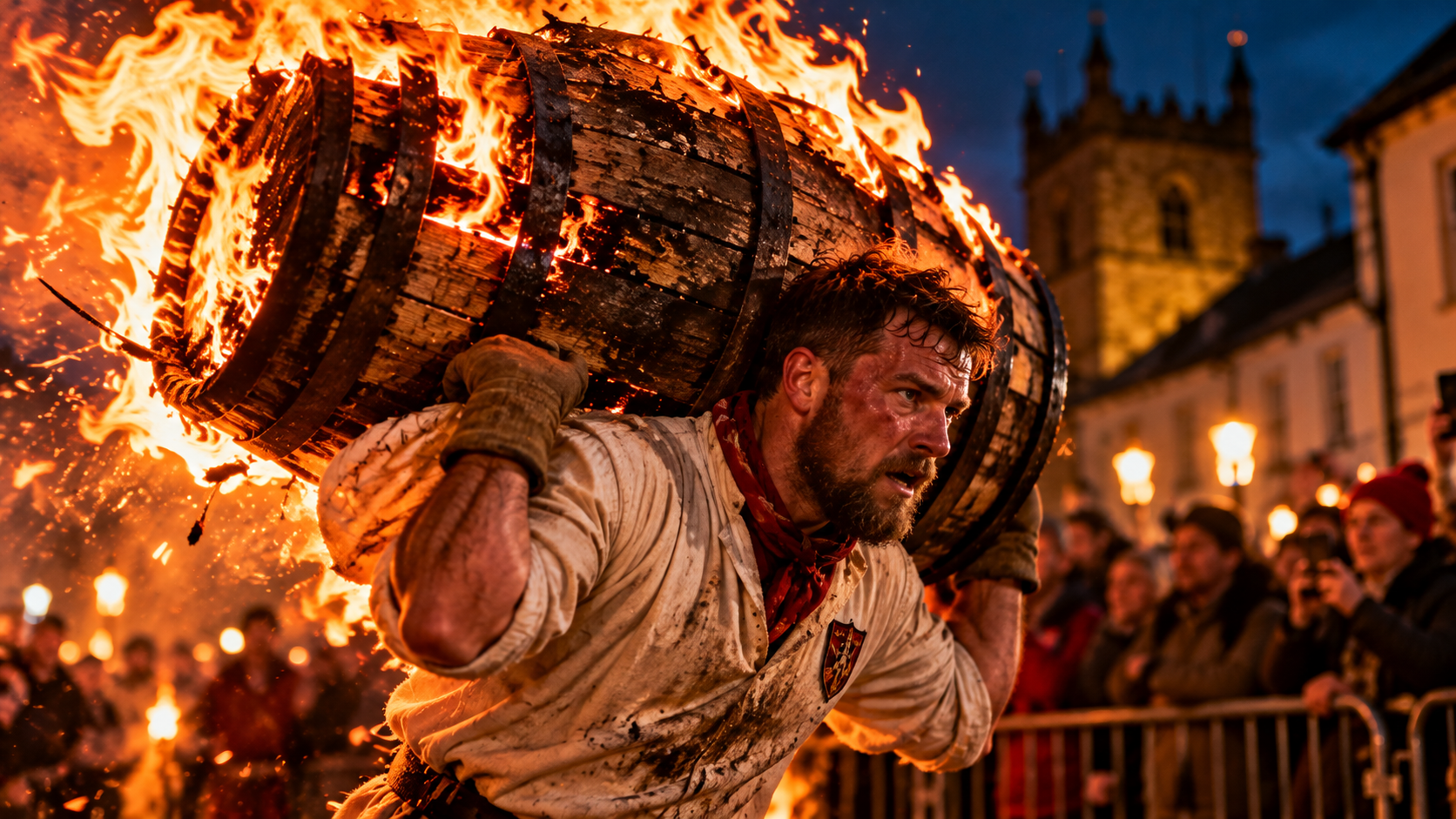
Every November, this historic East Devon town stages a spectacle that would probably give most health and safety officers a nervous breakdown. Local people hoist blazing, tar-coated barrels onto their shoulders and carry them through streets crowded with spectators. Flames leap above their heads, burning material falls to the ground, and the barrel carriers, known locally as rollers, move through the crowds with an apparent disregard for the fact that they are supporting a considerable fire on their backs.
It is one of Britain’s most extraordinary surviving fire traditions, and unlike the carefully choreographed torchlit processions found elsewhere, the Ottery barrels retain something gloriously unpredictable.
The celebration takes place on 5 November, unless that date falls on a Sunday, when the event moves to the preceding Saturday. Throughout the afternoon and evening, barrels of increasing size are carried at different locations around the town. Smaller barrels are used by younger participants, with larger examples appearing as the evening progresses. The festivities culminate in the famous Midnight Barrel, the largest and most anticipated of the night.
The sight is difficult to forget. A roller emerges from the crowd carrying a blazing barrel, the flames streaming backwards as they move. Other rollers wait to take over, and spectators press forward to watch the action. The barrel is passed from shoulder to shoulder, while the fire continues to consume the material inside it.
It looks like something that should have been prohibited centuries ago.
Instead, it has become the town’s most famous tradition.
The origins of the Ottery tar barrels are uncertain, although local tradition places them several centuries in the past. The most frequently repeated explanation connects the custom with the Gunpowder Plot of 1605, when Guy Fawkes and his fellow conspirators attempted to destroy Parliament and kill King James I.
Bonfires and other public celebrations became associated with the anniversary of the plot’s failure, and burning barrels were once found in numerous West Country towns. In many places, the barrels were rolled along the streets rather than carried, which is a considerably more sensible arrangement when the object in question is on fire.
At some point, the people of Ottery apparently decided that rolling a flaming barrel was insufficiently exciting and began carrying them instead.
Precisely when that change occurred is difficult to establish. The organisers themselves acknowledge that the custom’s exact beginnings are unknown, and the familiar story of its evolution from rolling to carrying should be understood as local tradition rather than a precisely dated historical event.
Other explanations have been offered over the years. Some suggest that burning barrels were once used to fumigate cottages during outbreaks of disease. Others associate them with warning signals during the approach of the Spanish Armada in 1588. A more romantic interpretation links the custom to pre-Christian fire rituals intended to purify communities or drive away evil spirits.
All three possibilities have appeared in accounts of the festival, but none establishes the origin of Ottery’s particular practice. The Armada explanation, for example, is difficult to reconcile with a custom specifically associated with 5 November, while a connection with ancient pagan ceremonies would require evidence of continuity that has not been demonstrated.
The safest conclusion is that Ottery’s tar barrels belong to the wider history of West Country fire customs, particularly the celebrations surrounding Bonfire Night. Their precise beginnings remain unresolved.
That uncertainty does not make the tradition any less remarkable.
Indeed, the history of Ottery St Mary suggests that fire, political feeling and public disorder were closely intertwined in the town’s November celebrations. The Gunpowder Plot was not the only event that gave 5 November significance. In 1688, William of Orange landed at Brixham in Devon, beginning the invasion that would lead to the overthrow of James II.
The coincidence of dates strengthened the anniversary’s Protestant associations. For generations, Bonfire Night could serve as an expression of political and religious identity as well as an occasion for communal entertainment.
Research published by the Ottery St Mary Heritage Society records the burning of political effigies in the town, including an image of the German Kaiser placed on the bonfire in November 1919. The same research describes attempts by authorities to move the celebrations away from the streets, only for residents to restore their fires to the town.
There is a familiar pattern here. Across Britain, traditional fire celebrations often brought communities into conflict with officials concerned about disorder, injury and damage to property. Lewes developed its own elaborate bonfire societies, while Ottery retained the particularly hazardous business of moving burning barrels through its streets.
Yet the modern event is far from an uncontrolled free-for-all.
Participation is restricted, and the people who carry the barrels are drawn from the local community. The custom is deeply associated with Ottery families, some of whom have taken part for generations. Children begin with smaller barrels, and experienced rollers take on the larger examples as they grow older.
The distinction between spectators and participants is important. Visitors may watch the proceedings, but carrying a barrel is not something anyone can simply decide to try after a couple of pints.
Preparation begins well before November. Barrels are treated with tar and prepared for burning, while organisers arrange the many practical requirements involved in bringing thousands of people into a relatively small historic town.
The barrels themselves are traditionally associated with particular public houses and locations, creating a route through the community rather than a single central display. As the evening progresses, the crowds move between sites, following the increasingly dramatic appearances of the rollers.
The event also includes a giant bonfire, fireworks and a fairground, although the barrels remain its defining attraction.
There is another element of Ottery’s November celebrations that deserves attention: the firing of the rock cannons.
These small, handheld devices produce enormous reports and have long been associated with the town’s festivities. A surviving television report from 1976 records that the practice had been revived in 1956, with the cannons fired during the day as part of the celebrations.
Like the barrels themselves, the rock cannons contribute to an atmosphere in which noise and fire are not incidental entertainment but essential parts of the occasion.
Fortunately, the modern organisers recognise that preserving a dangerous-looking tradition requires considerable work behind the scenes. Risk assessments, emergency arrangements, stewarding and crowd management are part of keeping the event viable.
A Health and Safety Executive review of the carnival described the strong local commitment that sustained the tradition, noting the participation of successive generations of families. That sense of ownership helps explain why Ottery has retained a custom that disappeared from many other places.
It is tempting to regard the festival simply as a thrilling spectacle, but doing so overlooks the community that makes it possible. The barrels are not merely props brought out for the benefit of tourists. They are part of a local inheritance, maintained through preparation, participation and the passing down of practical knowledge.
This is particularly apparent in the way younger rollers are introduced to the custom. The smaller barrels are not simply miniature versions provided for entertainment. They represent the continuation of the tradition itself, allowing another generation to become part of something their parents and grandparents may have experienced before them.
There is also an interesting contrast between Ottery and other British fire festivals.
At Burghead, the Burning of the Clavie marks the old New Year through the ceremonial carrying of a blazing barrel. In Lerwick, Up Helly Aa transforms the burning of a specially constructed galley into an elaborate celebration of Shetland’s Norse heritage. At Lewes, Bonfire Night has become inseparable from the town’s history of religious conflict and resistance to authority.
Ottery St Mary, meanwhile, has preserved a physical custom whose origins are much less clearly understood. The spectacle is not primarily about elaborate costume or historical reenactment. Its defining act is startlingly simple: someone picks up a burning barrel and carries it.
The simplicity is deceptive, of course. What looks like chaos depends upon familiarity, cooperation and experience, as well as the organisation required to keep participants and spectators as safe as possible.
Perhaps that is why the tradition has endured. It has remained recognisably itself even as the world around it has changed. The barrels have not been replaced with electric lights, nor has the event been transformed into a purely theatrical representation of an old custom.
The fire is real. The weight is real. The danger is real, even if considerable effort goes into managing it.
And the determination to keep the custom alive is real, too.
Every November, as the crowds gather in Ottery St Mary, the town renews a tradition whose beginnings have become obscured by centuries of repetition, speculation and local memory.
Nobody can say with certainty who first decided that a burning barrel belonged on somebody’s shoulders rather than rolling along the ground.
But generations of Ottery residents have apparently agreed that it was an excellent idea.
And, against all reasonable expectations, they have kept doing it ever since.