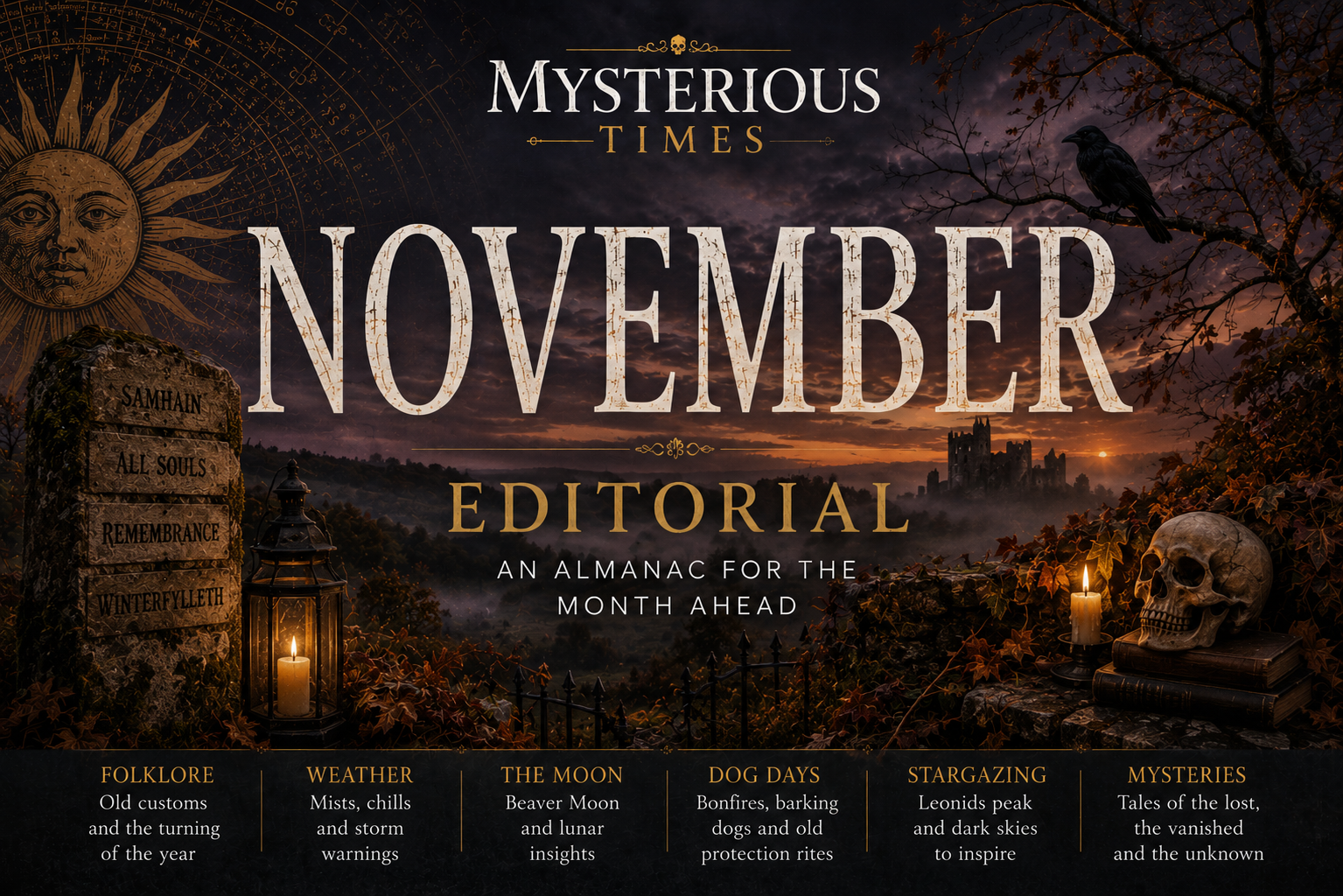
I love November.
October makes a great fuss about its ghosts, witches and things that go bump in the night, but November is altogether more subtle. It doesn’t need carved pumpkins or plastic skeletons. It has bare branches tapping against bedroom windows, mist creeping across fields, and the sort of darkness that makes an ordinary walk home feel like the opening chapter of a ghost story. Especially if you live somewhere like we do – the middle of nowhere.
The clocks have gone back, the evenings have drawn in, and the countryside is settling into its winter sleep. The last leaves cling stubbornly to the trees, hedgerows are heavy with berries, and somewhere in the distance, somebody is lighting a bonfire.
Our ancestors understood November rather differently from us. It was a month of endings and preparations, when livestock were brought in or slaughtered, winter stores were counted, and families gathered around the hearth. It was also a time for remembering the dead, watching the skies and observing customs whose origins have sometimes become rather muddled over the centuries.
So, put the kettle on, draw the curtains against the gathering dark, and join us for a wander through November’s folklore, history, natural wonders and celestial happenings.
The Month of the Dead
November begins in the shadow of Halloween, but the traditional season of remembrance doesn’t end when the pumpkins are thrown away.
The first day of November is All Saints’ Day, followed on the second by All Souls’ Day. Together with All Hallows’ Eve, these form Hallowtide, a period in the Christian calendar devoted to remembering saints and the departed.
In parts of Britain, the season was once accompanied by the custom of souling. Children or poorer members of the community visited houses, sometimes singing or offering prayers for the dead in exchange for food, particularly small cakes known as soul cakes.
One familiar version of the traditional song begins:
“A soul, a soul, a soul cake,
Please, good missus, a soul cake.”
The custom varied considerably from place to place, and not every community observed it in quite the same way. In some districts, souling survived into the twentieth century, while elsewhere it disappeared or became entangled with other autumn traditions.
There is something rather touching about the idea of remembering the dead through the simple exchange of a cake and a prayer. Although, knowing human nature, one suspects the cakes were at least as important as the prayers to some of the participants.
November’s association with the dead is older and broader than any single religious observance. The Irish festival of Samhain, marking the transition into the darker part of the year, has long been associated in folklore with supernatural encounters and the presence of otherworldly beings. However, the precise relationship between ancient Samhain observances and later Halloween customs is more complicated than popular accounts sometimes suggest.
What remains unmistakable is the importance of this seasonal turning point. Summer’s abundance has gone, winter is approaching, and the living pause to remember those who have departed.
Remember, Remember: The Fifth of November
Few British calendar customs are quite as noisy as Bonfire Night.
On 5 November 1605, Guy Fawkes was discovered guarding barrels of gunpowder beneath the House of Lords, part of a conspiracy intended to destroy Parliament and kill King James I.
The plot failed, and celebrations of the king’s survival began almost immediately. The Observance of 5th November Act of 1606 established an annual day of thanksgiving, although the legislation was eventually repealed in 1859.
Over the centuries, religious and political observances evolved into the familiar spectacle of bonfires, fireworks and effigies.
Yet the history of Bonfire Night is not simply one of harmless autumn entertainment. The celebrations could be fiercely anti-Catholic, politically charged and occasionally violent. The burning of effigies, including representations of the Pope, was once a prominent feature in some places.
Today, most people are rather more interested in fireworks, baked potatoes and whether the dog is hiding behind the sofa.
Fire itself has an extraordinary place in British folklore. From protective hearth fires to seasonal bonfires, it has been associated with purification, community, warmth and the turning of the year.
It is tempting to imagine every November bonfire as a direct descendant of an ancient pagan ritual, but historical evidence rarely permits such a neat explanation. Customs change, merge and acquire new meanings.
Sometimes a bonfire is an ancient tradition. Sometimes it commemorates a failed conspiracy. And sometimes it is simply an excellent excuse to stand in a muddy field eating something hot.
Martinmas and the Old Winter
The eleventh of November is Martinmas, the feast of St Martin of Tours, a fourth-century Christian saint remembered particularly for the story of sharing his cloak with a beggar.
In the agricultural calendar, Martinmas was once a significant turning point.
It was associated with the end of the farming year, the settling of accounts, hiring arrangements and the preparation of winter provisions. In some regions, animals that could not economically be fed through winter were slaughtered, providing meat for preservation and feasting.
The tradition of the Martinmas goose became particularly well established in parts of Europe and Britain.
Martinmas also has its weather lore. A spell of unusually mild weather around the saint’s feast has sometimes been called St Martin’s Summer, although it is not a reliable annual occurrence.
There is a practical wisdom beneath much of this folklore. By November, the harvest was over, winter fodder was limited, and the household needed to know whether its supplies would last until spring.
The old calendar was not merely a collection of quaint customs. It was a survival guide.
The Wild Hunt and the Winter Sky
As the nights lengthen and autumn storms begin to sweep across the countryside, we enter the season most readily associated with one of northern Europe’s most unsettling supernatural traditions: the Wild Hunt.
Stories of spectral riders, ghostly huntsmen and packs of supernatural hounds occur in various forms across European folklore.
In Britain, traditions involving Gabriel Hounds, the Yeth Hounds and other mysterious aerial packs have been associated with strange cries heard overhead during darkness or bad weather.
Some accounts describe the sounds as omens of death. Others connect them with restless spirits or supernatural hunters.
Natural explanations have been proposed for certain reports, particularly the calls of migrating birds heard at night. Geese and other birds can produce surprisingly eerie sounds when passing unseen through darkness.
Of course, explaining a strange noise doesn’t necessarily make it any less frightening when you’re standing alone on a moor in November.
The Wild Hunt is not a single uniform British legend, and the many regional traditions should not be treated as interchangeable. Nevertheless, they share an enduring fascination with the unseen company that might travel through the winter darkness.
If you hear something strange overhead this month, it is probably worth checking for geese before assuming the dead have taken up hunting.
The November Night Sky
November 2026 offers some excellent opportunities for anyone willing to wrap up warmly and spend a little time looking upwards.
The Southern Taurid meteor shower reaches its November maximum around the 4th and 5th. The Taurids are not especially prolific, but they are celebrated for producing occasional brilliant fireballs.
The Northern Taurids follow around the 11th and 12th, when favourable moonlight conditions should make darker rural skies particularly rewarding.
Then come the Leonids, with their principal maximum expected on the 17th. These swift meteors are associated with debris from comet 55P/Tempel-Tuttle, and the shower has occasionally produced spectacular meteor storms in the past.
No comparable storm is expected this year, but the early hours of 18 November should offer a reasonable opportunity to see some shooting stars, weather permitting.
On 15 and 16 November, Mars and Jupiter will also appear unusually close together in the predawn sky. The planets are not actually approaching one another in space, of course. It is simply a particularly attractive alignment from our viewpoint on Earth.
And on 24 November, the Full Moon will be a supermoon, appearing slightly larger and brighter than an average full Moon because it occurs relatively close to Earth.
Traditionally, November’s Full Moon is often called the Beaver Moon, a name popularised through North American moon-naming traditions. It is not an ancient universal British name, despite what some modern folklore calendars might suggest.
For those who prefer a more atmospheric description, the Moon above the bare trees will do very nicely.
Saints, Smiths and Strange November Customs
November’s calendar contains several lesser-known observances that once held considerable importance in particular trades and communities.
St Clement’s Day falls on 23 November. Clement became associated with blacksmiths and metalworkers, and in parts of England the day was marked by gatherings, feasting and ceremonies connected with the forge.
Some communities observed a custom known as Clementing, in which children or workers went from house to house seeking contributions or treats. As with many traditional customs, the details varied by locality and period.
Two days later comes St Catherine’s Day, traditionally associated with unmarried women and, in some English districts, lace-makers.
The women who worked in the lace trade sometimes celebrated the occasion with special gatherings, food and festivities. The customs surrounding St Catherine’s Day also developed differently across Europe, where the saint became associated with marriage hopes and particular forms of divination.
November closes with St Andrew’s Day on the 30th, honouring Scotland’s patron saint.
Across parts of Europe, St Andrew’s Eve was associated with marriage divination, including attempts to discover the identity of a future husband.
Apparently, waiting to meet somebody naturally was simply not sufficiently mysterious for our ancestors.
In the Hedgerows and Woodlands
November is not quite the lifeless month it sometimes appears.
Although many trees are bare, the hedgerows remain busy places. Hawthorn berries, rosehips, holly and other autumn fruits provide valuable food for birds and mammals, while flocks of winter thrushes arrive from northern Europe.
Fieldfares and redwings become familiar sights in the British countryside, particularly where berries remain plentiful.
The first hard frosts may arrive, although their timing varies considerably from year to year. On colder mornings, cobwebs suddenly reveal themselves in the hedges, outlined in silver, and fallen leaves become brittle beneath our feet.
Fungi may still be abundant in damp woodland, and the unmistakable smell of wet earth and decaying leaves fills the air.
There is folklore here, too.
The elder tree has long been surrounded by beliefs concerning protection, misfortune and the supernatural. Hawthorn is deeply embedded in fairy traditions, although its associations vary by region. Holly, meanwhile, carries a wealth of winter symbolism and will soon take its place in the decorations of the approaching festive season.
November is an excellent month for noticing the small things.
A bird moving through the hedge. A fox crossing a lane at dusk. The last stubborn leaf on an otherwise naked tree.
Not every mystery needs to be supernatural.
November’s Curious Anniversaries
November has supplied history with some rather remarkable events.
On 5 November 1605, the Gunpowder Plot was discovered, ensuring that Guy Fawkes would become one of the most recognisable figures in British historical memory.
On 7 November 1872, the brig Mary Celeste departed New York on the voyage that would end with her discovery abandoned in the Atlantic the following month. Her fate remains one of maritime history’s most famous mysteries, although many of the sensational details in popular retellings were later inventions.
On 17 November 1558, Elizabeth I became Queen of England following the death of her half-sister Mary I. Her accession began a reign that would profoundly shape the country’s religious, political and cultural history.
On 24 November 1859, Charles Darwin published On the Origin of Species, a book that transformed scientific understanding of life on Earth and provoked enormous debate.
And on 30 November 1936, London’s Crystal Palace was destroyed by fire, bringing a dramatic end to one of Victorian Britain’s most extraordinary architectural achievements.
Five very different events, each leaving its own mark upon the historical imagination.
A Little November Weather Wisdom
Our ancestors watched the weather closely, and November acquired its share of seasonal sayings.
One familiar proverb declares:
“If there’s ice in November that will bear a duck, there’ll be nothing after but sludge and muck.”
Like most traditional weather predictions, it should be enjoyed as folklore rather than treated as a dependable forecast.
Nevertheless, such sayings reveal how carefully rural communities observed the changing seasons. The timing of frost, rainfall, wind and animal behaviour mattered enormously in a society where a difficult winter could mean genuine hardship.
We may have weather apps and central heating, but there is still something satisfying about stepping outside, looking at the sky and making our own prediction.
Even if the sky then proves us completely wrong.
Before December Comes Calling
By the end of November, the last traces of autumn are fading.
The countryside has changed its colours. Gold and copper have given way to grey, brown and the dark green of evergreens. The nights are long, the mornings reluctant, and the year is drawing towards its shortest day.
Yet November isn’t just a waiting room for Christmas.
It has its own character, its own history and its own peculiar magic. It is the month of remembered souls and burning fires, of old agricultural customs, wandering hounds, falling stars and winter birds.
It reminds us that darkness need not be empty, and that some of the most fascinating stories are found when the world grows quiet.
So, wherever November finds you, keep your eyes open, your curiosity alive and perhaps a torch in your pocket.
You never know what might be waiting just beyond the circle of light.
From all of us at Mysterious Times, may your November be full of wonder, warmth and just enough mystery to keep things interesting.