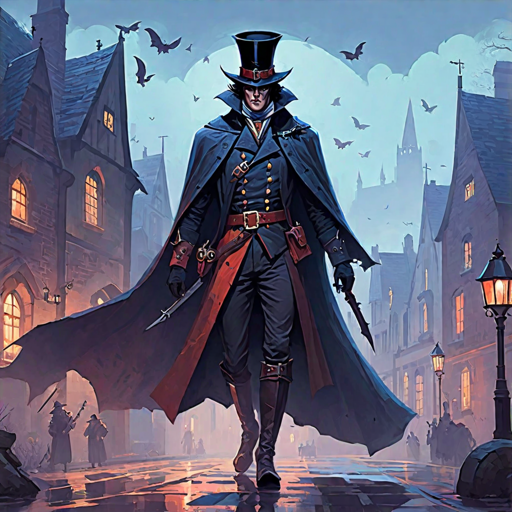
In the heart of Victorian London’s dimly lit streets, a figure emerged, striking terror into the hearts of its residents.
Spring Heeled Jack, a phantom-like character, transcended the boundaries between reality and folklore, leaving an indelible mark on the collective psyche of the era.
This elusive and mysterious being became a spectre haunting the imaginations of Londoners in the early 19th century and as the legend of Spring Heeled Jack took root, he became a narrative woven into the fabric of the city’s tales.
His ghostly presence was characterised by a tall, thin figure adorned in a dark cloak with demonic features that inspired both fear and morbid fascination. However, what truly set Spring Heeled Jack apart from conventional urban legends were the extraordinary feats attributed to him.. his ability to leap great heights and distances with an agility that seemed supernatural, rendering him seemingly impervious to capture.
Spring Heeled Jack’s legacy unfolded in 1837 when Mary Stevens, a servant, recounted a harrowing experience of being accosted by this agile assailant.
Reports soon followed of Jack effortlessly leaping over walls and buildings, leaving both law enforcement and witnesses bewildered in his wake.
The legend grew, evolving into a tale of not just a mysterious figure, but one with malevolent tendencies. Whispers circulated of Jack spitting blue flames at his victims and possessing razor-sharp claws capable of tearing through flesh, transforming him into a spectral entity that embodied the darkest fears of the Victorian populace.
The impact of Spring Heeled Jack on society was profound, permeating the everyday lives of Londoners. Newspapers, pamphlets, and the oral tradition fueled the spread of his legend, amplifying a sense of paranoia and unease throughout the city.
Mothers, seeking to instill discipline in their children, invoked the name of Spring Heeled Jack as a cautionary tale, warning of the spectral figure that would materialize in the night to punish misbehavior.
Efforts to capture or unmask Spring Heeled Jack became a communal endeavor. Vigilante groups formed, and citizens remained on high alert, yet the enigmatic figure consistently eluded capture, disappearing into the shadows just as swiftly as he appeared.
The pursuit of this elusive phantom became a symbol of the struggle between the tangible reality of Victorian London and the otherworldly realm that Spring Heeled Jack seemed to effortlessly traverse.
Numerous theories abound, attempting to demystify the phenomenon of Spring Heeled Jack. Sceptics argue that the tales were exaggerated or entirely fabricated, attributing the legend to mass hysteria and the influence of Gothic literature prevalent during the time.
The absence of concrete evidence has allowed the myth to persist, shrouding Spring Heeled Jack in an enduring mystery that transcends time.
Spring Heeled Jack remains an enigmatic and perplexing figure in the annals of folklore. Whether born from the vivid imaginations of storytellers, embellished tales, or a manifestation of something more sinister that once haunted the gaslit streets of Victorian London, the legend endures.
Spring Heeled Jack continues to captivate the curious minds of those drawn to the mysterious and unexplained, forever etching his spectral presence into the historical tapestry of 19th-century London.