June is a month of changes.
The sun reaches its highest point, the nights become brief and luminous, and folklore tells us that the boundaries between worlds become strangely uncertain. It is the season of midsummer fires, fairy processions, ghost lights over lonely hills and mysterious things glimpsed at the edge of vision during long twilight evenings.
Across Britain and beyond, June has accumulated centuries of strange traditions, supernatural encounters, unexplained aerial phenomena and cryptozoological reports. Whether you believe these tales literally or regard them as part of humanity’s rich storytelling tradition, June remains one of the most fascinating months in the calendar of high strangeness.
So – pull up a chair, unwrap your Cornetto and let us explore the mysteries of June together.
The month begins much as it started, with the fading echoes of May Day and Beltane. In many parts of Britain, particularly Scotland, Ireland and northern England, the old belief persisted that fairy activity remained strong throughout early June. Hawthorn trees stood in blossom and were often considered portals of sorts between the human world and the realm of the Good Folk.
Country people were careful not to cut flowering hawthorn unnecessarily. In some regions, bringing hawthorn indoors was believed to invite illness, misfortune or supernatural visitors. Yet offerings left beneath ancient hawthorns were thought to attract blessings and protection.
The first week of June has long been associated with ghostly processions. Throughout Derbyshire, Yorkshire and Lancashire, tales survive of spectral funeral parties seen crossing moorland tracks before vanishing into mist. Such apparitions were often interpreted as warnings of a death yet to come.
One particularly intriguing tradition from the Peak District speaks of the Nine Ladies stone circle near Stanton Moor. Local stories tell of ghostly figures dancing around the stones during midsummer twilight. Witnesses have occasionally reported unusual lights near the site, adding a modern layer to ancient folklore.
The skies themselves have also become part of June’s mysteries. Historically, June has produced numerous reports of unexplained aerial phenomena. One of the most famous occurred on 24 June 1947 when pilot Kenneth Arnold reported seeing nine crescent-shaped objects near Mount Rainier. His description led journalists to coin the term “flying saucer”, effectively launching the modern UFO era.
In Britain, June has produced its own share of strange reports. During the 1970s and 1980s, multiple witnesses across Wiltshire, Hampshire and the Peak District reported silent triangular objects moving slowly across the sky during long summer evenings.
The longest days often create ideal viewing conditions for unusual aerial phenomena. Bright planets, noctilucent clouds, satellites and atmospheric effects can account for many sightings, yet some reports continue to resist simple explanation.
June also traditionally marks the beginning of crop circle season. As cereals mature across southern England, reports of new formations begin appearing in counties such as Wiltshire, Hampshire, Dorset and Oxfordshire. Whatever their origins, crop circles have become one of Britain’s most distinctive modern mysteries. The area surrounding Avebury and Silbury Hill remains particularly active. Researchers, artists, sceptics and enthusiasts continue to debate whether the formations represent human creativity, environmental phenomena, hoaxes or something more unusual.
May 2026 has already seen renewed interest in the subject, with several early-season formations reported in southern England. As always, visitors are encouraged to respect farmers’ property and seek permission before entering fields.
Cryptozoology thrives during June. Long evenings encourage exploration and wildlife activity increases dramatically. Consequently, reports of mystery animals often rise during the summer months. In Scotland, June is traditionally associated with increased sightings of Loch Ness Monster. Tourist numbers increase and more eyes watch the waters of Loch Ness.
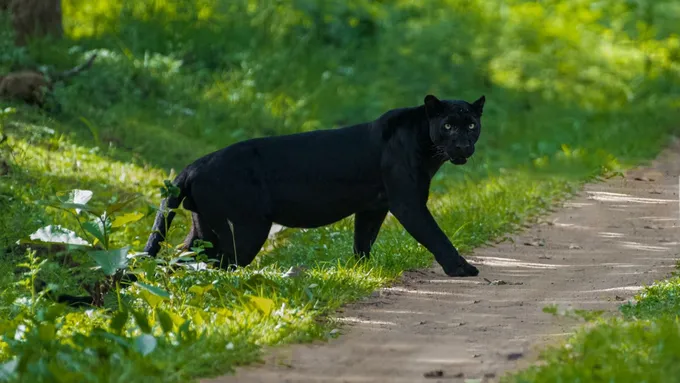
Across Britain, reports of large black cats continue to emerge. From Cornwall to Northumberland, witnesses occasionally describe seeing animals larger than domestic cats moving through woodland and farmland. While escaped exotic pets and misidentifications likely account for many reports, the phenomenon remains one of Britain’s most persistent modern mysteries.
The waters of the world also produce strange tales in June. Sea serpent reports historically increase during warmer months when more people take to the coast. From Canada’s Pacific shoreline to the Scandinavian fjords, stories of immense unknown creatures continue to surface.
And for all of you spook chasers out there – ghost lore takes on a different character during midsummer.
Winter ghosts belong to darkness and cold.
June ghosts often appear in sunlight or twilight.
Folklore contains numerous accounts of phantom armies marching across hillsides, spectral horsemen riding ancient tracks and white-clad women appearing near rivers and wells. One recurring British tradition concerns phantom music. Across several counties, people have reported hearing distant singing, bells or fiddle music drifting across fields on still summer evenings. Sometimes the source can never be found.
Ancient wells become particularly significant during June. Many holy wells hold feast days during the summer months. People would leave flowers, ribbons and coins as offerings. Some wells were believed to cure illness, while others were said to grant visions or prophetic dreams.
The highlight of June is of course the summer solstice, which arrives around 20 to 21 June and represents one of the most important dates in the folkloric year.
Ancient monuments such as Stonehenge attract visitors from around the world. While modern celebrations vary enormously, the symbolism remains remarkably consistent. The solstice marks abundance, illumination and the triumph of light. Yet folklore reminds us that every peak contains the seed of decline. Once the sun reaches its highest point, the days slowly begin shortening once more and this tension between light and darkness appears throughout midsummer traditions.
Bonfires were, and still are lit across Britain and Europe to ward off evil spirits, protect crops and ensure good fortune. People leapt flames, carried torches through fields and gathered medicinal herbs believed to possess enhanced powers. Particularly prized was St John’s Wort, gathered around the feast of St John the Baptist on 24 June. Folk tradition held that the plant offered protection against evil influences, nightmares and malevolent spirits.
Here’s your at-a-glance calender. You’re welcome!
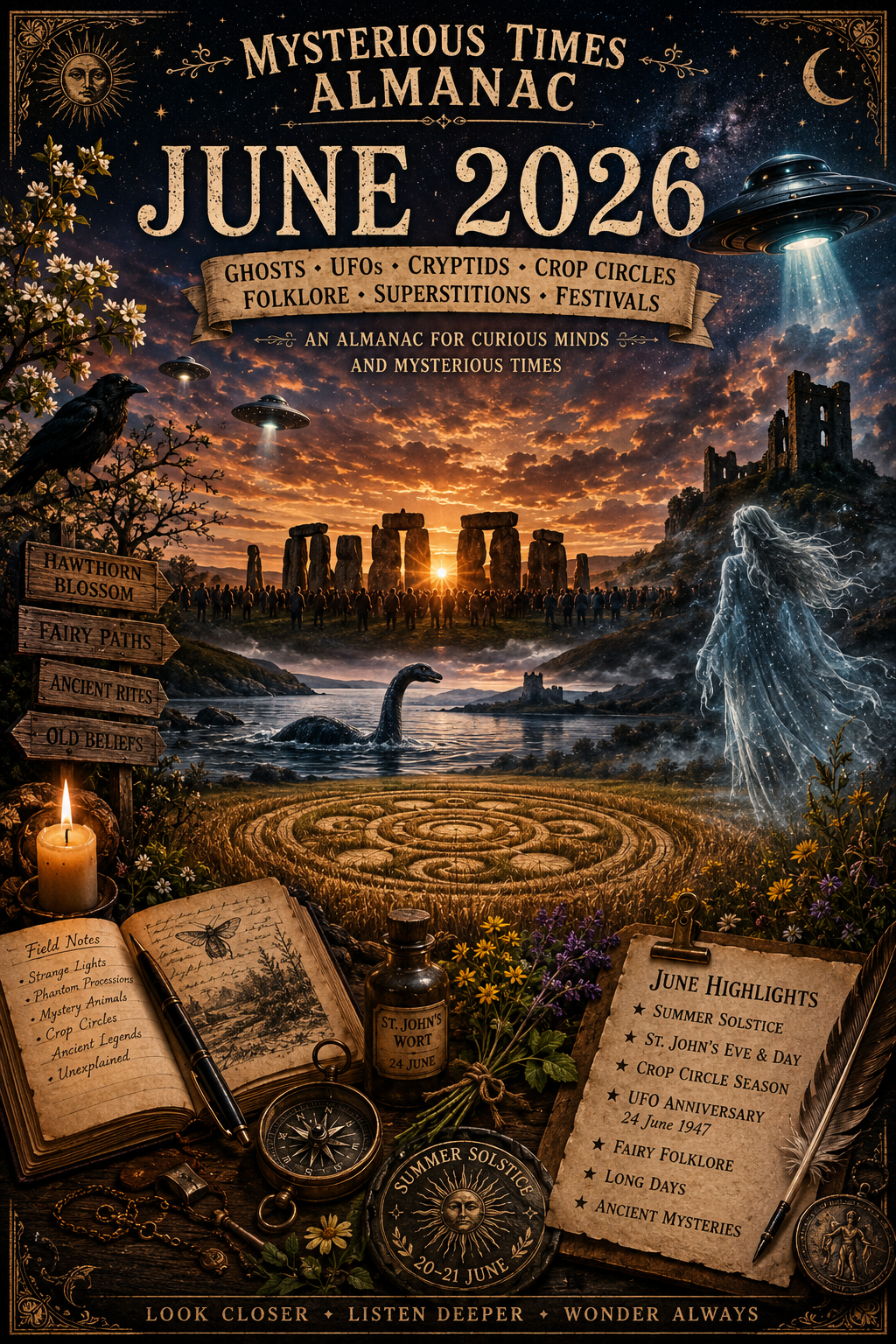
June 2026 Calendar of Strange Things
1 June – Beginning of traditional crop circle season.
8 June – Traditional flower blessing customs recorded in parts of England.
11 June – Feast of St Barnabas, associated in folklore with weather divination.
20-21 June – Summer Solstice. One of the most important dates in the folkloric and archaeological calendar.
23 June – St John’s Eve. Bonfires, protective rituals and midsummer celebrations across Europe.
24 June – Feast of St John the Baptist and anniversary of Kenneth Arnold’s famous 1947 UFO sighting.
Late June – Peak period for reports of noctilucent clouds, often mistaken for UFOs.
Signs and Superstitions for June
A ring around the sun foretells changing weather.
A hawthorn blooming heavily predicts a good harvest.
Hearing unexplained music on a midsummer evening means the fairies are travelling.
Dreams experienced on St John’s Eve are said to contain glimpses of the future.
A butterfly entering the home brings news from afar.
Seeing a white deer at midsummer is considered a sign of transformation and profound change.
Field Notes for Curious Wanderers
Watch for unusual lights over moorland after sunset.
Listen for unexplained sounds around ancient wells and stone circles.
Observe the skies around dawn and dusk when atmospheric conditions create unusual visual effects.
Keep an eye on local crop circle reports throughout southern England.
Record any wildlife sightings carefully. Today’s folklore sometimes becomes tomorrow’s cryptozoology.
Most importantly, leave places exactly as you found them. The best investigators are also the best custodians.
June is a month of light, but light reveals as much mystery as darkness. Between the solstice fires, the crop circles, the phantom processions, the unexplained lights and the ancient stories whispered beneath flowering hawthorns, the world still feels enchanted.
And that is June’s greatest gift. It reminds us that wonder is never very far away.
Further Reading
The Folklore Society (https://folklore-society.com)
The Society for Psychical Research (https://www.spr.ac.uk)
MUFON (https://mufon.com)
The Centre for Fortean Zoology (https://www.cfz.org.uk)
English Heritage – Stonehenge (https://www.english-heritage.org.uk/visit/places/stonehenge/)
Crop Circle Connector (https://www.cropcircleconnector.com)
Copyright © 2026 Mysterious Times. All rights reserved. This article or images may not be reproduced, republished or redistributed without prior written permission except for brief quotations used for review and research purposes.