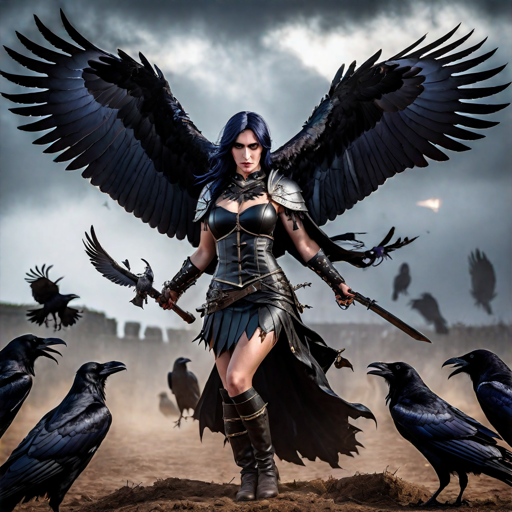
In Celtic mythology, with all its magic, heroism, and mystery, few figures captivate the imagination quite like the Morrigan, who strides through the ancient tales as a complex and multifaceted deity, embodying the essence of sovereignty, battle, and prophecy.
Yet, her mysterious nature defies easy understanding, shrouded in layers of symbolism and interpretation..
The Morrigan, often referred to as the “Phantom Queen,” is a central figure in Irish mythology, although traces of her presence can also be found in Welsh lore. Her name translates to “Great Queen” or “Phantom Queen,” indicative of her regal and otherworldly nature. However, attempts to pinpoint her precise origins or identify her as a singular deity prove elusive.
Scholars and mythologists have debated whether the Morrigan represents a singular entity or a collective of goddesses, each embodying aspects of war, fate, and sovereignty.
Some interpretations suggest she is one of a trinity of goddesses alongside Badb (the Fury) and Macha (the Sovereignty Goddess). Others view her as a standalone figure, capable of shape-shifting and assuming various guises.
The Morrigan is most commonly associated with warfare, acting as both a harbinger of battle and a fierce warrior herself.
In Irish mythology, she often appears on the eve of conflict, either in the form of a crow or a striking woman, foretelling the outcome of battles and influencing the fate of warriors. Her presence instils both fear and reverence, as she possesses the power to bless or curse those who cross her path.
Beyond her association with war, the Morrigan embodies the concept of sovereignty, representing the land and its rulership. In this aspect, she is both a guardian and a tester of kings, ensuring that the rightful ruler ascends to the throne and maintaining the balance of power within the realm.
The Morrigan is a prominent figure in several key myths, leaving an indelible mark on Celtic folklore.
One of her most famous appearances is in the Ulster Cycle, where she encounters the hero Cú Chulainn. In the tale of the Táin Bó Cúailnge (the Cattle Raid of Cooley), she appears to him in various forms, testing his courage and prophesying his fate in battle.
Another significant myth involving the Morrigan is the Battle of Mag Tuired, where she plays a pivotal role in the conflict between the Tuatha Dé Danann and the Fomorians. Here, she demonstrates her power as a warrior and a sorceress, shaping the outcome of the battle and influencing the course of Irish mythology.
The influence of the Morrigan extends far beyond the realms of ancient mythology, permeating contemporary culture and inspiring artists, writers, and spiritual seekers alike. Her image adorns countless works of art, from intricate tapestries to modern interpretations in literature and film.
Moreover, her archetype continues to resonate with those drawn to her aura of mystery and power.
Devotees and practitioners of modern Paganism often invoke the Morrigan in rituals and ceremonies, seeking her guidance in matters of warfare, sovereignty, and prophecy. Her enduring presence serves as a testament to the timelessness of Celtic mythology and the legacy of its revered figures.


Leave a Reply