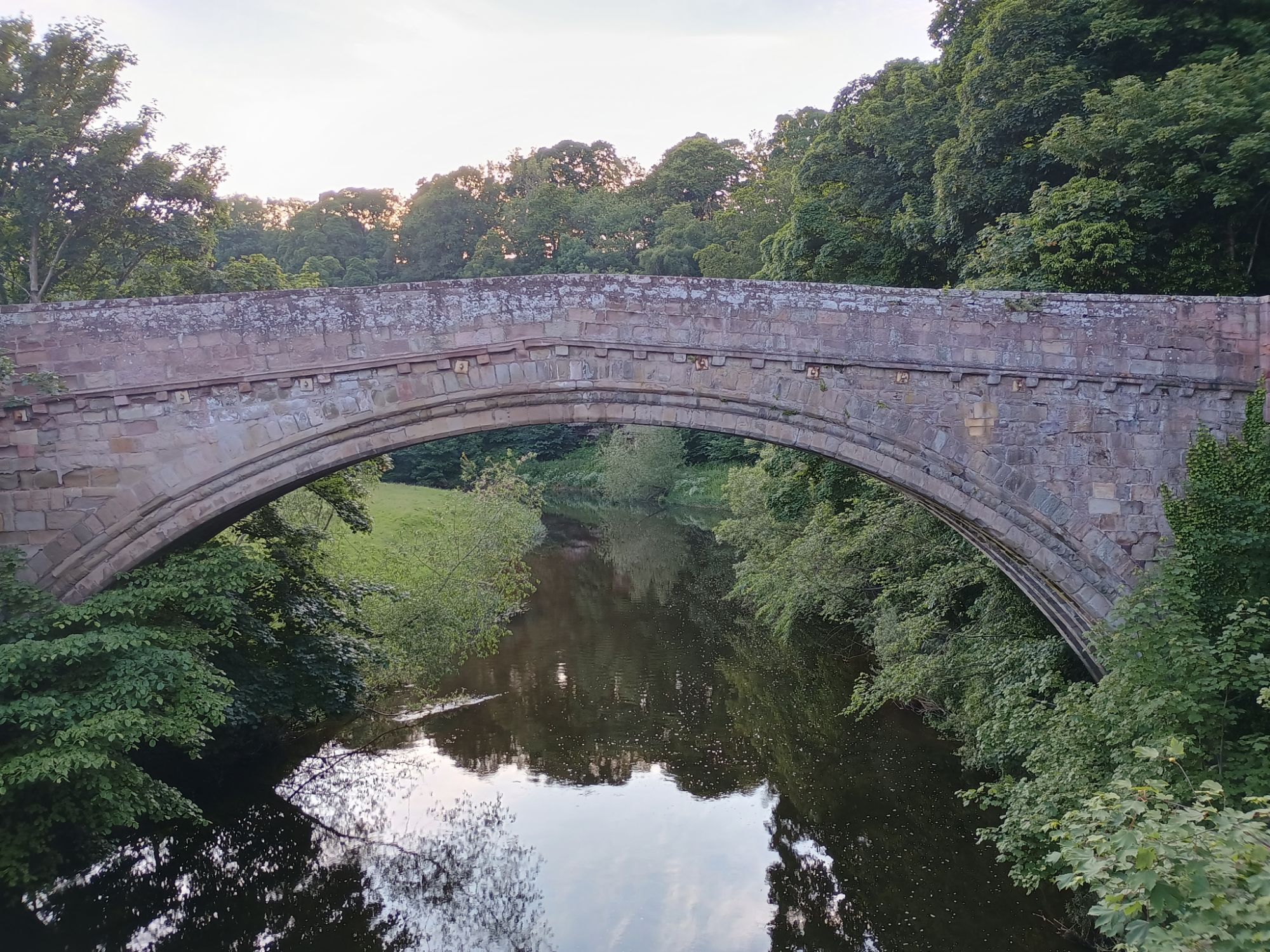
During a recent MT Roadtrip to the Scottish Borders, SiAx and I happened upon what we at first thought was just a pretty old bridge. So pretty in fact that I badgered Si into turning the Battlewagon around to go and have a closer look.
Turns out it was more than just a pretty bit of old stonemasonry. It is a scheduled ancient monument which played a part in the Battle of Flodden in 1513.
The Twizel Bridge, to give it it’s full name, is a medieval stone bridge located near Cornhill-on-Tweed in Northumberland, England. It is an architectural marvel from its time, known for its single span of 90 feet.
The strategic role this bridge played in the events leading up to the Battle of Flodden on September 9, 1513 transpired when the English army, led by the Earl of Surrey, crossed Twizel Bridge to position themselves advantageously against the Scots.
Directly because of this clever move by the Earl, the battle ended in a decisive victory for England, resulting in the death of King James IV of Scotland and many Scottish nobles, significantly impacting Scottish history.
Over the centuries, as is true with many historical sites of this nature, Twizel Bridge has become associated with many supernatural and folkloric tales, which help to preserve the region’s heritage.
The bridge is reputedly haunted by the spirits of soldiers who died at the Battle of Flodden in the form of spectral figures in medieval armour. The sounds of clashing swords, and cries of anguish have been reported by witnesses, contributing to the bridge’s eerie reputation. Sadly, during our brief visit the only sounds we heard were the sheep baaing in the pasture across the road and the sound of the river below.
Local legend also tells of a White Lady who appears on Twizel Bridge and frankly, in view of the sites history I would’ve been disappointed if there hadn’t been a White Lady here. She is believed to be the ghost of a local woman mourning her lover lost in the battle, her apparition evoking a profound sense of sorrow and loss.
Again, Si and I were disappointed. Maybe it was her evening off.
Some paranormal investigators claim the traumatic events of the battle have left residual energy at the site, making it a hotspot for paranormal activity. I assume these investigators are referring to Stone Tape Theory here. If you haven’t heard of Stone Tape Theory you clearly haven’t discovered Danny Robins’ Uncanny podcast yet – and you probably should. It really is quite entertaining. I digress… Stone Tape theory is, simply put, the idea that traumatic events and / or high emotions can somehow be recorded by the environment in which they occurred. It obviously hasn’t been proved or disproved and it is an interesting theory that goes back a long way.
As does the local folklore – one local tale tells of the bridge’s builder making a pact with the Devil to ensure its completion. The Devil demanded the soul of the first being to cross the bridge, but the builder sent a dog instead, resulting in the dog’s spirit wandering the area eternally. Bridge builders making Faustian pacts is such a popular folk tale it warrants a whole article to itself – there are literally… well, lots anyway. The added dog spirit isn’t unusual either. Lots of barghests, padfeet and shucks frequent the British Isles…
Another story suggests the stones used to construct the bridge were taken from an ancient burial ground, angering the spirits. This act is said to have cursed the bridge, bringing misfortune to those who cross it around the anniversary of the Battle of Flodden. There is a stone circle quite close by but we didn’t have time to visit. This time.
The River Till, spanned by Twizel Bridge, is believed to be home to water spirits or kelpies, which lure travellers to a watery grave. Caution is advised when near the river, particularly at dawn or dusk. We were there quite close to dusk but didn’t see any water spirits ourselves. If you go and see them and are lucky enough to get video or photos, please do send them in – it might stop folk complaining about the AI pics I usually have to fall back on..
The surrounding woods are magnificent. Towering and dark, seemingly impenetrable in places they are thought to be protected by ancient spirits or elementals who maintain the natural balance and protect the land. Mysterious figures appearing and vanishing in the woods are said to be these guardians. I’ll be honest, I didn’t venture into the woods. Mainly because we were in a hurry but also they look like pretty much anything could live in there.
The beautiful mix of history and supernatural folklore around Twizel Bridge really enhances its already wonderful narrative. The site becomes attractive to history enthusiasts and paranormal investigators alike, drawn by the bridge’s architectural significance and its haunting legends.
So if you are ever in the area Twizel Bridge is definitely worth a look – who knows? you may even hear the ghostly clash of steel echoing back at you from the kelpie infested waters below…
Let us know if you do 🙂





Leave a Reply to RLCancel reply