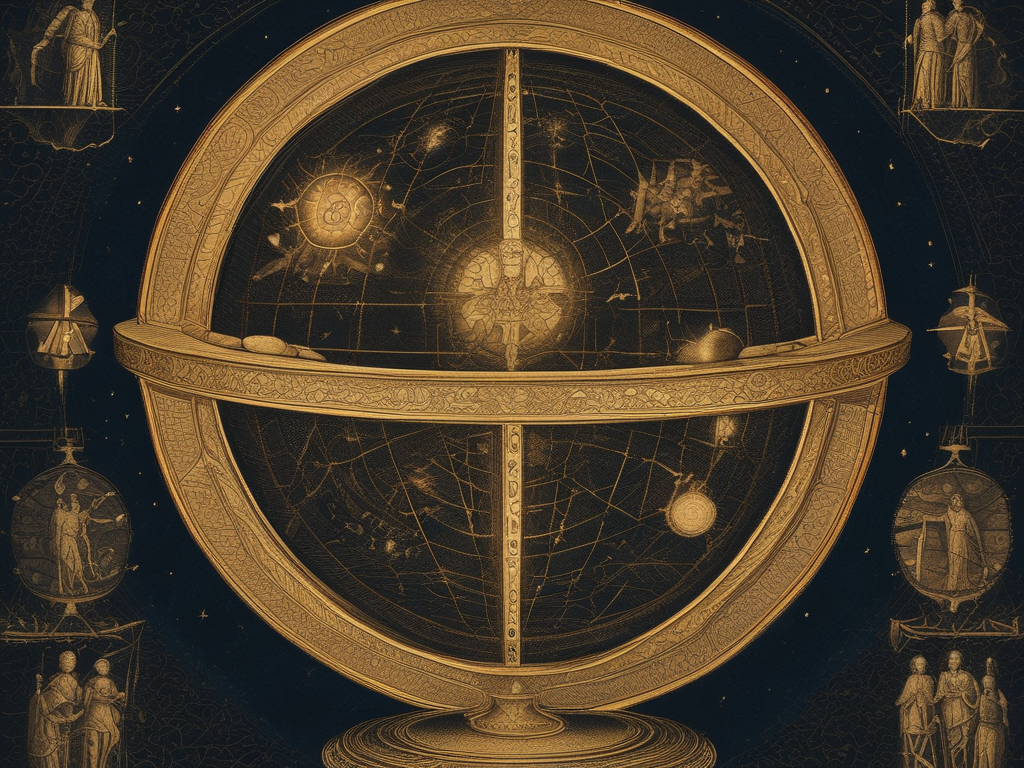
John Dee (1527-1608/09) was a remarkable figure in the history of Renaissance England.
A mathematician, astronomer, astrologer, alchemist, and advisor to Queen Elizabeth I, Dee was a polymath who made significant contributions to various fields of knowledge.
His life and work continue to intrigue scholars and the public alike, not only for his scientific achievements but also for his deep involvement in the mystical and esoteric traditions of his time.
John Dee was born on July 13, 1527, in Tower Ward, London, to a Welsh family. His father, Rowland Dee, was a minor courtier, which allowed young John access to education and the intellectual circles of the time.
Dee attended the Chelmsford Chantry School before matriculating at St. John’s College, Cambridge, at the age of 15. He quickly distinguished himself as a brilliant student, excelling in the study of mathematics and the classical sciences.
In 1546, Dee received his Bachelor of Arts degree and remained at Cambridge as a fellow, continuing his studies and lecturing in Greek. His keen interest in the scientific and philosophical traditions of antiquity led him to study the works of Euclid, Ptolemy, and other classical authors, laying the foundation for his future scholarly pursuits.
Dee’s early career was marked by significant contributions to the fields of mathematics and astronomy. He traveled extensively across Europe, studying under prominent scholars and exchanging ideas with other intellectuals.
During his travels, Dee became acquainted with the works of the German mathematician and astronomer Regiomontanus, whose methods influenced Dee’s own astronomical practices.
In 1555, Dee published his first major work, “Propaedeumata Aphoristica,” which dealt with the applications of mathematics to astrology. Although astrology is now considered a pseudoscience, during the Renaissance, it was an integral part of scientific inquiry. Dee’s work was well received and earned him a reputation as a leading mathematician and astrologer.
Dee’s expertise in navigation and cartography also played a crucial role in the Age of Exploration. He advised English explorers such as Martin Frobisher and Sir Humphrey Gilbert and provided guidance on the best routes for their voyages. Dee’s contributions to navigation were instrumental in the development of England’s naval power and its eventual dominance as a global maritime empire.
John Dee’s reputation as a scholar and his connections to influential figures brought him to the attention of Queen Elizabeth I.
In 1558, Elizabeth ascended to the throne, and Dee quickly became one of her most trusted advisors. He was consulted on a wide range of matters, from astrology and alchemy to navigation and statecraft.
One of Dee’s most notable contributions to the Elizabethan court was his involvement in the formulation of the “British Empire” concept.
Dee was a staunch advocate for England’s expansion and believed that the nation had a divine mandate to explore and colonize new territories. He coined the term “British Empire” and provided Elizabeth with historical and geographical justifications for England’s imperial ambitions.
Dee also played a role in the Queen’s coronation, selecting the date for the ceremony based on his astrological calculations. His influence extended to the selection of auspicious dates for important state events and his guidance on the interpretation of celestial phenomena.
Despite his significant contributions to science and statecraft, John Dee is perhaps best known for his esoteric and mystical pursuits.
Dee’s interest in the occult was not unusual for his time – many Renaissance scholars sought to reconcile scientific inquiry with mystical and religious traditions. Dee’s work in this area, however, was particularly extensive and controversial.
Dee’s esoteric interests were deeply influenced by the Hermetic and Neoplatonic traditions, which suggested that the material world was a reflection of a higher spiritual reality. He believed that through the study of mathematics, alchemy, and other esoteric disciplines, he could gain insight into the divine order of the universe.
In the late 1580s, Dee began conducting a series of experiments in which he attempted to communicate with angels.
He employed a scryer, Edward Kelley, to act as an intermediary in these sessions. Kelley claimed to see and hear angels through a crystal ball or a “shewstone,” and Dee meticulously recorded their conversations in a series of journals known as the “Angelical Diaries.”
The angels purportedly conveyed complex esoteric knowledge to Dee and Kelley, including the Enochian language, a system of magical incantations and symbols. Dee believed that this angelic communication would reveal the secrets of the universe and enable him to bring about a new golden age of human knowledge.
Dee’s later years were marked by personal and professional challenges. His association with Kelley and their esoteric experiments attracted suspicion and criticism, both from the church and from secular authorities.
In 1583, Dee and Kelley embarked on a series of travels across Europe, seeking patronage and support for their work.
However, their efforts were largely unsuccessful, and Dee returned to England in 1589 to find his home and library ransacked.
Despite these setbacks, Dee continued his scholarly pursuits until his death. He spent his final years in relative obscurity, struggling with financial difficulties and the decline of his once-great reputation.
Dee died in either late 1608 or early 1609, leaving behind a vast body of work that spanned the scientific, philosophical, and esoteric realms.
John Dee’s legacy is complex. He is remembered as a pioneering mathematician and astronomer whose contributions to navigation and exploration were instrumental in the expansion of the British Empire. His role as an advisor to Queen Elizabeth I highlights his influence on the political and cultural landscape of the time.
Dee’s esoteric and mystical pursuits, while controversial, have also left a lasting impact. His work in alchemy, astrology, and angelic communication has inspired generations of occultists and mystics.
The Enochian language and magical system he purportedly received from angels continue to be studied and practiced by contemporary esoteric traditions.
In recent years, there has been a resurgence of interest in Dee’s life and work. Scholars and historians have reevaluated his contributions to science and the occult, recognizing the importance of his efforts to bridge the gap between empirical inquiry and mystical knowledge. Dee’s ability to navigate and integrate these diverse fields of study makes him a unique figure in the history of Western thought.
John Dee’s life and legacy is a good example of the complicated interplay between science, mysticism, and politics during the Renaissance. His achievements in mathematics, astronomy, and navigation were groundbreaking, laying the groundwork for future advancements in these fields.
At the same time, his deep engagement with esoteric and mystical traditions reflects the broader intellectual currents of his time.
Dee’s influence can still be seen in the continued fascination with his work, both among scholars and the general public. His attempts to unlock the secrets of the universe through a combination of empirical study and mystical insight remain a testament to the curiosity and ambition that drove the intellectual pursuits of the Renaissance.