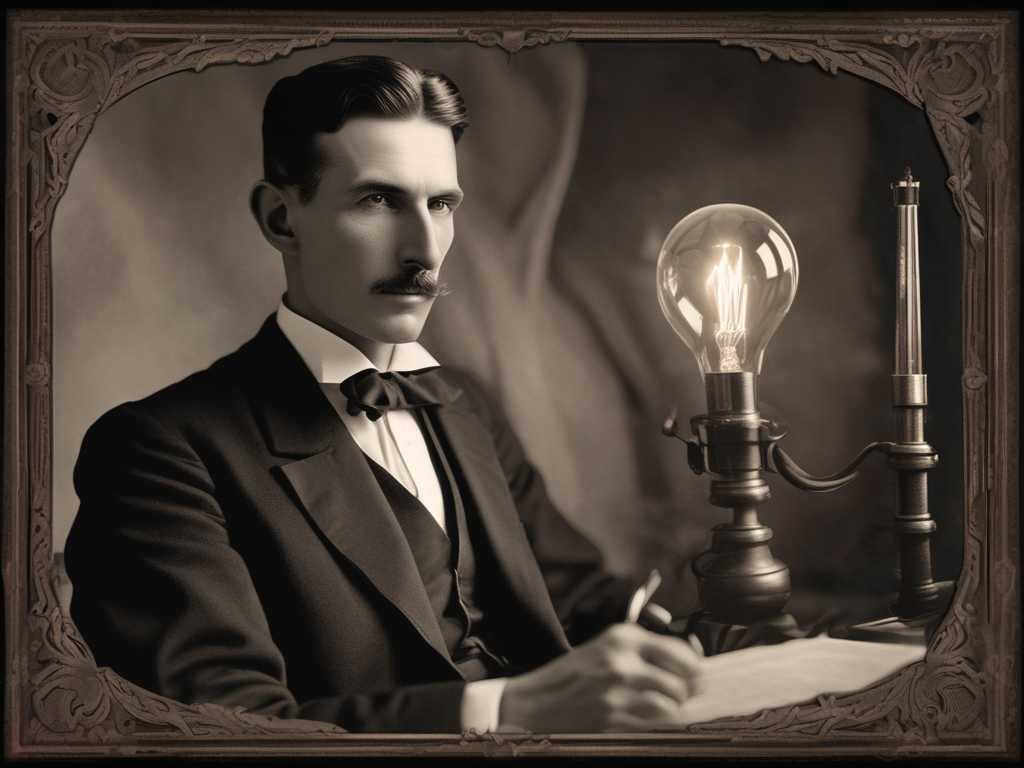
Nikola Tesla, born on July 10, 1856, in Smiljan, then part of the Austrian Empire (modern-day Croatia), was a man whose life was as mysterious and electrifying as the inventions that defined his legacy. From a young age, Tesla exhibited extraordinary intelligence and an insatiable curiosity about the world around him. His early fascination with the mysteries of nature and the workings of the universe set him on a path that would eventually transform the world.
Tesla’s education began in the austere and rigorous environment of Austrian schools, where he excelled in mathematics and physics. However, it was his ability to visualize complex mechanical devices in his mind—an ability he referred to as “picture thinking”—that truly set him apart. This unique cognitive gift allowed him to develop intricate concepts and solutions without the need for physical prototypes.
After completing his studies at the Technical University of Graz and the University of Prague, Tesla moved to Budapest, where he worked for a telegraph company. It was there, during a walk in a city park, that the idea for the alternating current (AC) motor came to him in a moment of epiphany. This breakthrough laid the groundwork for his future innovations in electrical engineering.
In 1884, Tesla emigrated to the United States, arriving in New York City with little more than a letter of introduction to Thomas Edison. The two initially collaborated, but their relationship quickly soured due to differing visions for the future of electricity. While Edison championed direct current (DC), Tesla was convinced of the superior efficiency of alternating current. The rift between them culminated in the infamous “War of Currents,” a fierce public battle that ultimately saw Tesla’s AC system emerge victorious, revolutionizing the generation and distribution of electricity.
Tesla’s career in America was marked by a series of astonishing achievements and collaborations. He worked with George Westinghouse to develop the first AC power systems, which led to the successful illumination of the 1893 World’s Columbian Exposition in Chicago and the harnessing of Niagara Falls for hydroelectric power. These feats solidified his reputation as one of the foremost electrical engineers of his time.
Yet, Tesla’s genius extended far beyond electrical power. He was a prolific inventor with over 300 patents to his name, covering a wide range of technologies including wireless communication, radio, and even the foundations of modern robotics. His visionary ideas often seemed to defy the boundaries of contemporary science. One such concept was the “World Wireless System,” an ambitious project to transmit free electricity globally using the Earth itself as a conductor. Although this project was never fully realized, it anticipated the development of wireless technology by decades.
Despite his profound contributions to science and technology, Tesla’s life was fraught with financial difficulties and personal eccentricities. He was known for his obsessive work habits, often laboring for days without rest, and his aversion to germs, which led to ritualistic hand-washing and a meticulous lifestyle. Tesla also claimed to experience vivid visions and communicated with pigeons, which he considered his only true friends.
As he grew older, Tesla’s fortunes waned. He spent his final years living in relative obscurity in New York City, working on his theories and feeding the pigeons in Bryant Park. His financial situation deteriorated, and he died alone in his room at the New Yorker Hotel on January 7, 1943. At the time of his death, much of his work was unrecognized, and he was largely forgotten by the public.
However, history has been kinder to Tesla’s memory. In the decades following his death, recognition of his contributions has grown exponentially. Today, he is celebrated as one of the greatest inventors and visionaries of all time. His name graces everything from cutting-edge electric cars to units of magnetic flux density, a testament to the enduring impact of his work.
Nikola Tesla’s life was one of brilliance, innovation, and perseverance. His relentless quest to harness the unseen forces of nature and his unwavering belief in the power of scientific progress continue to inspire generations of scientists, engineers, dreamers… and conspiracy theorists..
Imagining Nikola Tesla’s reaction to the thousands of conspiracy theories about him, I can almost picture him raising an eyebrow with a mix of amusement and bewilderment – after all, this was a man whose life was filled with enough real intrigue and scientific marvels to outshine even the wildest of speculations.
Tesla might giggle at the idea of being linked to time travel or secret government projects – “If only I had a time machine,” he might muse, “I would have ensured my inventions received the recognition they deserved while I was still alive!” He’d probably find some of the more outlandish theories, like those suggesting he communicated with extraterrestrials, both entertaining and flattering. Given his love for the mystical and the unknown, he might even appreciate the creativity behind such stories.
On a more serious note, Tesla would likely feel a bit exasperated by the misinformation surrounding his life and work. “The truth,” he might say, “is far more fascinating than fiction.” He’d probably urge people to focus on the real legacy he left behind—his contributions to alternating current, radio, and wireless technology—rather than the unfounded myths.
Ultimately, Tesla’s reaction to these conspiracy theories would likely be a blend of humour and a gentle reminder to look at the facts. “Science is the true magic,” he’d insist, “and it’s accessible to all who seek it with an open mind and a curious heart.”
So today, on what would have been Nikola’s 168th birthday, we remember not just the man, but the luminous legacy he left behind—a legacy that continues to light up our world in ways he might have only imagined.