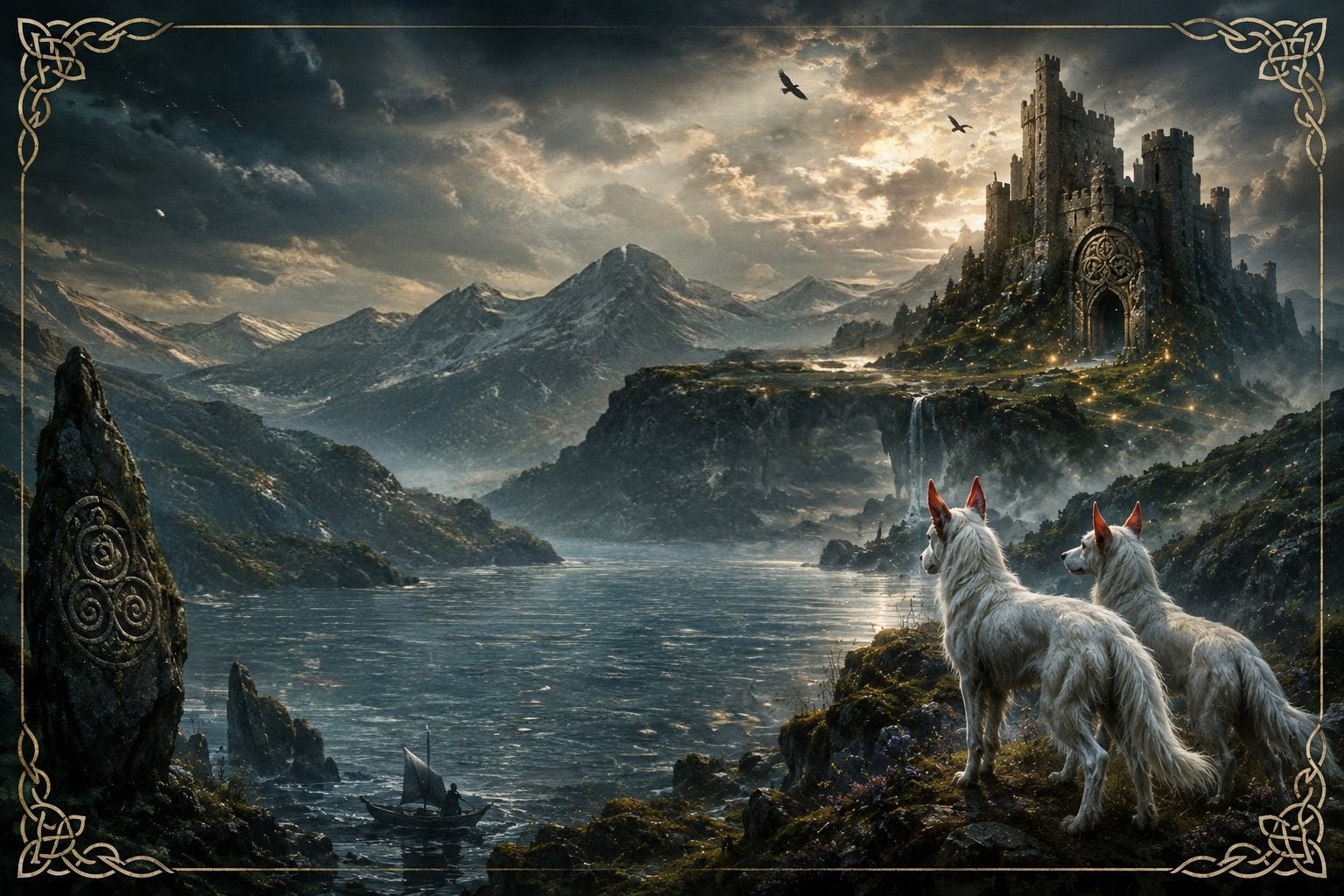
Annwn (pronounced AH-noon), the Welsh Otherworld, holds a deeply mystical place in Celtic mythology. Often described as an idyllic realm of eternal youth, beauty, and abundance, Annwn has captured the imagination of countless generations. Its lore is complex, rooted in ancient beliefs and evolving through history to remain relevant in modern culture and popular folklore.
The roots of Annwn can be traced back to pre-Christian Celtic traditions, where it was considered a realm of the dead or a mystical land existing parallel to our own. The name “Annwn” itself is derived from Old Welsh, with interpretations varying from “the Deep” to “the Very Deep,” reflecting its enigmatic and mysterious nature. Unlike the grim and often foreboding depictions of the underworld in other mythologies, Annwn was perceived as a place of great beauty and abundance, a haven where the dead could rest in peace and joy.
Annwn is vividly brought to life in the medieval Welsh tales of the Mabinogion. One of the most notable stories featuring Annwn is the First Branch, “Pwyll Pendefig Dyfed.” In this tale, Pwyll, the prince of Dyfed, swaps places with Arawn, the ruler of Annwn, for a year and a day. This exchange allows Pwyll to experience the wonders of Annwn firsthand and solidifies a bond between the two realms. Arawn is depicted as a noble and just ruler, reinforcing the idea of Annwn as a land of order and prosperity.
Annwn is also closely associated with the concept of the Wild Hunt, a ghostly procession led by a supernatural figure, often Gwyn ap Nudd in Welsh tradition. Gwyn, a psychopomp guiding souls to the afterlife, is a central figure in the mythology of Annwn. The Wild Hunt, accompanied by the eerie baying of the Cŵn Annwn, or Hounds of Annwn, serves as a chilling reminder of the thin veil between the worlds of the living and the dead. The spectral hounds, with their ghostly white fur and red ears, were believed to be harbingers of death, their howls foretelling doom or disaster.
Throughout history, the perception of Annwn and its inhabitants has shifted. With the advent of Christianity, the once idyllic Otherworld was often reinterpreted through a Christian lens. Annwn became conflated with notions of purgatory or hell in some interpretations, reflecting the changing religious and cultural landscape. However, the core elements of its mythology—beauty, mystery, and the supernatural—remained intact, continuing to captivate and inspire.
In modern times, Annwn has not faded into obscurity but has instead found a place in contemporary Welsh culture and beyond. The tales of Annwn and its inhabitants are preserved and celebrated through literature, art, and popular media. Fantasy literature, in particular, has embraced the mythology of Annwn, drawing upon its rich imagery and themes. Authors such as Lloyd Alexander in his “Chronicles of Prydain” series and Susan Cooper in “The Dark Is Rising” series have woven elements of Annwn into their narratives, introducing new audiences to this enchanting Otherworld.
Moreover, Annwn’s influence extends to modern pagan and neopagan practices, where it is revered as a sacred and mystical realm. The idea of Annwn as a place of eternal beauty and peace resonates with contemporary spiritual seekers, who often incorporate its mythology into their rituals and beliefs.
Parallels between Annwn and other UK fairy cultures further illustrate its significance. In Irish mythology, the Otherworld is known as Tír na nÓg, a land of eternal youth and beauty, similar to Annwn. Both realms share common features: they are places of abundance, peace, and supernatural wonder, accessible only to those chosen or worthy. The Isle of Avalon in Arthurian legend also parallels Annwn. Avalon is a mystical island where King Arthur is taken to heal after his final battle. Like Annwn, it is a place of beauty and mystery, a realm beyond the ordinary world.
Scottish folklore, too, has its own version of the Otherworld. The Sìthean, or fairy hills, are believed to be entrances to an otherworldly realm inhabited by the Aos Sí, or fairies. These beings, like the inhabitants of Annwn, are both revered and feared, embodying the capricious nature of the supernatural.
In popular culture, Annwn’s legacy continues to thrive. Films, television series, and video games often draw upon its mythology, incorporating its themes and imagery to create rich, fantastical worlds. The enduring appeal of Annwn lies in its timelessness — a place where the boundaries between the natural and supernatural blur, inviting endless exploration and imagination.
The story of Annwn truly is a testament to the power of myth and its ability to evolve while retaining its core essence. From its ancient roots in Celtic tradition to its presence in modern literature and popular culture, Annwn continues to enchant and inspire. Its legacy is a reminder of the richness of Welsh folklore and our fascination with the mystical and the otherworldly.
Further Reading:
1. “The Mabinogion” – Translated by Sioned Davies. This collection of medieval Welsh tales is essential for understanding the broader context of Welsh mythology, including the stories of Annwn.
2. “The Grey King” by Susan Cooper. Part of “The Dark Is Rising” series, this book draws heavily on Welsh mythology, including the legend of Annwn.
3. “Chronicles of Prydain” by Lloyd Alexander. This fantasy series, inspired by Welsh mythology, features many elements related to Annwn and other Welsh mythological themes.
4. “Celtic Mythology” by Proinsias Mac Cana. This book provides a comprehensive overview of Celtic myths and legends, offering insights into the origins and development of Annwn.
5. “The Welsh Fairy Book” by W. Jenkyn Thomas. This collection includes various Welsh folk tales, some of which feature references to Annwn and other supernatural beings.
6. “The Tain: From the Irish Epic Táin Bó Cúailnge” by Thomas Kinsella. While focused on Irish mythology, this work offers a comparative perspective on Celtic myths that enriches the understanding of Welsh legends like Annwn.
7. “Myths and Legends of the Celts” by James MacKillop. This book provides a detailed exploration of Celtic mythology, including the Welsh traditions and the lore surrounding Annwn.
8. “The Encyclopedia of Celtic Mythology and Folklore” by Patricia Monaghan. This reference work offers detailed entries on various elements of Celtic mythology, including Annwn and related figures.