The story of the Greenbrier Ghost is rooted in real historical events. Zona Heaster Shue was a real person, she died under suspicious circumstances, and her husband, Erasmus Shue, was convicted of her murder. While the ghost story adds a supernatural layer to the case, the conviction was largely based on the findings of the autopsy rather than the alleged spectral testimony. The Greenbrier Ghost case is a fascinating example of how folklore and fact can intertwine, creating a compelling narrative that endures over a century later.
The story of the Ghost of Greenbrier County, often referred to as the Greenbrier Ghost, is one of the most remarkable and enduring tales of the supernatural in American history. It stands out not only because of the ghostly visitation involved but also because this paranormal encounter led directly to a murder conviction, making it a unique case in legal history.
The Greenbrier Ghost case took place in the late 19th century in the rural setting of Greenbrier County, West Virginia, and revolves around the tragic death of a young woman named Zona Heaster Shue.
Zona Heaster, born Elva Zona Heaster, was a young woman from a modest farming family in Greenbrier County. She was described as a kind, gentle woman with a reputation for her beauty. In 1896, Zona met a drifter named Erasmus (often called Edward or “Trout”) Shue, who had recently moved to the area to work as a blacksmith. The two quickly became romantically involved, and despite Zona’s mother, Mary Jane Heaster’s, reservations, they married soon after meeting.
Erasmus Shue had a somewhat mysterious and shady past, though Zona and her family seemed unaware of it at the time. He had been married twice before, with one wife dying under mysterious circumstances and another divorcing him due to alleged abuse. This darker history of Shue would only come to light after Zona’s death.
In January 1897, just a few months into their marriage, Zona was found dead under suspicious circumstances. On the morning of January 23rd, Erasmus had sent a young boy, Andy Jones, to the Shue residence to check on his wife and ask if she needed anything from the store. The boy arrived at the house and found Zona lying at the foot of the stairs, motionless. At first glance, it appeared that she had simply fallen down the stairs. Her body was in an odd position, with her feet together, one arm by her side, and the other draped across her chest. Her head was tilted slightly to one side.
The local doctor and coroner, Dr. George W. Knapp, was called to the scene. By the time he arrived, Erasmus had already carried Zona’s body to the bedroom and dressed her in a high-necked gown with a stiff collar, an unusual action at a time when it was typically women who prepared bodies for burial. Shue displayed an overly emotional and possessive attitude towards Zona’s body, cradling her head and not allowing anyone, including the doctor, to get too close. Dr. Knapp’s examination was brief, due in part to Shue’s strange behavior and his insistence that his wife had died from natural causes. Knapp initially reported that Zona had died of “everlasting faint” or heart failure, but this cause of death would later be changed to childbirth complications, though there was no evidence Zona was pregnant.
Zona’s body was quickly buried, and the death was accepted as an unfortunate accident. However, Mary Jane Heaster, Zona’s mother, was not convinced. She had never liked or trusted Erasmus Shue and had an ominous feeling about her daughter’s sudden death. Over the next few weeks, Mary Jane began praying fervently for answers, asking for a sign or some revelation to explain what had happened to her daughter. According to Mary Jane, her prayers were answered in a most extraordinary way.
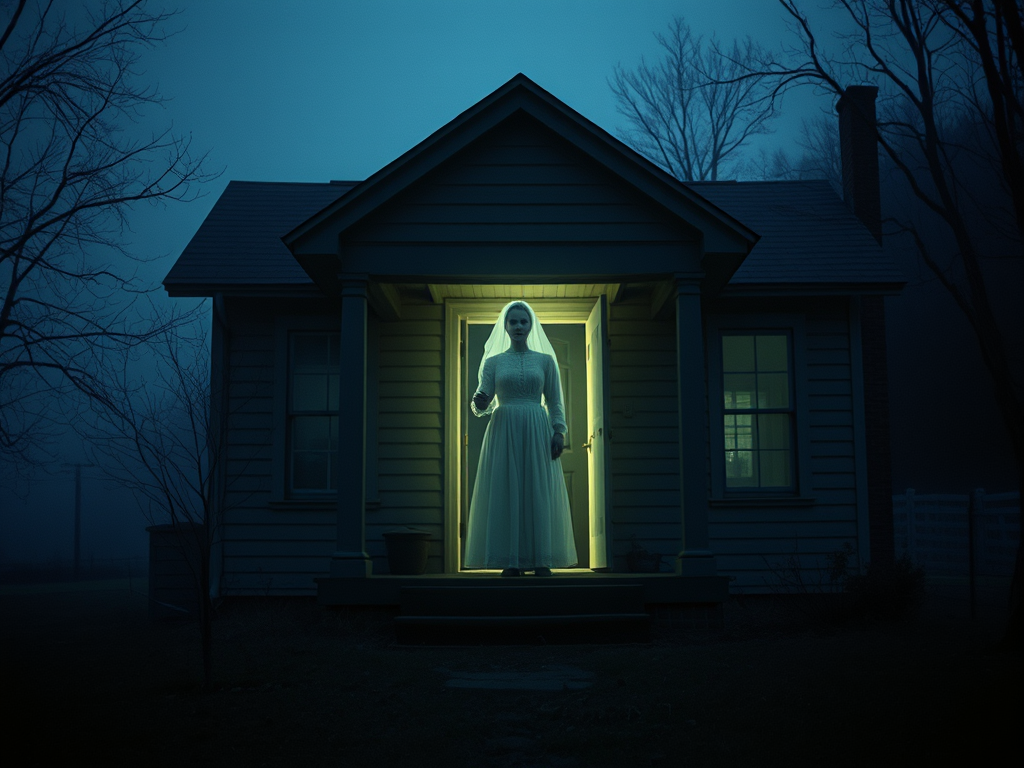
Mary Jane claimed that Zona’s spirit visited her over the course of four nights. During these visitations, the ghost appeared in the room and spoke to her, revealing that Erasmus Shue had murdered her. Zona’s spirit described in chilling detail how her husband had attacked her in a fit of rage after she had failed to cook meat for his dinner. He had become violent, grabbing her by the neck and breaking it. To prove her story, the ghost turned her head completely around in the vision, showing her broken neck. Mary Jane said that the spirit’s appearances were vivid and real, leaving no doubt in her mind that her daughter’s death was not an accident but a murder.
Convinced by these spectral visits, Mary Jane Heaster went to the local prosecutor, John Preston, to demand an investigation. Though skeptical at first, Preston agreed to reopen the case, partly due to the suspicious behavior of Erasmus Shue following his wife’s death. His overzealous control over the body, the unusual speed of the burial, and his inconsistent statements about Zona’s cause of death raised enough red flags to warrant further inquiry.
Zona’s body was exhumed in February 1897, roughly a month after her death, and a proper autopsy was performed. The results were shocking. The examination revealed that Zona’s neck had indeed been broken, and her windpipe was crushed. The ligaments around her neck were torn, and there were clear finger marks indicating strangulation. Her vertebrae were dislocated, confirming that her neck had been twisted violently. This was clear evidence of murder, and Erasmus Shue was arrested and charged with the killing of his wife.The trial of Erasmus Shue began in June 1897 and attracted widespread attention, in part because of the ghostly testimony that had led to the investigation.
The prosecution built a strong case around the physical evidence from the autopsy and Shue’s suspicious behavior. However, it was the testimony of Mary Jane Heaster that captured the public’s imagination. During the trial, she recounted how her daughter’s spirit had appeared to her and revealed the details of the murder.
The defense tried to discredit Mary Jane’s story, suggesting that her visions were merely the product of a grief-stricken mind. They attempted to argue that the idea of Zona being murdered was planted in her head long before the ghostly visitations. However, Mary Jane remained steadfast in her testimony, and the jury seemed to be swayed by the combination of her conviction and the overwhelming physical evidence. Though the ghost’s testimony was not officially entered into the court record, it undoubtedly influenced the outcome.
Erasmus Shue was found guilty of murder and sentenced to life in prison. He died three years later in the West Virginia State Penitentiary, having never admitted to the crime. The case of the Greenbrier Ghost became a part of local folklore, celebrated as a tale where the supernatural helped deliver justice.
The story endures to this day, not only because of its ghostly elements but because it remains a rare case where a spirit’s testimony—at least in the eyes of the public—led to a criminal conviction. The courthouse in Greenbrier County still stands, and the tale is a part of the region’s history, often retold in books, documentaries, and local tours.
Zona Heaster Shue is buried in the Soule Chapel Methodist Cemetery in Greenbrier County, and her tombstone bears a simple inscription: “In Memory of Zona Heaster Shue,” with no mention of the extraordinary events that followed her death.
Though skeptics dismiss the ghost story as mere folklore, others see it as a powerful testament to a mother’s love and determination to seek justice for her daughter. The Greenbrier Ghost continues to intrigue both believers in the paranormal and those fascinated by one of the most unique legal cases in American history.