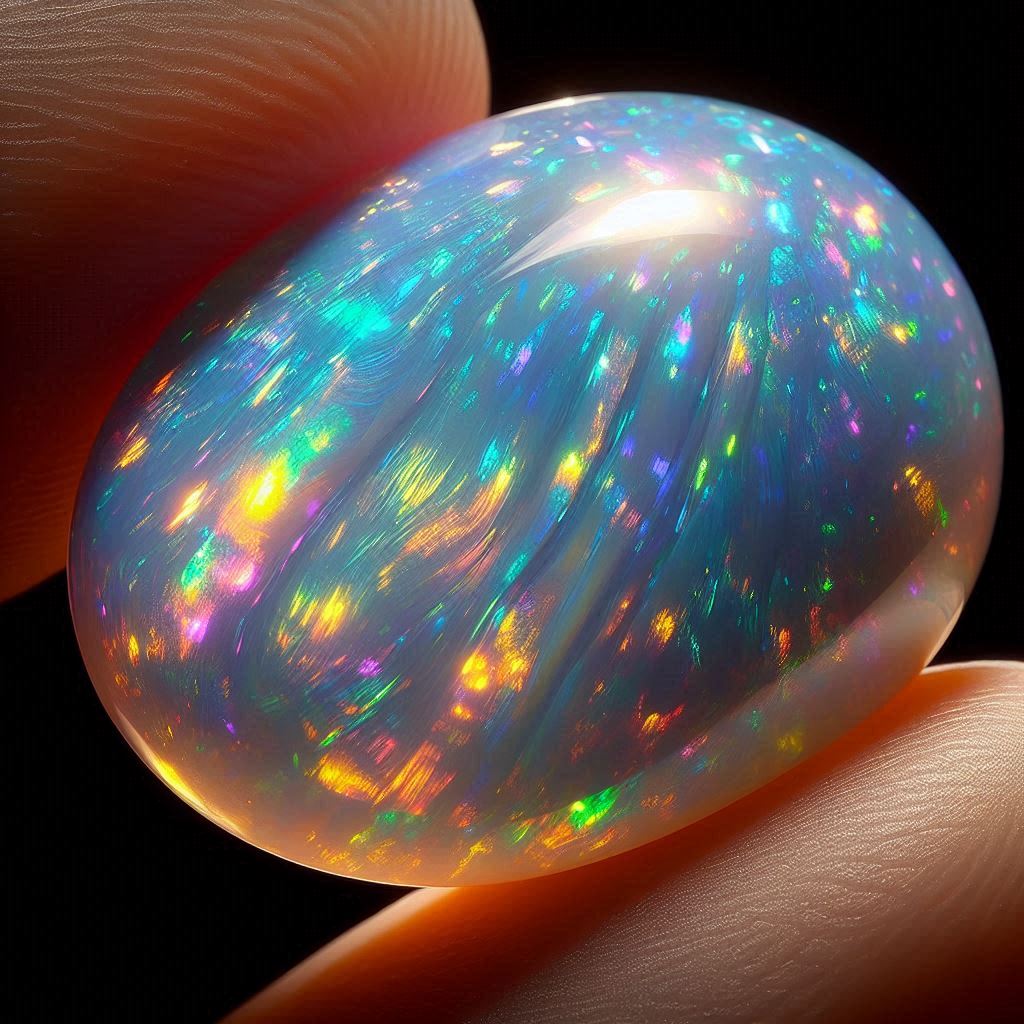
October’s birthstone, the opal, is a gemstone that has captivated people for centuries with its mesmerising play of colours and deep symbolism. Known for its iridescent quality, the opal is unlike any other stone, displaying a spectrum of hues that seem to shift and change as the light hits it from different angles. This unique characteristic, called “play of colour,” has made opal a highly sought-after gem throughout history. But beyond its beauty, opal is also rich in meaning and lore, symbolising everything from hope and purity to protection and creativity.
The name “opal” is thought to have originated from the ancient Greek word “opallios,” meaning “to see a change in colour.” The Romans also prized opal, referring to it as “opalus,” and believed it was one of the most precious and powerful stones. The Roman scholar Pliny the Elder wrote about opals in the first century, admiring their ability to show the colours of other gemstones in a single stone. Ancient Romans believed opal brought good luck, protection from disease, and overall fortune to those who wore it.
Opals are formed from silica-rich water that seeps into cracks and crevices in the earth. Over millions of years, the water evaporates, leaving behind the silica, which eventually forms opal. This process gives opal its delicate structure, composed of tiny silica spheres that diffract light to produce the stone’s signature play of colours. While opals can be found in several locations around the world, the majority of precious opal comes from Australia, which produces about 95% of the world’s supply. Other notable sources include Ethiopia, Mexico, and the United States.
One of the most fascinating aspects of opal is its diverse range of colours and varieties. White opals, with their milky appearance and flashes of rainbow hues, are perhaps the most common. Black opals, considered the rarest and most valuable, have a dark body colour that makes the vibrant flashes of red, green, and blue even more striking. Fire opals, primarily found in Mexico, are known for their warm shades of orange, yellow, and red, resembling flames. Boulder opals, which are mined in Australia, contain pieces of the host rock within the gem, giving them a rugged, earthy appeal. Water opals are nearly transparent and display a subtle play of colours, which makes them a more understated but equally beautiful variety.
The beauty of opal is not limited to its visual appeal. Throughout history, many cultures have attributed powerful metaphysical properties to the stone. In ancient times, opal was believed to have healing properties, especially for the eyes, and was thought to cure diseases related to vision. It was also said to bring protection, both physical and emotional, to the wearer. In medieval Europe, opals were considered a symbol of purity and hope. Some believed the stone could make its wearer invisible or enhance their magical powers. Opal’s shifting colours were often thought to reflect the emotions and desires of the person wearing it, leading to the belief that it could reveal inner truths or hidden feelings.
However, not all of opal’s history is associated with positive attributes. During the 19th century, the stone gained a reputation for being unlucky, a superstition that stemmed from Sir Walter Scott’s 1829 novel Anne of Geierstein. In the story, a character wears an opal that changes colour in response to her moods, but when the stone is touched by holy water, it loses its brilliance and she dies soon after. This association with bad luck caused a decline in opal’s popularity, particularly in Europe, though the superstition eventually faded.
Despite this period of bad luck, opal has remained a beloved gemstone, especially in modern times, when it is more often associated with creativity, inspiration, and emotional expression. Many believe that opal can help enhance artistic abilities, making it a popular choice for people in creative fields. Its constantly shifting colours are thought to inspire new ideas and foster a sense of openness and imagination. Additionally, opal is often associated with love and passion, symbolising deep emotional connections and the ability to communicate feelings more freely.
As a birthstone for those born in October, opal is believed to provide balance, grounding, and protection. It is thought to help individuals connect with their emotions while also shielding them from negative energies. The stone’s reflective nature encourages self-reflection, allowing people to better understand themselves and their emotions. This quality makes opal a powerful stone for those seeking personal growth or looking to explore their inner world.
Opal’s connection to water is also significant. The stone is formed from water, and its energy is often linked to the element of water, symbolising purity, cleansing, and transformation. In this way, opal is seen as a stone of renewal, helping to wash away negative energies and bring about positive change. Its connection to water also aligns it with the moon and the feminine energies of intuition, emotion, and fluidity.
In terms of care, opal requires special attention due to its delicate composition. The stone contains a significant amount of water, making it more susceptible to damage from heat or dehydration. To keep an opal in good condition, it’s recommended to avoid exposing it to extreme temperatures and to store it in a moist environment. Some people even store their opals with a small amount of water to prevent them from drying out. Additionally, opal is softer than many other gemstones, so it should be handled carefully to avoid scratching or chipping the surface.
Whether you’re drawn to opal for its stunning appearance, its rich history, or its symbolic meanings, it remains one of the most intriguing gemstones available. As the birthstone for October, it holds a special significance for those born in this month, offering protection, creativity, and emotional insight. With its captivating play of colours and deep-rooted lore, opal continues to enchant and inspire, making it a treasured gemstone for both collectors and casual wearers alike.