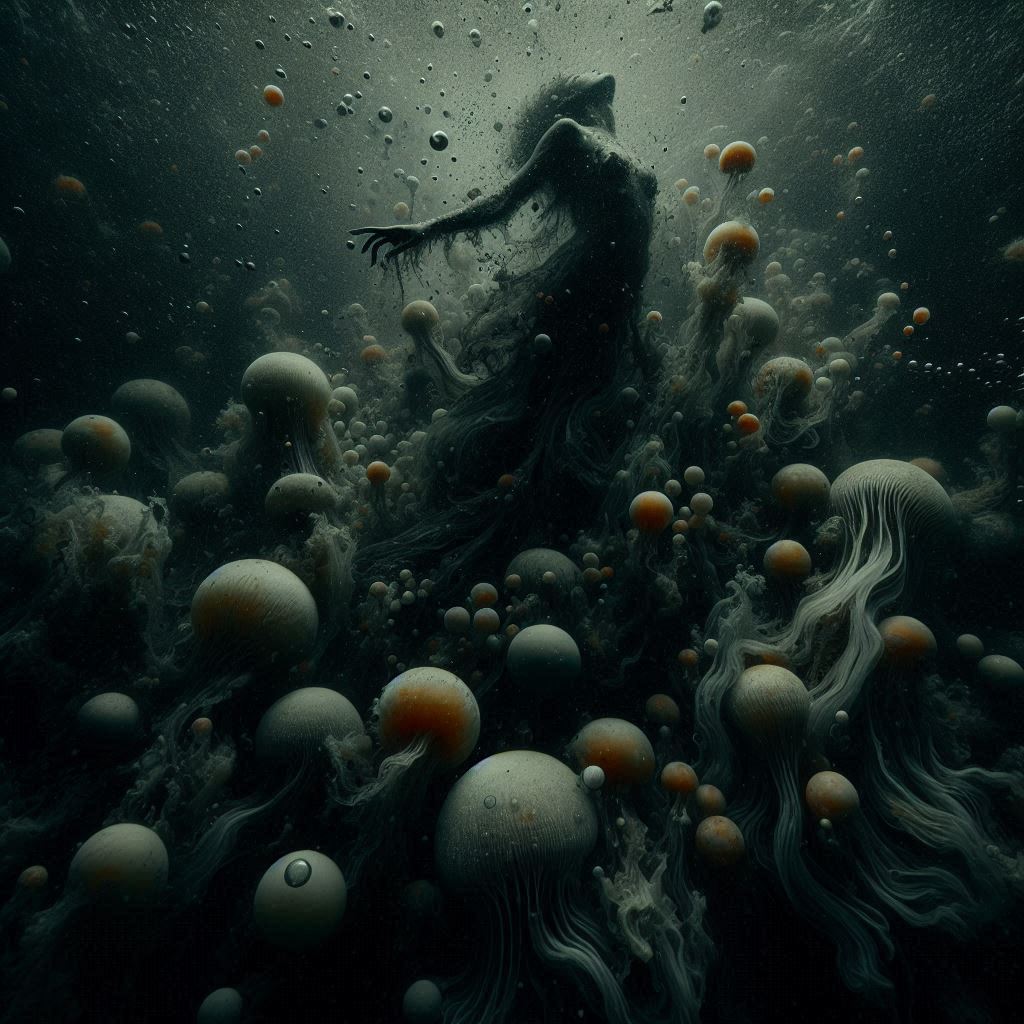
The fear of open, deep water is known scientifically as thalassophobia, a term derived from the Greek words “thalassa,” meaning sea, and “phobos,” meaning fear. It refers to an intense and persistent fear of vast, deep, and often uncharted bodies of water, such as oceans, seas, lakes, or even deep swimming pools.
For those who experience thalassophobia, the sight or thought of deep water can provoke feelings of terror, anxiety, or dread, often leading to physical symptoms like shortness of breath, a racing heart, or nausea. But what is it about deep water that inspires such visceral fear?
To understand this, we need to delve (not dive) into both evolutionary biology and modern psychology, as well as explore the different dimensions of this fear – its roots, triggers, and the ways it manifests in human behaviour.
In short, fear is a survival mechanism. It’s the brain’s way of responding to perceived threats, a way to protect us from potential harm. When we experience fear, our bodies go into a heightened state of alertness: our heart rate increases, our muscles tense, and our senses become sharper. This is known as the fight-or-flight response, an ancient evolutionary trait that has helped humans and other animals survive dangerous encounters.
In the case of thalassophobia, the threat is not always something tangible – like a predator – but rather the vastness, depth, and mystery of the water itself.
The evolutionary roots of thalassophobia may stem from our distant ancestors, who had to navigate treacherous landscapes filled with unknown dangers.
While human beings are remarkably adaptable creatures, we have never been truly at home in water. We are not natural swimmers; our bodies are not designed to breathe underwater, move quickly in it, or easily assess dangers lurking below the surface.
Throughout our evolutionary history, water has often been a source of life, but it has also represented a serious risk. Drowning, predatory animals, and unpredictable weather conditions all posed threats to early humans who ventured into deep or open water. Our innate aversion to deep water may, in part, be a holdover from these times – an instinctual fear that once helped keep us safe.
Psychologically, thalassophobia can be understood through the lens of fear of the unknown. Deep, open water is often murky, vast, and impenetrable, leaving us unable to see what lies beneath. Humans are creatures of vision; we rely heavily on our ability to see and understand our environment to feel secure.
When faced with the expanse of the ocean or a deep, dark lake, that sense of certainty is stripped away. We are left vulnerable, not only to the elements but also to our imagination. The deeper the water, the less we can see, and this ambiguity fuels fear. What could be lurking beneath the surface? Sharks, eels, jellyfish, or more existentially, the vast emptiness of the unknown itself?
The mind fills in the blanks, often in terrifying ways, because the unknown is inherently unsettling.
There’s a reason why so many horror stories, myths, and legends are set in or around water. From sea monsters like the Kraken to the mysterious Bermuda Triangle, deep water has long been a setting for humanity’s greatest fears. It is a place where ordinary rules no longer apply, where human control over the environment is severely limited.
The unpredictability of the sea, with its vastness, storms, and hidden creatures, has inspired awe and terror for centuries. Many people experience a sense of “uncanny” when confronted with open water – a feeling described by Sigmund Freud as the strange familiarity of something that both attracts and repels. Water is familiar in its necessity and everyday presence, yet when we encounter it in its vastness and depth, it becomes alien and unnerving.
For people with thalassophobia, this fear of the unknown is heightened. The sight of deep water triggers the imagination to run wild, filling the unseen spaces with terrifying possibilities. Unlike other specific phobias that are often triggered by direct experience – like a fear of snakes stemming from a childhood encounter – thalassophobia often doesn’t need a triggering event. The fear can be anticipatory or purely imaginative, activated by thought alone. Even images or descriptions of deep water can provoke anxiety in someone with this condition. It’s not necessarily the water itself that’s feared, but the vastness, depth, and sense of entrapment it creates.
Studies have shown that people with thalassophobia often display a heightened sensitivity to certain visual and sensory stimuli associated with water. The colour blue, particularly dark or murky shades, can evoke feelings of dread or unease. Similarly, sounds associated with the ocean – waves crashing, the deep hum of underwater currents, or the howling wind over a vast sea – can trigger an anxiety response. The brain, when confronted with these stimuli, associates them with danger, even if no immediate threat is present.
Fear of drowning is another significant aspect of thalassophobia. Water represents an environment where humans are not naturally equipped to survive. The sensation of being submerged, of struggling to breathe, taps into one of our most primal fears: suffocation.
For many, the idea of being in deep water is accompanied by the fear of being pulled under, trapped, or consumed by the sea. This fear is compounded by the helplessness that comes with water-related accidents. Unlike on land, where we can generally run or fight back against a threat, in water, our movements are slower, and our options for escape are limited. The sense of vulnerability is acute.
Thalassophobia also intersects with other common fears, such as fear of the dark (nyctophobia), fear of confined spaces (claustrophobia), and fear of animals (zoophobia), particularly aquatic creatures like sharks, squids, or jellyfish. Many people with thalassophobia report a specific fear of being in deep water where they might encounter these creatures.
The popularity of movies like Jaws, which depict terrifying, predatory animals in the ocean, has only amplified this fear in modern times. Even though the statistical likelihood of being attacked by a shark is exceedingly low, the imagery associated with such attacks – sharp teeth, sudden violence, and the inescapable water – becomes seared into the cultural imagination.
In this way, thalassophobia is not just a fear of water itself, but of what might be lurking within it.
Interestingly, thalassophobia can also be linked to a fear of isolation. The ocean, with its vastness and absence of human control, represents a form of existential isolation. Being alone in the middle of the sea, cut off from help, surrounded by nothing but water, taps into our fundamental fear of being abandoned or lost. This fear is compounded by the fact that the ocean has no boundaries, it stretches on indefinitely, and that infinity can feel overwhelming. It’s a fear of being swallowed up by something so much larger and more powerful than oneself.
Despite its intensity, thalassophobia is not insurmountable. Like many phobias, it can be managed and even overcome with time, patience, and the right therapeutic approach.
Cognitive-behavioural therapy (CBT), for example, is one of the most effective treatments for phobias. It works by helping individuals confront their fear in a controlled and gradual way, teaching them to reframe their thoughts and challenge the irrational beliefs that feed their anxiety. Exposure therapy, a form of CBT, involves gradually exposing the person to the feared object or situation – in this case, deep water – in small, manageable steps. Over time, repeated exposure helps reduce the intensity of the fear response.
Another useful approach is mindfulness and relaxation techniques, which can help individuals manage the physical symptoms of anxiety, such as rapid heart rate or shallow breathing, when faced with their fear. Learning to stay grounded in the present moment and detach from the spiralling thoughts of “what if” can help those with thalassophobia regain a sense of control.
For some, understanding the nature of their fear – the evolutionary and psychological factors at play – can itself be a form of empowerment, allowing them to face the unknown with more confidence.
Thalassophobia is a deeply human fear, one that taps into our oldest and most primal anxieties about the world around us. It reminds us of our limitations, of the vastness and unpredictability of nature, and of our deep-seated need for control and understanding.
But like many fears, it also offers an opportunity for growth and self-awareness. By confronting the things that terrify us, we can learn more about ourselves – our vulnerabilities, our strengths, and our capacity to endure.
For those who experience thalassophobia, the fear of open, deep water is not just a fear of drowning or being attacked by sea creatures; it is a fear of losing control, of being engulfed by something much larger and more powerful than oneself. Yet, just as the ocean has its calm, quiet depths, so too can those who fear it find ways to navigate their anxiety, learning to float rather than sink in the face of their deepest fears.