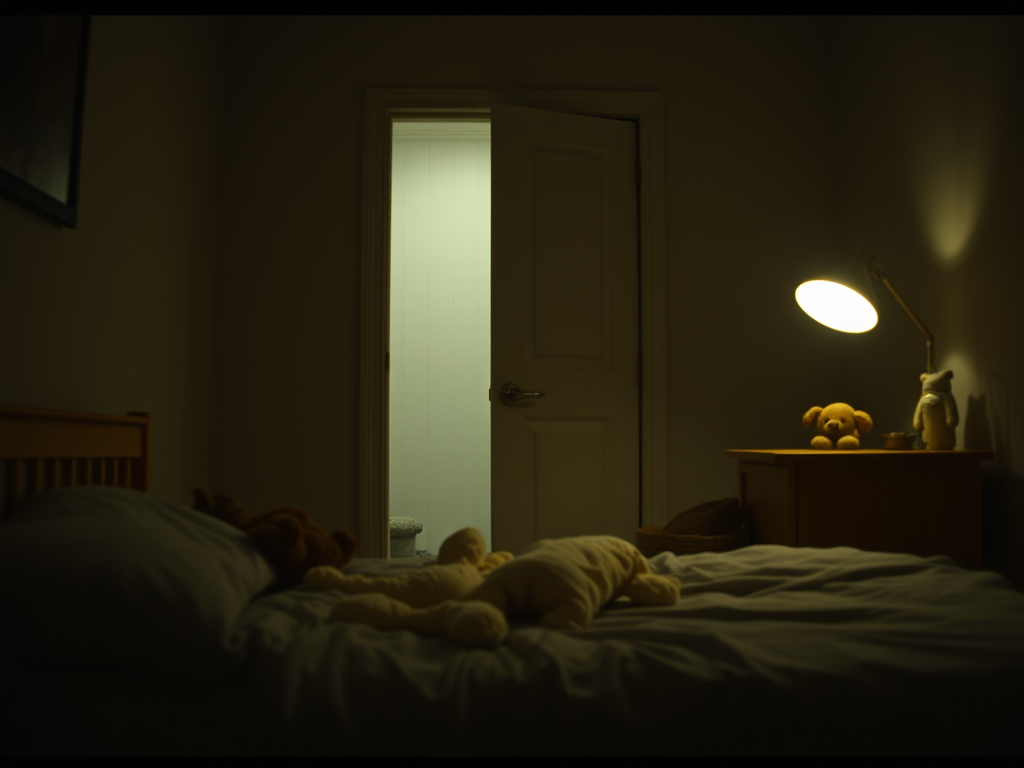
The idea of a monster lurking in the closet or hiding under the bed has terrified children for generations, if not centuries. No matter where you go in the world, there’s a good chance you’ll find some version of this creature that haunts the dark corners of a child’s room.
For many of us, the memory of staring at the closed closet door or pulling the covers up to our noses for protection against whatever was lurking beneath the mattress is still vivid, even long after we’ve outgrown the fear.
But where did this idea come from? How did we arrive at a point where kids across cultures and continents share the same strange belief that there’s something hiding, just out of sight, ready to pounce the moment the lights go out?
The story of the “monster in the closet” or the creature “under the bed” is as old as human imagination, born from a blend of psychology, folklore, and the universal experience of fear.
To understand the origins of these monsters, we first need to take a look at how children’s minds work.. and, more broadly, how fear functions in human beings.
Children are imaginative creatures. From an early age, their minds are developing at an incredible rate, constantly taking in information and trying to make sense of the world around them. But with that growing imagination comes the potential for fear. As they start to understand that the world can be a dangerous place, children begin to develop anxieties about the unknown, and their minds fill in the gaps with vivid, often terrifying details.
Think about it. During the day, children are busy interacting with their surroundings. The world is bright, full of action, noise, and distractions. There’s little room for fear when life is bustling all around you. But at night, everything changes. The familiar world becomes a lot less certain once the sun goes down. Shadows grow longer, sounds become more pronounced, and the comforting presence of light fades away, leaving darkness to take over.
It’s no wonder children’s imaginations tend to run wild at night. The darkness, combined with the quiet stillness of the night, offers the perfect stage for a child’s fears to come to life. And this is where the monster under the bed or in the closet comes into play.
These monsters are really manifestations of the unknown, of that creeping sense that there could be something dangerous just out of sight, hidden by the darkness.
Psychologically speaking, fear of the dark and fear of the unknown are deeply embedded in our evolutionary history. Long ago, our ancestors had every reason to be cautious of the dark. Without the safety of fire or shelter, the nighttime was full of potential threats.. wild animals, predators, or even other hostile humans. Those who stayed alert, who kept an ear out for the rustling in the bushes or the crack of a twig in the dark, had a better chance of survival.
Even though most of us no longer live in caves or huts, our brains still carry that evolutionary baggage. Our instinct to fear what we can’t see or fully understand remains, even if it doesn’t have the same life-or-death implications today.
For children, this instinct is heightened because they are still learning how the world works. When you’re young and inexperienced, there’s a lot you don’t understand yet, and that lack of understanding often leads to fear.
Children’s natural curiosity and imagination also play a significant role in creating these monsters. Kids are always trying to figure out how things work, and part of that process involves filling in the blanks when they don’t have all the information. When the closet door is closed, and they can’t see inside, their imaginations take over. What if there’s something in there? What if it’s watching, waiting for the moment when everyone’s asleep? And if you’ve ever seen the gap beneath the bed in the middle of the night, you know how it can look like a portal to another, darker world. It’s the perfect hiding spot for a monster.
Of course, this fear of the closet or the bed isn’t just rooted in our evolutionary past or the way children’s minds work. There’s also a rich history of folklore and mythology that has helped shape these fears. Across different cultures, stories of creatures that lurk in the night have been passed down from generation to generation. These tales, often told to warn children about the dangers of the world, also served to reinforce the idea that the night, and the places we can’t see, are full of hidden dangers.
In many cultures, monsters or bogeymen are used as cautionary tales to keep children in line. If you don’t behave, the monster will come and get you!
In Spain, there’s a legend of El Coco, a fearsome creature that will come to snatch disobedient children from their beds. In the Netherlands, parents warned their children of Zwarte Piet, a dark figure who would take bad kids away in a sack. In Mexico, children are told about La Llorona, the ghostly woman who steals away children who wander too far from home.
Even in English-speaking countries, the idea of a “bogeyman” exists in various forms. The bogeyman isn’t one specific creature, but more of a shape-shifting figure that can take on different appearances depending on the culture or even the individual’s imagination. It’s a universal stand-in for whatever children find most terrifying.
These stories, while meant to encourage good behaviour or warn against dangerous situations, also fed into the idea that danger was lurking just out of sight. The closet, with its closed doors, became a natural hiding place for whatever monster was threatening to come out, and the dark space beneath the bed offered a perfect hiding spot for anything waiting to reach out and grab an unsuspecting foot dangling over the edge of the mattress.
These traditional monsters -whether real, imagined, or exaggerated – played a major role in establishing the cultural foundation for the fear of the dark and, by extension, the idea that something could be hiding in the most ordinary of places. Over time, these tales evolved and adapted to fit modern sensibilities. The traditional bogeymen became the “monster in the closet” or the “thing under the bed,” reshaping the way children, and even adults, conceptualise their fear of the unknown.
The world of media has also had its hand in keeping the monster in the closet alive. From scary stories to movies, the trope of something hiding in the shadows has become a staple of horror.
Children’s books, like Where the Wild Things Are or There’s a Nightmare in My Closet, playfully tap into this fear, offering a way for children to confront and overcome it. Even more frightening tales, like those in the Goosebumps series or classic horror films, often include some variation of a monster hiding just out of sight.
Movies have been especially powerful in feeding this fear. Who hasn’t been terrified by the sight of a closet door creaking open or a hand reaching out from under the bed in a horror film? While these images may seem exaggerated or unrealistic, they still tap into that deep, primal fear of what we can’t see.
But what’s interesting is that many of these stories ultimately end with the characters confronting and defeating the monsters. Whether through bravery, cleverness, or even kindness, the child or hero often finds a way to stand up to the creature hiding in the dark. This narrative arc mirrors the psychological process of overcoming fear. By bringing the monster out into the open, by shining a light on it-literally and figuratively – the characters (and by extension, the audience) can take away its power.
For many children, this process of confronting the monster is an important part of growing up. While the fear of the dark and of hidden dangers may never completely disappear, children often learn to manage these fears over time. They come to realise that the closet is just a closet, the space under the bed is just empty, and the shadows on the wall are just shadows.
As adults, we may no longer fear monsters under the bed, but the memory of that fear lingers. Perhaps it’s because the idea of something lurking just out of sight is something that stays with us, even as we grow older. We may no longer believe that there’s a physical creature waiting to grab us in the night, but the metaphorical monsters of adulthood.. stress, anxiety, uncertainty – can sometimes feel just as real.
In a way, the monster in the closet or under the bed serves as a reminder that we all, at some point, must confront our fears. Whether they’re imaginary creatures from childhood or the very real challenges of life, we learn to face them, to pull back the covers or open the closet door and take a look for ourselves. And more often than not, we find that the monster wasn’t quite as scary as we thought.