The legend of Abhartach is one of Ireland’s most fascinating and mysterious tales, and it’s thought to be one of the earliest vampire legends in the world. While Bram Stoker’s “Dracula” is often credited with popularising the vampire myth, the story of Abhartach might have inspired some of his chilling ideas. But who exactly was Abhartach? And why has this story endured in Irish folklore for centuries?
I have no idea but I do have a bottle of Baileys and a thirst for knowledge… Let’s find out!
Abhartach’s legend is rooted in ancient Celtic tales from the dark, misty hills of Derry in Northern Ireland. I’ve never had the good fortune to visit Derry in Northern Ireland, so if the hills aren’t dark and misty I apologise.
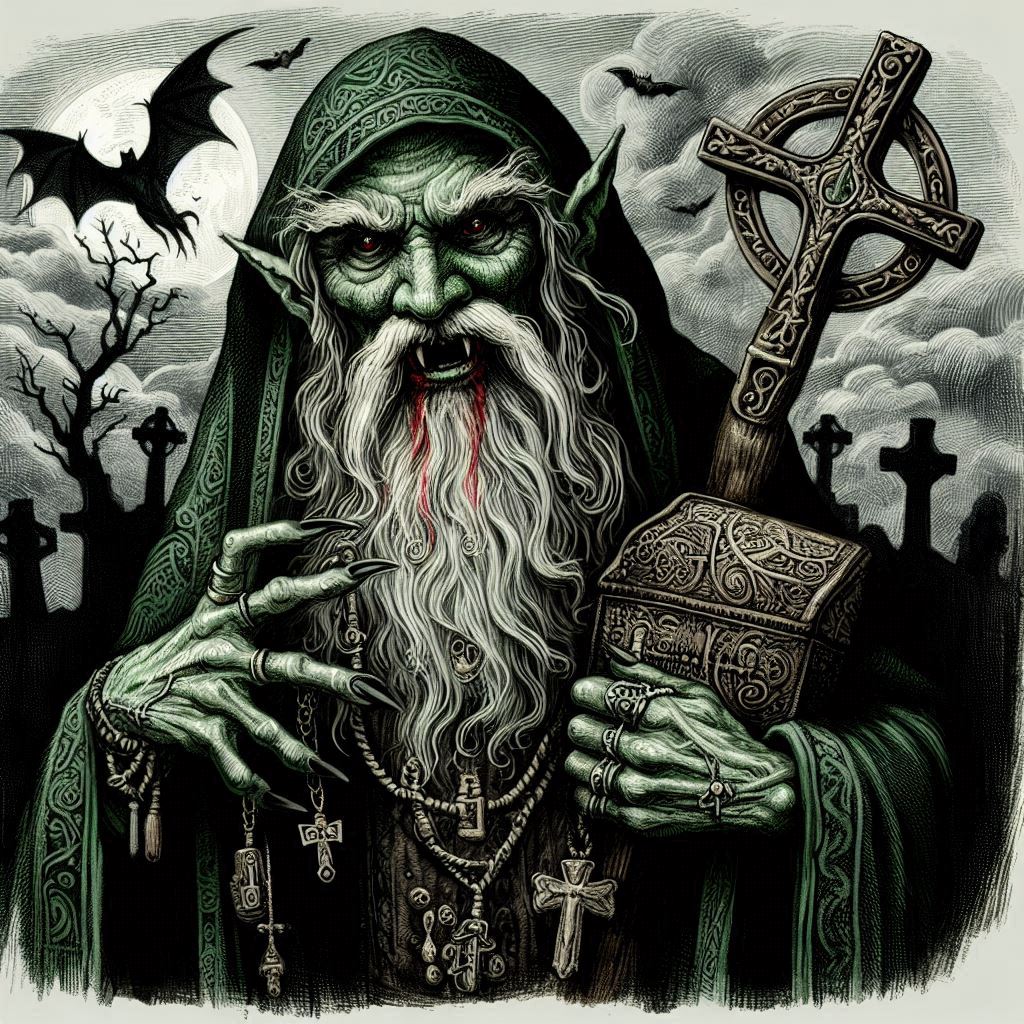
Anyway… In Irish mythology, Abhartach was believed to be an evil chieftain or possibly even a druid with strange and dark powers. Descriptions of him vary from a small, twisted figure to a wicked sorcerer with unnatural abilities. I suppose he could’ve been both really – a small, twisted and wicked druidic sorcerer. Very inclusive, very multi-discipline.. what everyone agrees on however, is that he was far from ordinary.
The name “Abhartach” itself is interesting: in Irish, it translates to something like “dwarf” or “crooked one,” which suggests he may have been physically small or deformed, adding to his eerie presence. Whatever his appearance, Abhartach was feared by his people for the terror he brought upon his lands.
The core of this story lies in Abhartach’s alleged supernatural abilities and his thirst for blood, which makes him a unique figure in folklore and gives him a vampiric edge long before the European vampire stories we’re familiar with today. According to legend, Abhartach was a cruel ruler who tormented his subjects. He was a tyrant who not only demanded complete obedience but was also notorious for his vile temper and cruel punishments. His subjects feared him immensely and felt trapped under his reign, as if they were under the spell of something truly evil. The people of his village began to suspect that Abhartach was no ordinary chieftain and that he might have connections to dark, otherworldly forces.
One day, the villagers could no longer tolerate his rule, and they reached out to another chieftain from a neighbouring clan, named Cathain, known for his courage and skill in battle. Cathain agreed to take on Abhartach, hoping to end his reign of terror and free the people from his brutal control. Cathain confronted Abhartach and killed him, burying him in an upright position, a mark of dishonour in Irish culture reserved for enemies and evildoers. The villagers thought they were finally free, but to their horror, Abhartach returned the very next day, seemingly unharmed and as malevolent as ever.
The story goes that Abhartach demanded a tribute of blood from his people, requiring them to fill a bowl with their blood for him to drink. This grotesque act terrified the villagers, who were desperate to be free from him. Once again, they called upon Cathain, who returned to fight Abhartach and killed him a second time, burying him in a remote spot with the same dishonourable burial. But just as before, Abhartach returned the next day, demanding more blood and at this point, Cathain and the villagers realised that ordinary methods would not keep Abhartach in the grave.
Unsure of how to deal with the undead chieftain, Cathain sought the counsel of a druid or a wise holy man – may even have been a saint, according to the lore. This holy man revealed that Abhartach was not merely a man but one of the “undead”, the neamh-mairbh or walking dead – possibly a zombie and definitely something even worse than a ghost or a spirit. To keep Abhartach from rising again, the holy man instructed Cathain to use ancient and specific burial rituals designed for containing supernatural beings.
Cathain was told to kill Abhartach once more, then bury him face-down this time, to prevent his spirit from escaping. He was also instructed to surround the grave with thorns and place a heavy stone or slab on top, as well as drive a wooden sword or stake, specifically made from Yew, through Abhartach’s heart. In some versions, iron was also used, as it was believed to ward off evil spirits and the sidh or fae in Celtic tradition. Cathain followed these instructions exactly, and Abhartach did not rise from his grave again. The evil chieftain was finally contained, and the people of the village were able to live in peace once more. However, it is said that his grave still exists today, in the townland of Slaughtaverty, marked by a large boulder under which he is believed to be trapped.
One reason the Abhartach legend is so compelling is that it incorporates many elements that we now associate with classic vampire lore. The demand for blood, the supernatural resurrection, and the necessity of a specific ritual to keep him contained all predate the more familiar vampire tales from Eastern Europe. There is a haunting quality to this legend, as it implies that Abhartach was not simply a malevolent spirit but an ancient evil with connections to dark magic. Some believe he was more like a sorcerer or druid who had mastered forbidden rituals to defy death, while others see him as a creature who became undead due to his wickedness in life.
The possible influence of Abhartach’s story on vampire mythology is intriguing, especially considering that Bram Stoker, an Irishman himself, was likely familiar with local legends when he wrote Dracula. Although Stoker set his novel in Transylvania and drew upon Eastern European vampire myths, the story of Abhartach may have contributed to his idea of an undead villain who rose from the grave seeking blood. Stoker’s use of ancient, monstrous evil and the blend of folklore with supernatural dread bear a striking resemblance to the themes found in Abhartach’s story.
In modern times, the grave of Abhartach has become a destination of sorts, drawing visitors and fans of vampire lore and Irish mythology. The burial site in Slaughtaverty is marked by a large stone that locals call “the Giant’s Grave” or “Abhartach’s Grave.” Interestingly, stories persist that those who disturb the grave may incur a curse or experience misfortune. Many people in the area still respect the site and avoid tampering with it, perhaps due to lingering superstition or simply as a mark of respect for a piece of local history that has captivated generations.
Abhartach’s story has sparked endless fascination for scholars and folklore enthusiasts alike, as it reveals much about early Celtic beliefs regarding death, the afterlife, and the supernatural. In Celtic mythology, the dead were not always considered entirely separate from the living. Spirits and otherworldly beings could cross between realms, bringing either help or harm to those still alive. The fear that someone as wicked as Abhartach could bridge this divide would have been especially horrifying to the people of ancient Ireland, who placed significant emphasis on proper burial rites and respect for the dead.
Another interesting element of Abhartach’s story is its reflection of Celtic views on the supernatural and nature’s power. In many tales, beings that defy death are often connected to nature, which was viewed with both reverence and caution in Celtic culture. By incorporating natural elements like the thorny barrier around the grave and the use of wood and iron to seal Abhartach’s body, the legend reflects the belief that nature itself has powers that can help contain dark forces.
The tale of Abhartach offers a fascinating window into Ireland’s past, blending history, myth, and a touch of horror. It serves as a reminder of the thin veil between the world we know and the possibility of mysterious forces which exist beyond it, concepts that have permeated Irish storytelling for centuries. Legends like Abhartach’s are truly timeless, capturing the minds of those who hear them and reminding us of all the fears and mysteries that have shaped human history. It’s easy to see why this story has endured – the combination of supernatural horror, cultural tradition, and a touch of dark magic creates a tale that’s as compelling today as it was centuries ago.
Abhartach’s story also shows how legends evolve over time, taking on new meanings and interpretations as they’re passed down through generations. Originally a local legend, the tale of Abhartach has gained wider recognition, particularly as scholars and enthusiasts draw connections between him and modern vampire stories. The enduring popularity of vampire tales and fascination with the undead have kept Abhartach’s legend alive, intertwining it with newer stories and characters that carry echoes of his eerie presence.
Abhartach remains an mysterious figure, a blend of ancient Celtic beliefs, local folklore, and the universal fascination with life after death. His tale is one that invites exploration, sparking the imagination of those interested in the supernatural and offering a unique piece of cultural heritage that is distinctly Irish.
For those of us with a taste for the eerie and the unexplained, Abhartach’s tale offers a tantalising glimpse into a past where magic and myth ruled, and where the boundaries between life and death were perhaps a little more flexible than they are today. Whether or not he was the true first vampire, Abhartach’s place in Irish legend remains a fascinating chapter in the story of the supernatural.