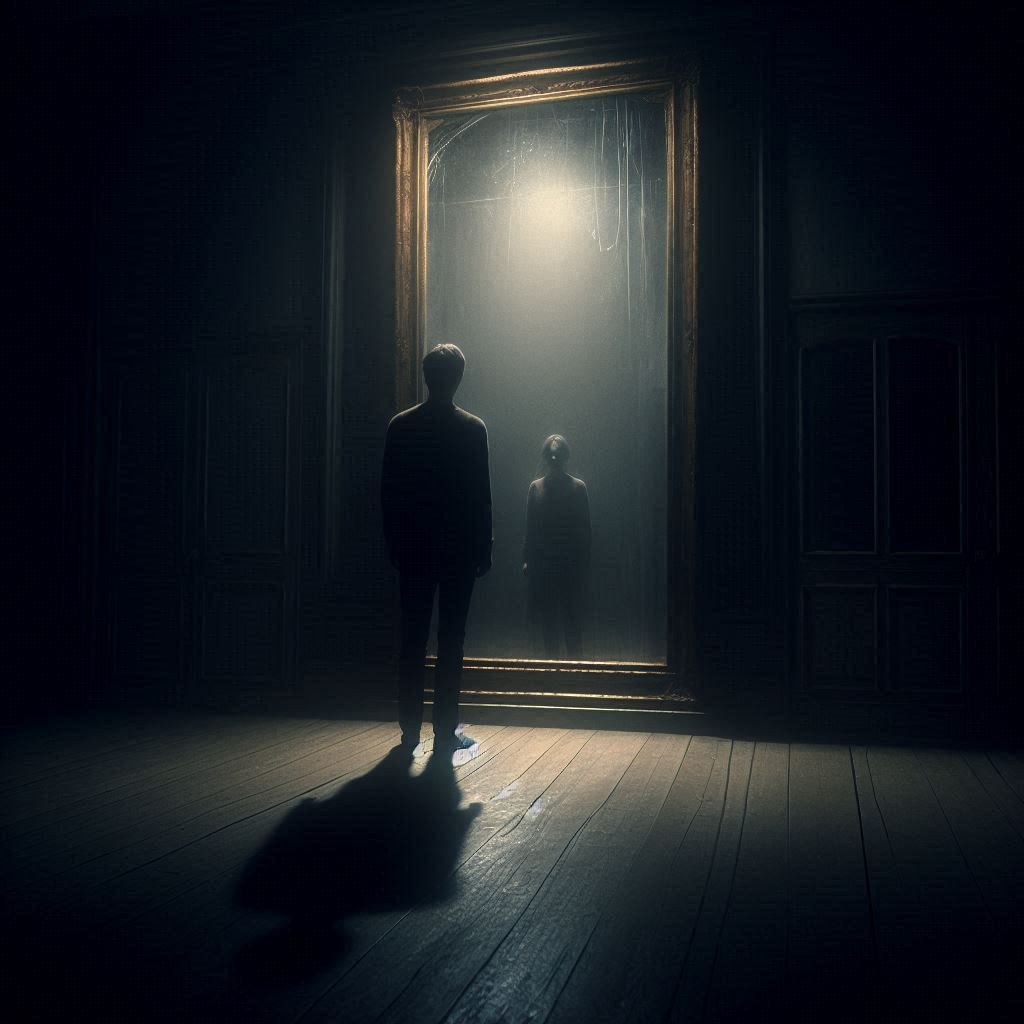
The fear of mirrors, known as spectrophobia or eisoptrophobia, is a fascinating psychological phenomenon that taps into deep-seated human anxieties. For some, this fear might be triggered by childhood memories of dark rooms, by myths and horror stories, or simply by an unshakable feeling that something about mirrors isn’t quite right.
So what is it about mirrors that makes some of us uneasy? Why do they inspire dread in ways that other everyday objects rarely do?
Mirrors have always held a certain… mystique. From early civilizations to modern times, mirrors have been more than simple objects to check one’s appearance. They’ve been seen as portals, as magical objects, as pathways to other worlds. Stories and superstitions around mirrors abound in cultures worldwide. Consider the tales of vampires who have no reflection or the superstition that breaking a mirror brings seven years of bad luck. These narratives hint at an underlying belief that mirrors are powerful and perhaps dangerous objects.
One theory about why mirrors inspire fear is that they offer us a perspective of ourselves we can’t see otherwise. When we look into a mirror, we’re given a reverse image of ourselves, something no other person can see. This reversal can feel inherently unnatural to some people. The mind expects certain things about the world, and when a mirror confronts us with an image that’s us but also somehow not us, it creates a kind of cognitive dissonance, a mental discomfort of sorts. This discomfort is particularly pronounced in individuals who are highly imaginative or prone to anxiety.
This dissonance is compounded when one considers how our brains process faces. Human brains are finely attuned to recognize faces, even to the extent that we see them where they don’t exist – like in clouds, rocks, or abstract art. We have dedicated areas in our brains specifically for recognizing and processing facial features.
When we look at our own reflection, these areas become activated. But because the face looking back at us is slightly unfamiliar, flipped left-to-right, and often exaggerated or distorted by lighting, our brain is forced into an uncanny valley of recognition, seeing something both familiar and strange.
This effect is most unsettling in dim or flickering light. Shadows and changes in light can make a face in a mirror look more like a stranger than ourselves, leading to a visceral sense of unease.
The psychology of this fear also involves a loss of control over our own perception. People tend to feel secure when they can predict and understand their environment. Mirrors disrupt that sense of predictability. If you’ve ever caught your reflection out of the corner of your eye, only to feel a jolt of fear or surprise, you’ve experienced this directly. Our peripheral vision isn’t as clear or detailed as our central vision, and sudden movement or the mere presence of a figure in our periphery can set off an instinctive alarm response. In nature, this response would alert us to potential threats – predators or other dangers approaching from the side. But in modern life, catching a glimpse of one’s own reflection triggers that same primitive fear response, even though there’s no actual threat.
Many psychologists argue that mirror fear is also tied to a deeper fear of self-confrontation. In front of a mirror, you’re faced with yourself in an unfiltered way. This can be distressing for people who struggle with self-image or self-acceptance. Mirrors don’t just show us how we look, they can act as a metaphorical reflection of our innermost selves. For people who experience negative self-talk, who grapple with insecurities, or who are dealing with trauma, looking in a mirror can feel like a harsh confrontation with aspects of themselves they’d rather avoid. In this way, the fear of mirrors might be less about the physical object itself and more about the fear of what it represents.
Children are particularly susceptible to developing a fear of mirrors. At a young age, children are still learning about the world and how to differentiate reality from fantasy. Mirrors can be confusing for young minds. A child might see their own reflection as another person, or they might not fully understand that the image in the mirror can’t harm them. Children are also exposed to a wide range of media, much of which might depict mirrors as objects that hide secrets or contain supernatural properties.
These influences can shape how they perceive mirrors, often turning them into objects of fear. In some cases, a particularly frightening experience or a horror movie can create a lasting association between mirrors and fear, an association that can persist into adulthood.
There’s also the issue of cultural narratives around mirrors. Folklore and myths have a powerful impact on our perceptions, and mirrors have been woven into the fabric of storytelling for centuries. Ancient cultures often viewed mirrors as spiritual or mystical objects. In many traditions, mirrors were thought to capture or reflect souls. Some cultures believed that mirrors could trap spirits or act as portals to other worlds. This belief persists in various forms, with many people feeling uneasy about mirrors at night, covering mirrors in the rooms of the deceased, or avoiding mirrors in certain contexts. These cultural stories reinforce the idea that mirrors are not just harmless objects, but rather, they are things with power and agency, objects that should be treated with caution.
Interestingly, the fear of mirrors can be exacerbated by specific psychological conditions, such as depersonalization and derealization disorders. These disorders create a sensation that one’s self or surroundings are unreal. In a state of depersonalization, a person may look into a mirror and feel disconnected from the image they see. This can make mirrors profoundly disturbing for those who experience these conditions, as the sense of self is already fragile, and the mirror seems to reflect a stranger rather than oneself. In cases of derealization, where the world itself feels fake or dreamlike, mirrors can amplify the sense of strangeness, making it feel as though the mirror is a gateway to an alternate reality or a distorted version of the world.
Some people experience what psychologists call the “strange-face illusion” when they stare into a mirror for a prolonged period, especially in dim lighting. This phenomenon, discovered by researcher Giovanni Caputo, involves the brain’s tendency to distort and alter the face staring back as it tries to make sense of the static, unchanging image. Over time, features may appear to melt, shift, or turn into the faces of strangers or even monstrous images. The strange-face illusion is thought to occur because of the way our brains process and interpret faces, particularly when deprived of context or external cues. For some, the strange-face illusion can be deeply unsettling, reinforcing the belief that mirrors hold something unnatural or threatening.
Another possible explanation for the fear of mirrors is rooted in evolutionary psychology. Humans have an instinctive fear of the unknown and of things that don’t make immediate sense. This survival instinct helped early humans avoid danger. In a time when survival depended on quick reactions, our ancestors would have learned to avoid anything that was strange, unpredictable, or potentially threatening. In an evolutionary sense, mirrors may feel dangerous because they present a perfect but opposite reflection, something that doesn’t exist anywhere else in nature. For some people, this effect is subtle, but for others, it can trigger an intense feeling of dread.
The paranormal aspect also can’t be ignored when it comes to fear of mirrors. Many people believe in ghosts or spirits, and mirrors are often seen as doorways to the supernatural. This belief can be found in “Bloody Mary” rituals or séances, where participants believe mirrors allow them to communicate with spirits or catch glimpses of another world. Even those who are skeptical of the paranormal might feel a subconscious pull towards caution when it comes to mirrors. After all, these beliefs have been passed down for centuries. They’re embedded in our collective psyche, creating a feeling of unease around mirrors that’s difficult to shake, even for the most rational minds.
The fear of mirrors can also be linked to dreams and the subconscious. Many people report unsettling dreams involving mirrors. In dreams, mirrors often symbolize self-reflection or self-perception. When these dreams are negative or unsettling, they can cause an individual to carry a lingering sense of dread toward mirrors in waking life. This association can create a psychological link between mirrors and negative emotions, making the mere sight of a mirror an anxiety trigger.
All of these factors – the cultural stories, the psychological processing of faces, the influence of horror media, and evolutionary instincts – combine to create a complex web of associations around mirrors. For some, these associations lead to a mild unease, a simple sense of discomfort around mirrors. For others, they can develop into a full-fledged phobia, where the sight of a mirror or even the thought of one is enough to cause intense fear and anxiety.
The fear of mirrors is ultimately a multifaceted phenomenon, tied deeply to our understanding of self, our interpretation of reality, and our cultural history. Mirrors confront us with our own image, but in a way that’s distorted, reversed, and sometimes unsettlingly lifelike.
They’re tools that can force us to confront our own insecurities, our fear of the unknown, and our discomfort with self-perception.
Whether rational or not, the fear of mirrors taps into something universal – a feeling that our reflection might show more than we want to see or reveal things about ourselves we’d rather keep hidden. It’s a fear that has both logical and mysterious roots, and it’s one that may continue to haunt us as long as mirrors remain part of our lives.


Leave a Reply