Ghost stories have long been an integral part of British folklore, with many of these haunting tales tied to specific locations.
Among the most chilling and indeed enduring are the legends surrounding infamous British road ghosts. These spectral figures, often seen by travellers or reported by those who live near haunted roads, are part of a centuries-old tradition of storytelling that keeps the memories of historical events alive.
But what lies beneath these stories? What are the likely causes of such sightings, and how do they reflect our relationship with history?
I don’t have to tell you that the tradition of telling ghost stories is an ancient one, an integral part of the fabric of British and any other culture. Folklore and oral traditions have long been a way for communities to preserve memories of local events, especially if those events are of a tragic or unsettling nature.
Roads, as essential lifelines connecting towns and villages, have often been the sites of such tragedies. Many of the most famous British road ghosts are tied to real events, and over time, these stories have been shaped and re-shared, gaining layers of myth and mystery.
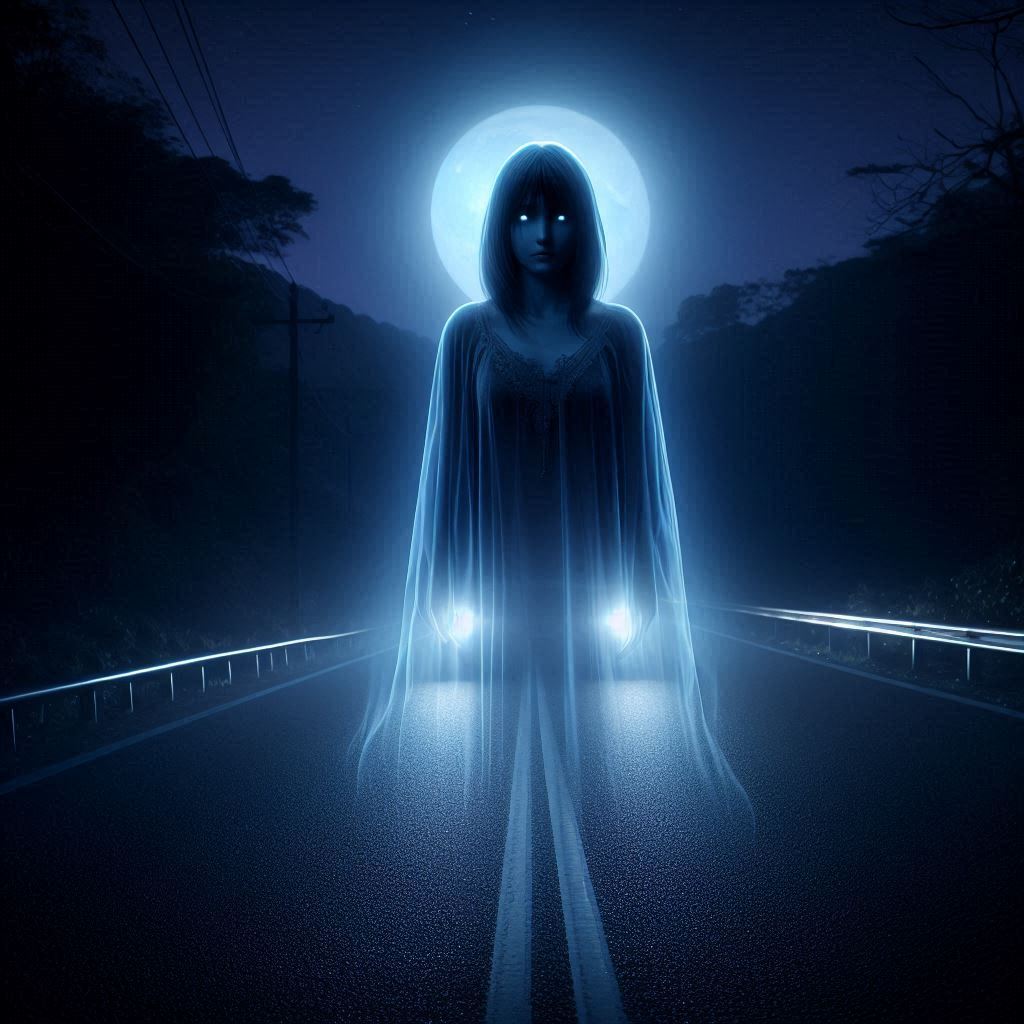
One of the most infamous road ghost types in Britain is the figure of the “Vanishing Hitchhiker,” a ghostly presence seen on roads all over the UK, although most commonly reported on the roads of the south of England.
These stories follow a similar pattern. A motorist, often driving alone at night, picks up a hitchhiker who appears suddenly on the side of the road. The hitchhiker is typically a young woman, dressed in old-fashioned clothing, and she seems to be in need of a lift. However, as the driver continues down the road, the hitchhiker mysteriously vanishes, often before reaching the destination. In some versions of the tale, the driver discovers that the hitchhiker had died years earlier in a tragic accident on that very stretch of road.
One of the more famous examples of the Vanishing Hitchhiker is the case of “The Green Man,” a ghostly figure who has been seen in the rural areas around Northumberland.
The Green Man is believed to be the ghost of a young woman who died in a tragic car accident in the 1950s. Despite being one of the more well-known urban legends, this story likely has its roots in real-life events. It is probable that the area was the site of a fatal crash, and the chilling tale of the ghostly hitchhiker emerged as a way to preserve that memory – these types of sightings often occur in places with long histories of fatal accidents, where the memory of loss becomes etched into the fabric of the landscape.
There are numerous reports of ghostly apparitions tied to these specific roads where tragic accidents or violent deaths have occurred. The most well-known example of this is the so-called “Ghost of the A303,” which runs through the southwest of England.
This road is infamous for its long history of accidents, and over the years, countless reports have emerged of a figure seen standing by the roadside, only for it to disappear when drivers approach. Some claim the figure is the ghost of a soldier from World War II, while others suggest it may be a more recent victim of a car crash.
But what is it about these road ghosts that continues to intrigue us? One possible explanation is the relationship between folklore and collective memory.
In an age where much of our history is written down, there remains a deeply rooted belief in the oral tradition, where stories are passed down from generation to generation. These tales serve as reminders of historical events, often tragic or unexplained, and allow them to live on in the collective consciousness of a community. Then, as new generations hear these stories, the past is preserved, not in dusty archives or books, but in the memories and voices of those who share them.
The very nature of road ghosts allows for this kind of collective memory to thrive. Roads are places of transition, of movement, where people pass through but rarely stay and as such, they often become symbolic of journeys both literal and metaphorical.
Roads are where life and death intersect, where people are constantly on the move, and where past tragedies can leave an indelible mark. It is no surprise, then, that ghost stories, such as those tied to roads, are so enduring. These ghosts represent something more than just spectral beings, they are symbols of the untold stories, of lives cut short, and of memories that refuse to fade.
In more modern times, there has been a growing tendency to seek rational explanations for these phenomena, and the cause of these sightings can often be attributed to a combination of factors such as poor road conditions, psychological suggestion, and that good old standby – a deep-seated belief in ghosts. The human mind is inclined to see patterns in the unknown, especially when emotional or traumatic events are attached to a specific location.
Some researchers suggest that many of the sightings may be the result of “optical illusions,” where the brain misinterprets the shadows or the movements of objects, especially in the darkness.
Some others point to the phenomenon of “phantom limb” sensations, where people feel the presence of something or someone that isn’t physically there, or in other cases theorise that certain types of road ghosts might be the result of “recurrent spontaneous psychokinesis,” where the emotional energy from a traumatic event could cause the memory of it to manifest as a ghostly presence. To be honest, both these unproven phenomena being used to try and explain another unproven phenomena seems ridiculous at best. In fact I personally hope the RSPK one has been put forward in jest…
While ‘rational’ explanations can provide a sense of closure, the fact that these ghost stories continue to be told year after year shows that we have not fully let go of the past.
These stories are much more than just tales of the supernatural. They are a way of preserving the past, of keeping alive the memories of those who have come before us. They remind us of the importance of oral traditions in maintaining the connection between generations, and there is something deeply comforting about these stories, about the idea that the past is never truly gone, it lives on, in the form of road ghosts, folklore, and the memories we share.
So as we drive along the roads of Britain, we are not only travelling through space but also through time. The ghosts of the past linger in the corners of our minds, in the stories we pass on, and in the places where tragedy once struck. Whether or not these spirits are real is a matter of personal belief, but the importance of these tales is undeniable. They connect us to our history, to the people who lived and died before us, and remind us that the road we travel is not just a path through the landscape but a journey through the collective memory of humanity.