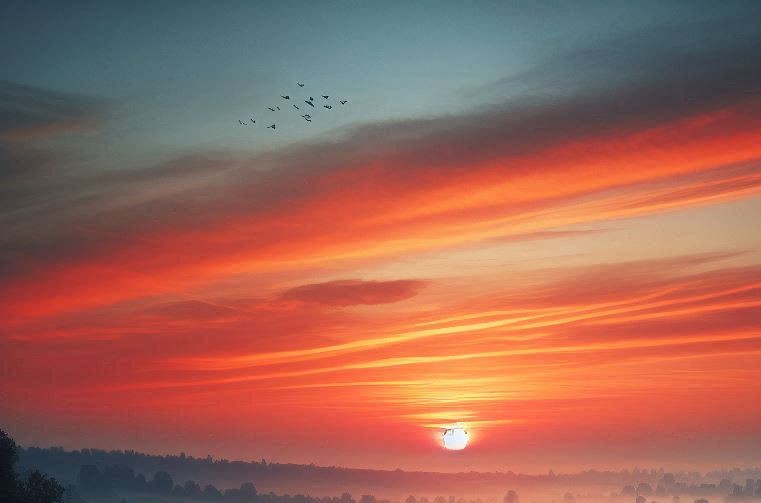
Standing here in Buxton this evening, I find myself captivated by the sky, which is painted in the most magnificent shades of red, pink, and orange. The sun, now dipping low, has turned from a golden orb into a fiery red disc, casting the entire landscape in a warm, otherworldly glow. It’s November 12, 2024, and there’s a bit of a chill in the air, but even that doesn’t detract from the sheer beauty of the scene.
Watching this fiery spectacle, I find myself caught between wonder and curiosity. Why does the sky turn red at sunset? And why is it that people throughout history have attached so much meaning to a red sky?
To understand why we see a red sky at sunset, let’s start with a bit of science.
It all comes down to the way light interacts with our atmosphere. The colours we see in the sky are caused by the scattering of sunlight by molecules and particles in the air. Sunlight, as we know, is made up of different colours that each have their own wavelength. Blue and violet light have shorter wavelengths, which makes them scatter more when they encounter molecules and particles in the atmosphere. This is why, on a clear day, we see a blue sky – because blue light is scattered in all directions by the atmosphere.
As the sun gets lower in the sky, it has to pass through more of the Earth’s atmosphere to reach us. The increased distance means more scattering, which gradually removes the shorter blue and violet wavelengths from our line of sight. What we’re left with, as the sun dips even lower, are the longer wavelengths – the reds, oranges, and pinks. These colours aren’t scattered as much and so dominate the sky near sunset. That’s why, when we have a clear atmosphere – free of too much pollution, dust, or clouds – the sky can light up in these beautiful fiery hues.
Tonight, it’s fairly clear here in Buxton, so the conditions are perfect for a bright red sunset.
But, as much as science can explain the colours we’re seeing, there’s something undeniably magical about a red sunset. I find myself thinking about all the myths, superstitions, and folklore tied to red skies.
One of the most well-known is the old saying, “Red sky at night, shepherd’s delight; red sky in the morning, shepherd’s warning.” I remember hearing that as a child, and it stuck with me ever since. As I watch the sky tonight, I can’t help but smile at the idea of it promising fair weather for tomorrow. This saying actually has some scientific basis to it, at least in regions like ours in the UK.
The way weather systems move across our islands means that a red sky in the evening usually suggests clear skies and high pressure approaching from the west, which means we’re likely to have good weather following it. In the morning, however, a red sky often means that high pressure has passed, making way for wet weather from the west. It’s fascinating to think that shepherds and sailors alike have relied on the colours of the sky as a sort of natural barometer for centuries.
Red skies appear in folklore and mythology all over the world, too. The colour red in the sky has often been seen as a powerful sign, a warning, or an omen. In some cultures, it’s believed that a red sunset means that the spirits of those who have passed on are watching over us. It’s a comforting idea, isn’t it? Standing here, feeling the air cool around me as the sun dips lower, I can almost imagine the sky as a sort of bridge between our world and whatever lies beyond.
In Japan, for example, a red sky is seen as a good omen, symbolizing peace and prosperity. In Chinese culture, the colour red itself is considered lucky, so a red sunset is seen as a sign of good fortune. For ancient sailors, a red sunset was thought to indicate safe travels, while a red sky in the morning meant it was better to stay ashore.
There’s something primal, too, about the way a red sky makes us feel. Long before we understood the science behind it, our ancestors looked to the heavens for guidance, for reassurance, or perhaps even for comfort in times of uncertainty.
Fire was one of the first things that humans learned to control, and it’s possible that seeing a red sky reminded our ancestors of the warmth and security of fire, or perhaps warned them of approaching danger. Fire itself was associated with gods and goddesses in many cultures, and a red sunset may have been seen as a reflection of those divine flames.
It’s easy to see why the ancient Greeks might have thought of the goddess Eos, who brought the dawn each day, as creating the brilliant reds and oranges in the sky. For the Romans, the god Sol, who drove his chariot across the heavens, was responsible for the light of day. When the sky turned red, it might have felt as if Sol himself were riding off to some distant place, painting the world with his last burst of colour as he went. Even here in England, our ancestors had their own ways of reading the sky. There are stories of red sunsets being seen as a warning of spirits or omens of change.
Looking back through the lens of folklore, it’s interesting how much power humans have given to the sky and its colours. Seeing a red sunset might have once filled people with dread or wonder, sparking stories and superstitions that spread from village to village, across generations.
There’s something beautifully human about that – about looking up at something so far beyond us and trying to find meaning in it.
Even today, I find that I can’t help but feel a certain thrill when the sky turns red. I know it’s just scattering light, but it feels bigger than that.
For some, red sunsets also carry a hint of sadness, especially as they signify the day coming to an end. Writers, poets, and artists have long drawn inspiration from the setting sun, and a red sky has often been used to symbolize longing, loss, or endings. There’s a poetic melancholy to it, as if the day itself is burning out in one last blaze before darkness falls.
Sitting here watching the sky fade, I can’t help but feel a little bit of that myself. It’s strange how something so beautiful can feel bittersweet.
I think about how many people around the world are watching the same sunset. Someone across the Atlantic might be looking up at the same red sky, feeling that same sense of awe and mystery. Maybe they’re wondering if the old sayings hold any truth. Maybe they’re reminded of someone they’ve lost, or maybe they’re simply enjoying the beauty of the moment, just as I am.
As the last of the light fades, I feel a little reluctant to leave, but I know this scene will stay with me. There’s something timeless about a red sunset – a reminder of all the beauty in the world, even in the ordinary rhythms of day and night. Science may explain why it happens, but that doesn’t take away the magic of it.
Standing here, I feel connected not only to the world around me but to all the people who’ve stood here before, looking up at the same sky, wondering at its colours and finding meaning in its changing hues.