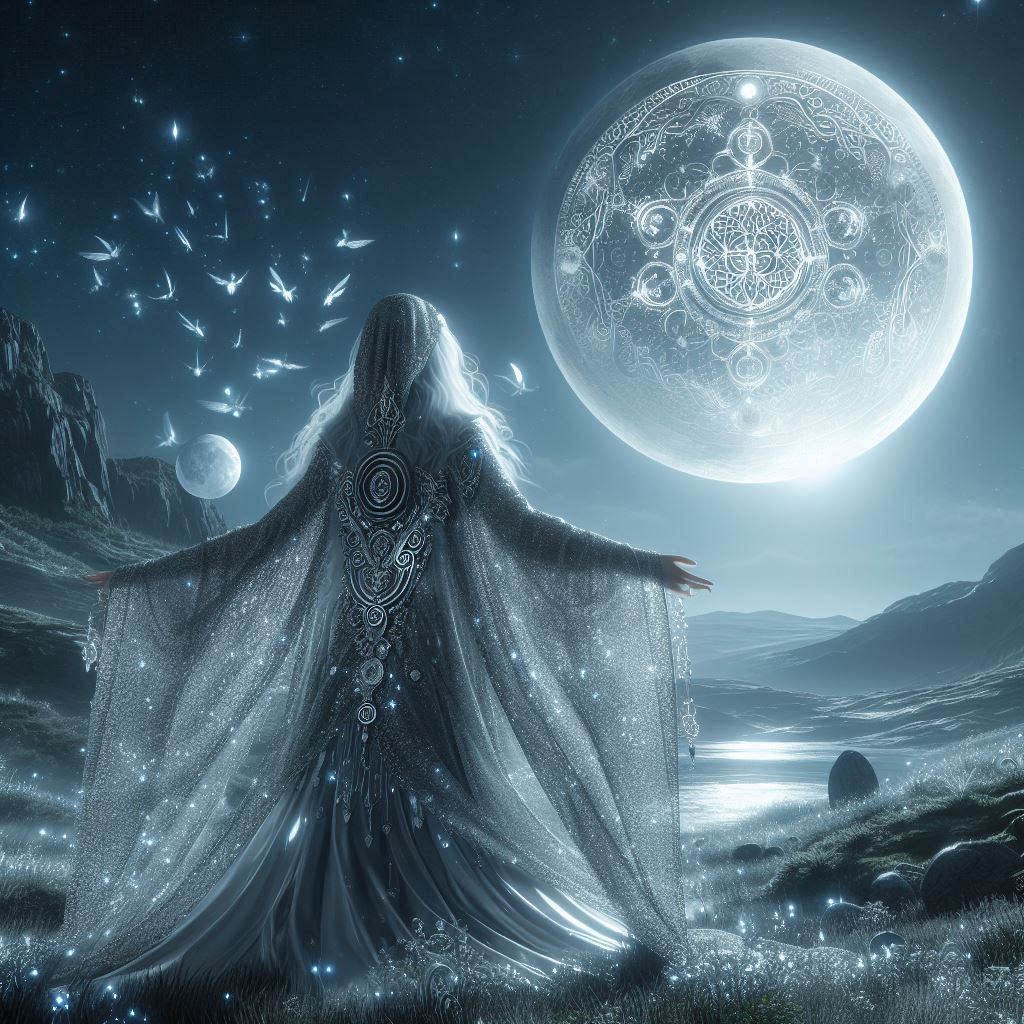
Whilst navigating the vast landscape of Celtic mythology, few figures captivated my imagination like Arianrhod (pronounced AH-ree-an-rhod).
Her story unfolds against the backdrop of ancient Wales, amidst the myths of gods, goddesses, and heroes intertwined with the mysteries of nature and the cosmos.
Arianrhod’s name, translated as “silver wheel” or “silver circle,” evokes images of the moon, cycles, and the endless passage of time.
DonArianrhod belonged to the Tuatha Dé Danann – mythical beings often described as gods or highly revered ancestors. Specifically, she was a member of the Welsh equivalent, the Children of Don. Her father, Don (possibly an early Welsh counterpart to the Irish goddess Danu), was a figure associated with the heavens, and her mother, Beli, was linked to light and fire.This meant our girl Arianrhod, embodied a duality – a connection to both the celestial and the terrestrial.
She was often depicted as a goddess of the moon and stars, weaving the fabric of life and destiny. Her association with the “silver wheel” might symbolise the cycles of life, the journey of the soul, or the cosmic order of the universe. Arianrhod’s domain was Caer Arianrhod (the “Fortress of Arianrhod”), a mythical island said to exist off the coast of Wales. Some believe it corresponds to a submerged land visible during low tide, hinting at an otherworldly connection.
Arianrhod’s most famous tale is told in the Mabinogion, a medieval collection of Welsh stories that preserves echoes of older Celtic traditions. In this tale, she plays a central role in the Fourth Branch of the Mabinogion, which revolves around the lives of Math, Gwydion, and Lleu Llaw Gyffes.
Math, the king of Gwynedd, could only remain alive if his feet rested in the lap of a virgin, except in times of war. When Math’s current virgin attendant betrayed his trust, a replacement had to be found. Gwydion, Arianrhod’s brother, suggested her for the role, assuming her purity would qualify her.
However, when Arianrhod stepped forward to prove her virginity through a magical test, the results were unexpected and shocking. As she passed over Math’s wand (a symbolic ritual), she gave birth – not once, but twice. The first was a lump of flesh that fled into the sea, later identified as a being named Dylan. The second was a small boy, whom Gwydion hid and raised.
Embarrassed and enraged by the revelation and her brother’s interference, Arianrhod imposed three harsh curses on the boy, who would later be named Lleu Llaw Gyffes. She declared that he would never have a name unless she gave it to him, he would never bear arms unless she armed him, and he would never have a wife born of mortal parents.
Arianrhod’s connection to the moon and stars goes beyond her name. The silver wheel may symbolise the Milky Way, which in Welsh folklore was known as Caer Gwydion – “The Fortress of Gwydion.” As the sister of Gwydion, who was skilled in magic and astronomy, Arianrhod’s role may also reflect celestial themes.
Her stories are filled with cycles, transformation, and resilience, much like the phases of the moon. Even her curses on Lleu, while harsh, ultimately led to creative solutions that showcased human ingenuity and magical intervention. Gwydion cleverly outwitted her, earning Lleu his name, his weapons, and a wife crafted from flowers.
Arianrhod is a complex figure, embodying themes of independence, resistance, and mystery. While she is sometimes portrayed as an antagonist in the Mabinogion, she is also a goddess of profound power. Her refusal to conform to societal expectations – whether as a virgin or as a compliant sister – makes her a figure of intrigue and strength.
Some modern interpretations view Arianrhod as a symbol of feminine autonomy and the cyclical nature of life. Her challenges to Lleu can be seen as harsh tests of his worthiness, ensuring he earns his place among the legendary figures of Welsh myth. Her island fortress, Caer Arianrhod, remains a haunting image of otherworldly beauty, lost but not forgotten.
Arianrhod’s story resonates with anyone who has ever felt the weight of expectations or the sting of judgment. She represents the moonlit path through uncertainty, the silver thread connecting us to the stars, and the resilience to carve our own destinies.
Her tale, woven into the fabric of Welsh mythology, is a lasting testament to the timelessness of myth and the human experience.
Arianrhod remains a glowing figure in the constellation of Celtic lore, a reminder of life’s cyclical nature and the power of the divine feminine.


Leave a Reply