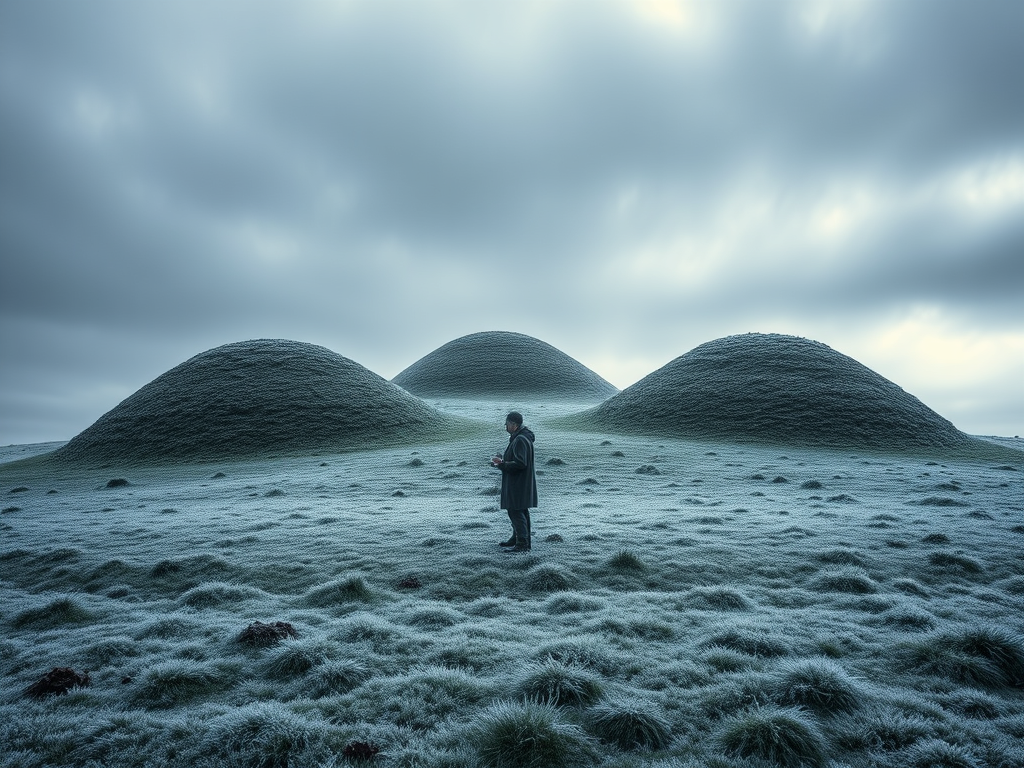
Extracts from the diary of Henry Tilbury, amateur archaeologist.
30th December, 1924
I arrived in Buxton today, the frost-tinged hills of Derbyshire stark against the leaden sky. The train journey from London was uneventful, though the further north we travelled, the heavier the sense of isolation grew.
My purpose here is clear: to investigate a series of burial mounds near Harpur Hill. They are thought to date to the Bronze Age, their secrets untouched for centuries. I have rented a modest cottage at the edge of town, its proximity to the site convenient for my work.The landlady, a Mrs Porter, raised an eyebrow when I mentioned my plans.
“You’ll want to steer clear of them mounds, sir,” she said. “They don’t like to be disturbed, especially this time of year.”
Superstition, of course. And yet her words left me with an odd unease.
31st December, 1924
The year’s end. A grey dawn greeted me as I made my way to the mounds. A biting wind swept the moor, and frost crackled underfoot. The burial site consists of three barrows, arranged in a crescent, the central one the largest and least disturbed.
My initial survey uncovered traces of an earlier excavation: a trench cut into the side of the central mound. Curious, I focused my attention there and soon unearthed a fragment of pottery, its surface decorated with primitive designs. A promising find.
Yet as the day wore on, I felt an unsettling presence. Once or twice, I thought I heard faint whispers on the wind, though the moor was empty. The gloom deepened early, and I returned to the cottage with a growing sense of unease.
1st January, 1925
The New Year dawned cold and bright, a deceptive cheerfulness masking the heavy atmosphere that seems to cling to this place.
I returned to the site, determined to begin a proper excavation. A local youth, George, agreed to assist me. He proved diligent, though clearly uneasy.
By midday, we had exposed a stone cist within the central mound. Inside, we discovered a small bronze dagger, dulled by time but unmistakably ceremonial in nature.
As we worked, George claimed to hear whispers, though I assured him it was nothing but the wind. Yet, I must confess, the silence of the moor seemed alive with something unseen.
Tonight, as the town celebrated the New Year, I remained indoors, unable to shake the feeling of being watched.
2nd January, 1925
George did not appear this morning. When I inquired after him, his landlady informed me he had left for Sheffield in great haste, muttering about “bad dreams.”
Undeterred, I continued the excavation alone. My efforts revealed a second find: a delicate gold ornament, its intricate design far beyond what I expected from the period. A remarkable discovery!
Yet as I examined it, a shadow passed over the mound, though the sky was clear. A wave of dread overcame me, so intense that I abandoned the site.
That night, the whispers invaded my dreams, joined by the vision of a hooded figure. Its face was obscured, but its presence was suffocating.
3rd January, 1925
Sleep eludes me.
The hooded figure has become a constant in my dreams, standing at the edge of my vision, watching.
Nevertheless, I returned to the site today, driven by a compulsion I cannot explain.
Beneath the cist, I discovered a sealed chamber, its entrance blocked by a heavy stone slab. Inscribed upon it were runes, unfamiliar and unnerving.
With great effort, I pried the slab loose. A foul stench issued forth, and inside I found a skeleton, its bones twisted unnaturally. Clutched in its fingers was a second bronze dagger, a twin to the first.
As I reached for it, the air grew thick, and a low moan rose from the earth. I turned to see shadowy figures circling the mound, their forms flickering in and out of sight.
I fled in terror, leaving my tools and the artifacts behind.
4th January, 1925
The whispers are louder now, audible even in the waking hours. They speak not in words but in tones of accusation and sorrow.
The gold ornament and daggers, though left at the site, appeared inexplicably on my bedside table this morning.
My attempts to destroy them have failed. I fear they are bound to me now.
The hooded figure stands closer in my dreams, its presence oppressive. Tonight, it stood by the window, its form more distinct than before. Its hand pointed toward the burial mounds, as though summoning me back.
5th January, 1925
I can endure no more.
The voices now fill the cottage, a cacophony of grief and rage. The air is thick with shadows, and the hooded figure is no longer confined to dreams.
This morning, I gathered the artifacts and carried them to the River Wye, intending to consign them to its depths. As I approached the water, the whispers grew into a deafening roar, and the hooded figure appeared before me, blocking my path.
I turned and fled, leaving the cursed items behind. Whether they remain there, I do not know.
I shall leave Buxton at first light, though I fear whatever I have awakened will not let me go.
This diary is my final record, should I fail to escape.
Epilogue
The diary of Henry Tilbury was discovered in an abandoned cottage near Buxton in 1925, its final pages marked with smears of mud and ash. The burial mounds at Harpur Hill remain untouched, though locals speak of strange lights and voices on the moor.
Tilbury himself was never seen again, and no trace of the artifacts he described has ever been found. Some say his spirit now roams the moor, forever bound to the secrets he unearthed.

Leave a Reply