It’s a gloriously sunny spring day here in Buxton. The birds are birding, the squirrels are squirrelling, and the ghost of Mary, Queen of Scots is taking the air in the Pavilion Gardens – or planning another escape, either way.
A little dog is yapping in the distance, its excited barks echoing across the morning, and it brings to mind an old tale from Yorkshire. A tale of another dog – one far less yappy, far more tragic, and, if legend is to be believed, still running through the woods long after it lost its head.
So, in between writing my novel (Forever 26 – Until I’m Not, coming soon, plug plug) and packing for our next Mysterious Times road trip, I’m going to take a moment, put the kettle on, and tell you a tale so tragic it’ll put you off your Spring cleaning….
You know the drill… ☺️
Put down your feather duster, pull up a chair and listen up as I share with you the legend of the Headless Hound of Toothill Hall, a sad and spooky little story that blends English heritage with eerie folklore…
Our tale begins in the heart of West Yorkshire, where the intriguingly named Toothill Hall has graced the landscape for centuries. Nestled at the junction of Toothill Lane and Huddersfield Road, the hall’s origins trace back to the 16th century. However, the land upon which it resides holds an even deeper history, with the Toothill family name first appearing as early as the 1300s.
The name “Toothill” is derived from the Old English “toot-hill,” meaning “look-out hill,” suggesting that this elevated ground served as a vantage point long before the Norman Conquest. Indeed, its commanding views of the lower Calder Valley would have made it an ideal spot for ancient sentinels keeping watch over the land.
For anyone interested in the architectural evolution of Toothill Hall, the current edifice owes its grandeur to Thomas Firth, a Quaker philanthropist who, in 1823, commissioned its construction. The hall is a fine example of early 19th-century design, featuring an ashlar front, hammer-dressed stone sides, and a slate roof. Its symmetrical five-bay façade is adorned with tall sash windows, a plinth, sill band, and a moulded eaves cornice. The central porch, graced with Roman Doric columns supporting a pediment, invites visitors through a six-panelled door surmounted by an arched fanlight. This architectural gem has rightfully earned its Grade II listing, preserving its legacy for future generations.
In short, it is very pretty. And it looks a bit like Tommy Shelby’s gaff in Peaky Blinders.
But aside from all this fluff lies a legend that has sent shivers down the spines of locals and visitors alike for years… A story that even a strong cup of Yorkshire tea and a slice of Parkin won’t take the edge off.
It is said that during the stormy times of the English Civil Wars in the mid-17th century, Toothill Hall was home to a young cavalier, a loyal supporter of King Charles I. This gallant gentleman found his heart captured by the beauty of Sybil Brooke, the daughter of the squire of Newhouse Hall, situated just over a mile away across Felgreave Wood in Sheepridge. Their love, however, was met with staunch opposition from Sybil’s father, who, despite sharing the cavalier’s Royalist sympathies, forbade their union and confined his daughter within the walls of Newhouse Hall.
But love, they say, knows no bounds, and the besotted cavalier devised a plan to communicate with his beloved. He entrusted his faithful hound with messages of affection, securely attached to the dog’s collar. Under the cloak of night, the loyal pupper would travel the moonlit paths of Felgreave Wood, delivering these secret letters to Sybil, who waited with bated breath and heaving bosom at the kitchen window of Newhouse Hall. This cloak and dagger exchange continued for some time, a testament to the ingenuity of love-struck souls.
However, fate took a cruel turn one fateful night. As the hound approached Newhouse Hall, it was not Sybil who greeted it but her enraged father. In a fit of fury, he drew his sword and, with a single, merciless stroke, decapitated the innocent messenger. The headless hound, driven by his unwavering loyalty even in death, turned and fled back through the woods to Toothill Hall, the blood-stained letter still affixed to its lifeless body.
The tragic death of his devoted companion struck the young cavalier with profound grief and anger and in an act of rage against the man who had caused him such sorrow, he abandoned his Royalist allegiance and pledged his support to Oliver Cromwell and the Parliamentarians, altering the course of his life amidst the backdrop of civil strife. A bit dramatic, but we’ve all been there..
But the story does not end there.
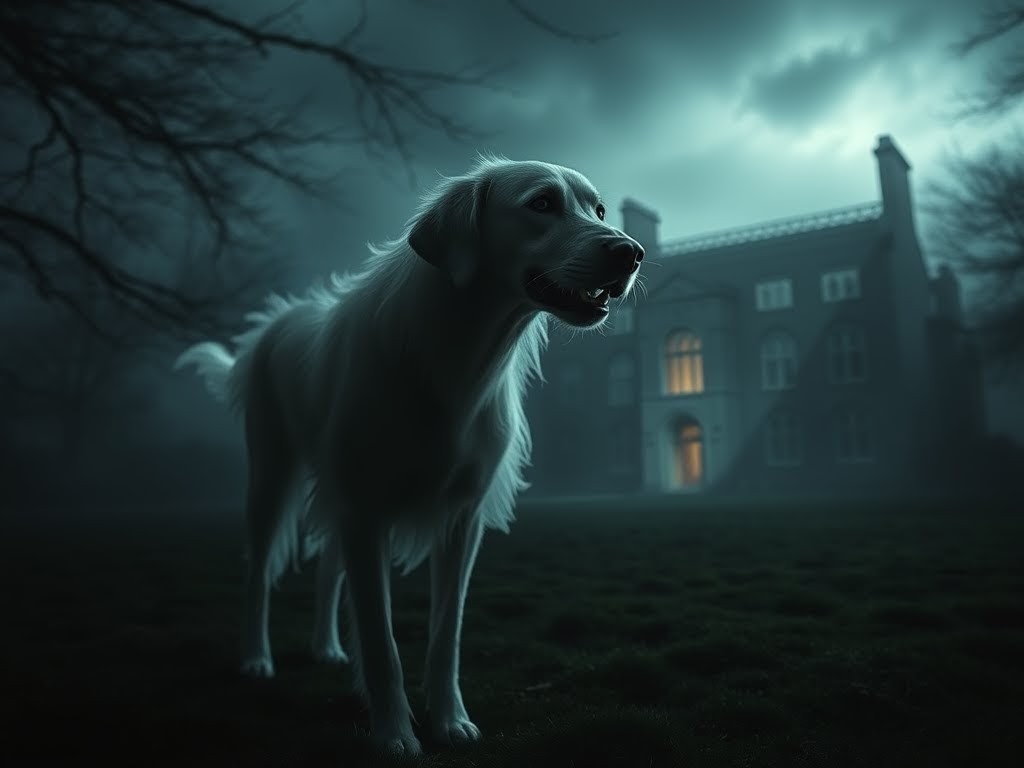
Legend has it that on moonlit autumn nights, the ghostly figure of the headless hound can still be seen roaming the paths of Felgreave Wood, retracing its final journey from Newhouse Hall back to Toothill Hall in a chilling reenactment of the tragic events that unfolded centuries ago. Local superstition holds that witnessing this phantom is an omen of grave misfortune, a belief that has persisted through the generations.
Such tales of ghostly hounds are not confined to Toothill Hall alone. The British Isles are rich with folklore featuring spectral canines, often portrayed as harbingers of doom. In Cornwall, the legend of the “wish hounds” or “yell-hounds” tells of headless dogs that roam the moors, their eerie howls piercing the night. Similarly, Devonshire speaks of the “yeth-hounds,” otherworldly creatures associated with dark omens. These regional variations underscore a shared cultural motif – the black dog as a symbol of death or misfortune – a theme that has permeated English folklore for centuries.
Archaeological insights further enrich our understanding of the area surrounding Toothill Hall. The term “toot-hill” itself suggests a lookout point, and such sites were often of strategic importance in ancient times. While specific archaeological records for Toothill Hall are limited, the presence of similar “toot-hill” sites across England indicates their use as signalling stations or defensive positions. These elevated grounds provided expansive views, allowing early inhabitants to monitor their surroundings effectively.
Legends like the Headless Hound of Toothill Hall serve as a touching reminder of how history, architecture, and folklore merge to shape the identity of a place. It reflects the human penchant for storytelling, our desire to connect with the past, and the ways in which we seek to explain the unexplainable.
Whether we view the tale as a cautionary fable, a romantic tragedy, or a supernatural mystery, it undeniably enriches the history of the region.
So, as you sit by the fire, pondering the spectral hound’s nightly journey, consider the layers of history and imagination that have woven this little tale together. The bones of it are old, buried deep in Yorkshire soil, tangled with the roots of ancient trees and the echoes of long-forgotten voices.
Was there truly a faithful dog who met such a cruel fate?
Did a heartbroken cavalier really abandon his king over love and loss?
Or is this just another one of those stories, passed from mouth to mouth, shifting with each telling until fact and folklore are indistinguishable?
Perhaps the truth doesn’t matter. Perhaps what lingers is the feeling – the hush of the woods at night, the sudden stillness of the air, the flicker of movement in the corner of your eye. It’s that moment when logic tells you there’s nothing there, but instinct begs to differ.
Maybe, just maybe, the headless hound of Toothill still runs, still searches, still carries a message long undelivered.
And if you ever find yourself walking that path between Toothill and Newhouse Hall as the mist creeps in and the wind falls silent, listen closely. If you hear the padding of unseen paws, the soft rustling of something moving just out of sight – well, best hope it isn’t looking for you.
Until next time – Stay Curious! 😉