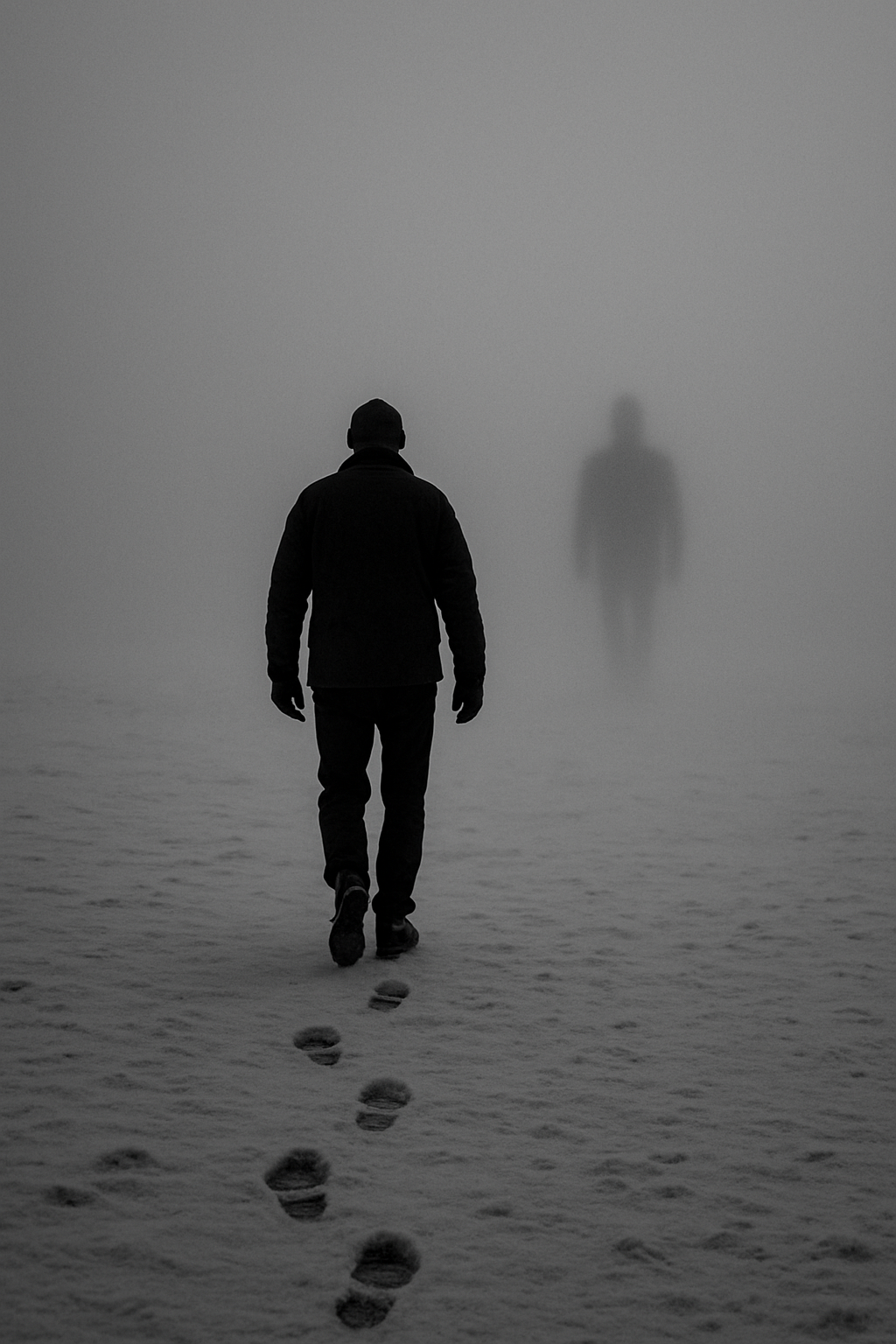
It’s a curious thing, the human brain. It protects us, deceives us, distracts us, and on occasion, it offers us company when no company should exist.
Third Man Syndrome, or the Third Man Factor, depending on who you ask, is the term given to the phenomenon where someone in extreme peril or isolation senses the comforting presence of an unseen figure.
I’m not talking about hallucination here, well not in the usual sense. Most people don’t report seeing this entity. It’s more like a palpable presence that is close enough to feel and guiding enough to follow. It whispers comfort, encouragement, advice. Sometimes it’s like a voice in the ear. Sometimes it’s a silent knowing. Almost always, it feels profoundly real.
Sir Ernest Shackleton famously described it during his 1916 Antarctic ordeal. He and two of his men were traversing the glaciers of South Georgia after their ship had been wrecked. Despite there being only three of them, all were convinced a fourth figure had been travelling with them – just out of sight. A companion who offered no conversation, cast no shadow, but felt undeniably there. Shackleton didn’t speak of it publicly for some time, fearing ridicule, but eventually mentioned it in his account, and others echoed the same experience.
You don’t need to be dragging a lifeboat across the ice to meet your Third Man. Mountaineers on Everest have felt it. Soldiers in combat zones. Shipwreck survivors. Hikers who’ve become lost, and climbers teetering close to death. Reinhold Messner sensed a benevolent figure helping him descend Nanga Parbat alone. Frank Smythe, another mountaineer, was so convinced by the presence beside him on Everest that he broke off half a biscuit and tried to share it – true story, apparently.
What’s particularly intriguing is that this presence is almost never described as hostile. Unlike psychosis or drug-induced hallucinations, which often bring terror, the Third Man is a quiet guardian. A protective shade.
Some call it a psychological coping mechanism. The mind fragmenting under pressure, conjuring a guide or witness to keep the survivor from spiralling. Others suggest it’s a dissociative trick, kind of a way for the brain to externalise a part of the self in order to survive, if that makes sense.
There are scientific papers explaining how sensory deprivation or trauma can create a sense of ‘felt presence’. Yet none of that really gets to the heart of how incredibly real the Third Man seems to those who encounter it.
Here’s where things get interesting for those of us who’ve spent years dabbling in the paranormal, the folkloric, the unseen.
The descriptions of this entity overlap alarmingly with ghost encounters, guardian angels, spirit guides, imaginary friends. Strip away the context of mountaineering or exploration, and the Third Man becomes familiar territory.
Children who’ve survived accidents often report being helped or spoken to by invisible companions.
People in mourning sometimes feel the presence of a lost loved one sitting beside them, just for a moment.
Mediums speak of protective spirits who travel with us.
Religions tell stories of guardian angels, ever-watchful, nudging us from harm’s way.
Even in folklore, there’s precedence. The ‘fetch’ in Irish tradition – the double that appears as a warning.
The silent white lady who walks the woods to lead lost children home.
In Appalachian ghost stories, there’s often a stranger at the crossroads who appears just in time. Always just in time.
So what do we do with a phenomenon that might be either a desperate neurological improvisation or a glimpse at something other?
Can it be both?
Can a human mind in peril be so powerful that it calls out and summons something from beyond, or within, or from some shared ancestral memory?
Pop culture, as ever, picks it up and runs with it. In The Waste Land, T.S. Eliot writes:
“Who is the third who walks always beside you?
When I count, there are only you and I together
But when I look ahead up the white road
There is always another one walking beside you…”
Inspired directly by Shackleton’s account, Eliot’s words capture the eerie familiarity of the phenomenon.
It’s made its way into films like Gravity, where Sandra Bullock’s character hallucinates a fellow astronaut guiding her to survival.
In The Edge, Anthony Hopkins’s character insists they must survive by thinking, by being clever, by pushing forward, almost as if he’s manifesting that presence for his companion.
In more recent television, figures appear beside the dying to help them let go, or resist.
And then there’s the quieter, everyday reports. People walking home late at night who feel a presence beside them, not malevolent but vigilant.
Car crashes where someone swears they heard a voice say, “Brake.”
The classic one is someone standing on a train platform, lost in thought, before something stops them from stepping forward. And yet, no one is there.
Sceptics will call this superstition, or brain chemistry, or sheer luck. But for those who’ve lived it, something more profound lingers.
One woman I interviewed years ago told me she’d been in a car accident, alone, and as she lay trapped in the vehicle, someone sat beside her, holding her hand. She never saw them. But when the emergency crew arrived and pulled her free, she said she could still feel their hand. She believed it was her late father.
Another man I spoke to swore blind that in the weeks after his wife died, he felt her lie down beside him each night, just briefly, before sleep took him.
These stories don’t fade. They anchor themselves in the soul.
So maybe the Third Man isn’t one thing or another. Maybe it’s a space. A liminal sliver between consciousness and spirit. A door that only opens when we are utterly alone, utterly desperate, and just barely still breathing. Maybe it’s an echo of ourselves, a psychic twin, a shade of the divine. Or maybe it’s something older, quieter, watching, waiting until it’s needed.
Whatever it is, the Third Man doesn’t ask for belief. It arrives unannounced, uninvited, and usually, unacknowledged until later. But in those fleeting moments, when all is lost, it walks beside you. A presence, a voice, a whisper of hope in the void.
And in a world where faith often falters and ghosts are dismissed, it might be the strangest and most beautiful mystery of all.




Leave a Reply