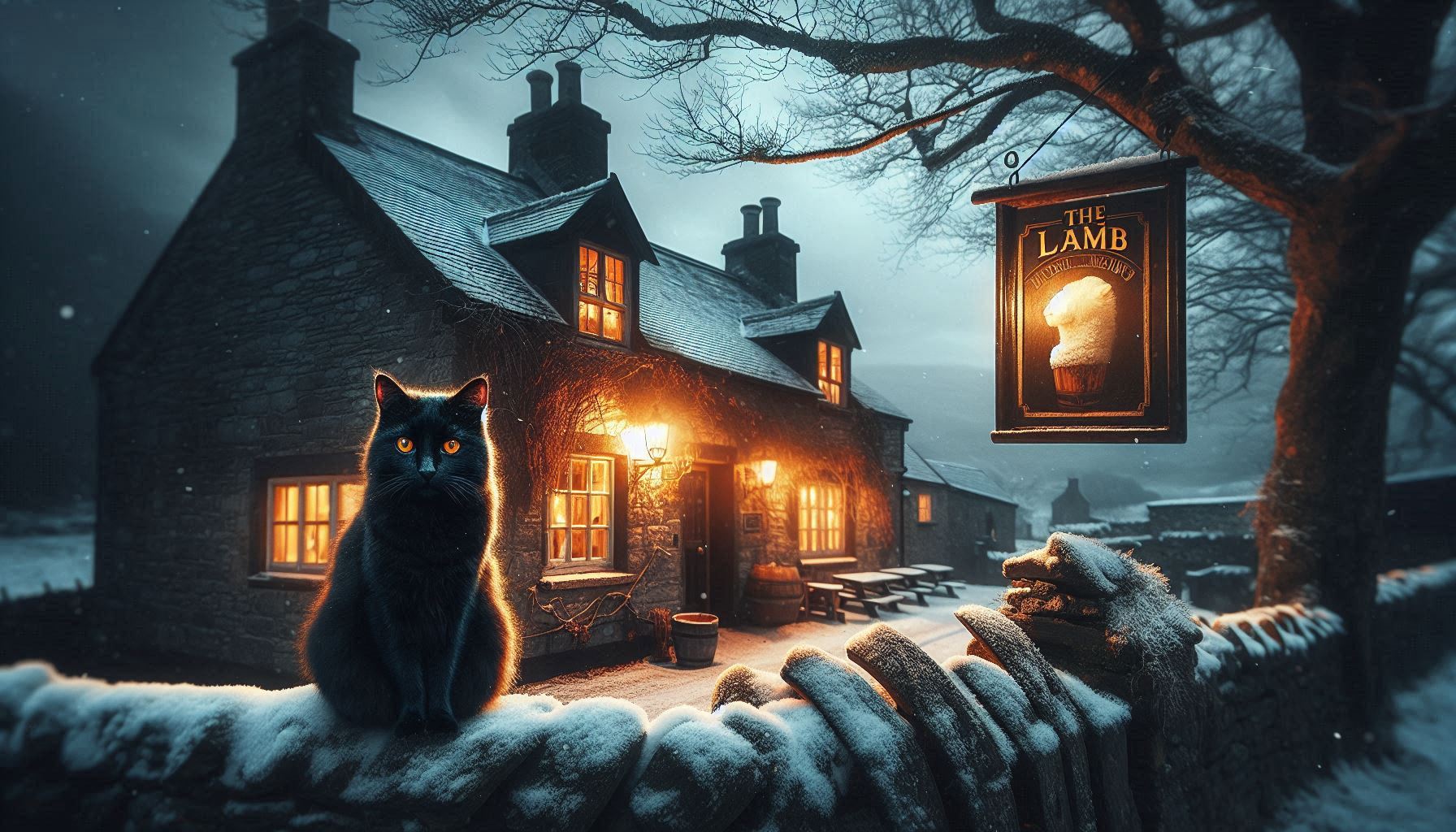
I first heard the name Matagot mentioned in a pub on the edge of nowhere. One of those places that looks half asleep and abandoned by daylight, but at night seems to suddenly blink awake with an eerie glow. The sign outside had long since surrendered its lettering to the weather, and the regulars looked much the same – faded, a bit threadbare, and full of old stories they loved telling.
It was a winter evening that smelled faintly of peat smoke and damp wood. We’d been in the area tracing some obscure superstition about cats and luck, and the landlady, a stout woman called Elsie with a nose red from years of tending to her customers, told me I ought to speak to her brother.
“He knows about them,” she’d said, lowering her voice as if the very mention might summon something best left undisturbed.
“Keeps to himself, mind. But he’ll talk to you… if he likes your face.”
Her brother, as it turned out, was a small man named Henry Naylor who lived in a cottage tucked beneath the hills a few miles away. When I arrived, the sky was sagging under the threat of snow. The place looked unremarkable – an old limestone dwelling, sagging a bit at the sides, smoke winding lazily from its crooked chimney. A black cat sat on the boundary wall, tail wrapped neatly round its paws, eyes like twin amber lamps.
“Don’t touch him,” Henry warned before I’d even knocked. He was standing behind the half-open door, pale eyes fixed on me. “That’s not a cat for petting.”
Inside, the cottage smelled of tobacco, burnt grease and something else. An odd metallic tang that made me think of blood. Henry led me to a fire that gave off more light than heat, poured a measure of whisky, and waited for me to explain why I’d come.
When I mentioned the word Matagot, his whole expression changed. Not surprise, more the tightening of someone who’s heard an unpleasant memory creak open.
“So they’re still talking about ‘im, are they?” he said.
“Well then, I suppose I’d better tell you the truth of it before someone else gets taken in.” He settled back, staring into the flames, and began his story.
It started, he said, in the winter of 1968 – the year of the great frost. His father had been the village gamekeeper then, and times were lean. Rabbits had grown scarce, pheasants vanished overnight. Something was hunting the land that wasn’t fox nor man.
Henry’s father, Arthur, had gone out one night with his lamp and his shotgun, tracking prints that seemed to shapeshift in the snow. Sometimes paw, sometimes hand. He followed them as far as the old lime kilns by the woods, and that’s where he found the creature.
“At first, he thought it were a cat,” Henry said, his voice low. “A big one, mind, sleek as sin, eyes shining green as bottle glass. But it spoke. Said it could bring him fortune, if he’d feed it proper.”
Arthur, who was no fool but clearly a desperate man had agreed. He shared the little good meat he had with the beastie and the next morning, there was a purse of silver coins by the doorstep. A week later, a stranger from town offered to buy up his surplus game for twice the usual price. Within a month, the Naylors were living better than they ever had – roast beef on Sundays, real coffee, even a new wireless.
But, as there always is in these matters, there was a price.
The cat demanded a bowl of fresh milk every night to be laid on the hearth before the last bell struck twelve. If Arthur forgot, the milk turned sour in the pail and the hens stopped laying. Once, when he missed a night altogether, the youngest of the lambs was found dead – its eyes open, its mouth full of ashes.
Arthur didn’t forget the milk after that.
Henry was a boy at the time, old enough to remember the smell of the thing when it brushed past, a musky, burning scent like singed fur. It slept on the threshold, guarding the house. Anyone who crossed it without its leave soon found themselves stricken with sudden illness, or misfortune of a peculiar sort.
“Folk thought we were cursed,” Henry said. “Truth is, we were blessed. Well, that’s what Father kept saying. Blessed by the black cat.”
But blessings, as any folklorist knows, have a habit of turning sour.
It happened the following autumn, when the fairs came through. A traveller, a woman with a French accent and a wild shock of white hair, arrived in the village selling charms and ribbons. She carried a black kitten in a wicker basket, which she called her ‘Matagot’. When she saw Arthur, she stopped dead.
“You’ve been keeping one of mine,” she said, voice sharp as frost. “And you’ve been feeding it wrong.”
Arthur, being a practical man, laughed in her face and told her to be on her way. She warned him then – three times, Henry said – to set the creature free, or the fortune it gave would turn to dust.
That night, when Arthur placed the milk on the hearth, the cat wouldn’t touch it. It sat staring at him, tail twitching, eyes wide with something close to contempt.
“Go on then,” Arthur said, reaching down. “Drink.”
The cat hissed, and every light in the cottage went out. When the light came back, Arthur was on the floor, his hand bleeding from a long, thin cut. The cat was gone.
They found him a week later at the edge of the copse, lying stiff in the frost, his eyes and mouth packed full of black fur. The purse of silver coins he’d kept in the cupboard had turned to grey dust.
Henry stopped speaking for a while then, staring at the hearth as if half expecting something to slink out from the shadows. The only sound was the slow tick of the clock and the faint patter of snow against the windows.
I asked if he’d ever seen the creature since.
“Once,” he said. “Years later. Came to me after me Mam died. Same eyes, same voice. Offered to help me keep the place. Said it could make the land fruitful again.”
“And did you accept?” He looked at me for a long moment before answering.
“Wouldn’t you?”
He smiled, thin and unpleasant. “Course, it’s not what you think. The wealth it brings isn’t always in money. Sometimes it’s luck. Sometimes it’s something else.”
He stood then, walking to the window, and I saw the shadow of the cat slip past his legs… or perhaps it was only the firelight playing tricks.
“You feed it proper,” he said softly, “and it’ll see you right. But forget, just once…” He didn’t finish the sentence.
We left soon after. I was shaken in a way I couldn’t quite explain. The cat was still on the wall as we passed, its eyes following us. We made it back to the car, started the engine. As I glanced in the mirror, for a heartbeat I thought I saw a figure standing in the road – small, stooped, something black cradled in his arms. Then it was gone.
And that might have been the end of it, had I not received a letter three weeks later. The envelope was old-fashioned, thick cream paper, sealed with black wax. Inside was a note in Henry’s uneven hand:
If you want to know more about the Matagot, come back. Bring milk…
I went, of course. Curiosity has always been my downfall.
The cottage was quiet, the door ajar. Inside, the fire had long since gone out, and the air was heavy with that same faint metallic smell. Henry was in the chair by the hearth, eyes open, expression oddly peaceful. On his lap sat the cat, licking a dark stain from its paws.
When it looked up at me, its eyes were not amber now, but a deep, unnatural gold – molten, almost human. I can’t say what held me there. Some mix of terror and awe, perhaps. Then it spoke, in a voice like wind in the flue.
“Feed me, and you shall never want.”
My body moved before my mind caught up. I fetched the milk from the pantry, poured it into a bowl, and set it on the hearth. The cat drank, slow and deliberate, tail flicking with satisfaction. Then it turned, padded towards the door, and was gone.
Henry’s body was cold. I made the necessary calls. The paramedics said heart failure. I didn’t mention the cat. Who would have believed me?
But here’s the thing – when I returned home, I found an envelope on my desk. Inside was a purse of silver coins. Old French ones, seventeenth century by the look of them. I sold one to a collector in Derby for more than enough to pay my bills for the month.The next morning, my own cat – a tabby I’d had for years – was lying stiff by the door, eyes open, mouth full of black fur.
You might expect that to have put me off entirely, but writers are strange creatures. We chase stories even when they snarl.
I began researching the Matagot in earnest, tracing its roots back through Provençal folklore. A spirit cat, they said, sometimes black, sometimes golden. It could take the form of a rat, a fox, even a serpent.
The word itself comes from mata, to kill, and got, meaning good fortune – a deadly blessing.
In the old tales, a traveller might find such a creature by crossroads at midnight. If he took it home, treated it well, and fed it the first morsel of his meal each day, it would make him rich. But neglect it, and ruin would follow.
I read accounts from the 1500s describing villages that vanished overnight, their wealth turned to ash. One legend told of a priest who tried to exorcise a Matagot and was found days later, face contorted, his cassock crawling with black hairs.
Of course, you could dismiss these as medieval superstitions. I might have done the same, if it wasn’t for what happened next.
It was late one night, weeks after Henry’s funeral. I’d been writing, the only light from the lamp on my desk. The coins lay in a neat little pile. Something moved in the corner. Just a flicker, a suggestion of motion. I looked up, expecting to see the curtains stirring but there was nothing.
Then came the sound. A faint purr, low and steady. The temperature dropped, and the shadows thickened. I could smell it again – that singed fur and blood scent, unmistakable.
A voice whispered just behind my ear.
“Feed me.”
The jug of milk I’d brought from the kitchen meant for my tea trembled in my hand. I set it down on the desk without thinking.
The air shimmered.
It appeared.
Sleek, black, perfect.
Its eyes glowed like dying coals. It rubbed against my arm, and where it touched, the skin burned faintly.
“Feed me,” it said again, softer this time. “And you shall never want.”
I don’t remember agreeing. I only remember the next morning, the bowl empty, the coins gleaming brighter than before.
Since then, things have changed. My work sells better than it ever has. Editors who once ignored my letters now ask for more. I’ve not wanted for money, or luck, or inspiration.
But every night, I hear it moving about the house. Sometimes I find paw prints in the dust – wet, though there’s been no rain.
Once, I woke to find it sitting on my chest, staring down at me, its breath cold against my face.
I tried to stop feeding it once, to see what would happen. The next day, the boiler broke, and every light in the house flickered out. That night, I dreamt of Henry’s father, his mouth full of black fur.
So I pour the milk. Every night, just before midnight, I set the bowl on the hearth. It never stays full for long.
You may think I’m mad, and perhaps I am. But there’s one last thing I should mention before you dismiss this story entirely.
Yesterday morning, the post arrived. Among the usual bills and circulars was a small parcel wrapped in brown paper. No return address. Inside, another purse of silver coins. And beneath them, a single black hair, thick as thread.
So if you’re reading this. If you find yourself at some forgotten inn, or drawn to a cottage with a cat on the wall, remember what I’ve told you.
Feed it well, and it will bless you. But if ever you tire of feeding it, or think to turn it away, do so before midnight. For when the last stroke of the bell fades and the bowl stands empty, it will come looking for you instead.
And it always finds its way in.




Leave a Reply