There are some people who slip quietly into history. Others kick the door down, throw glitter into the air and refuse to leave.
Samuel Johnson of Gawsworth was one of those people. Not the Samuel Johnson. Not the dictionary writer whose stern face still peers out from schoolbooks and libraries. No, this was a different Samuel Johnson altogether. He was a fiddler, a playwright, a dancing master, a wit, a professional fool and – depending on who you ask – the last true jester in England. History remembers him as Samuel Johnson. The people of Cheshire remembered him as Maggoty Johnson. But he preferred to be known by an altogether grander title:
Lord Flame.
Pull up a chair. This is a strange one. Even by my standards.
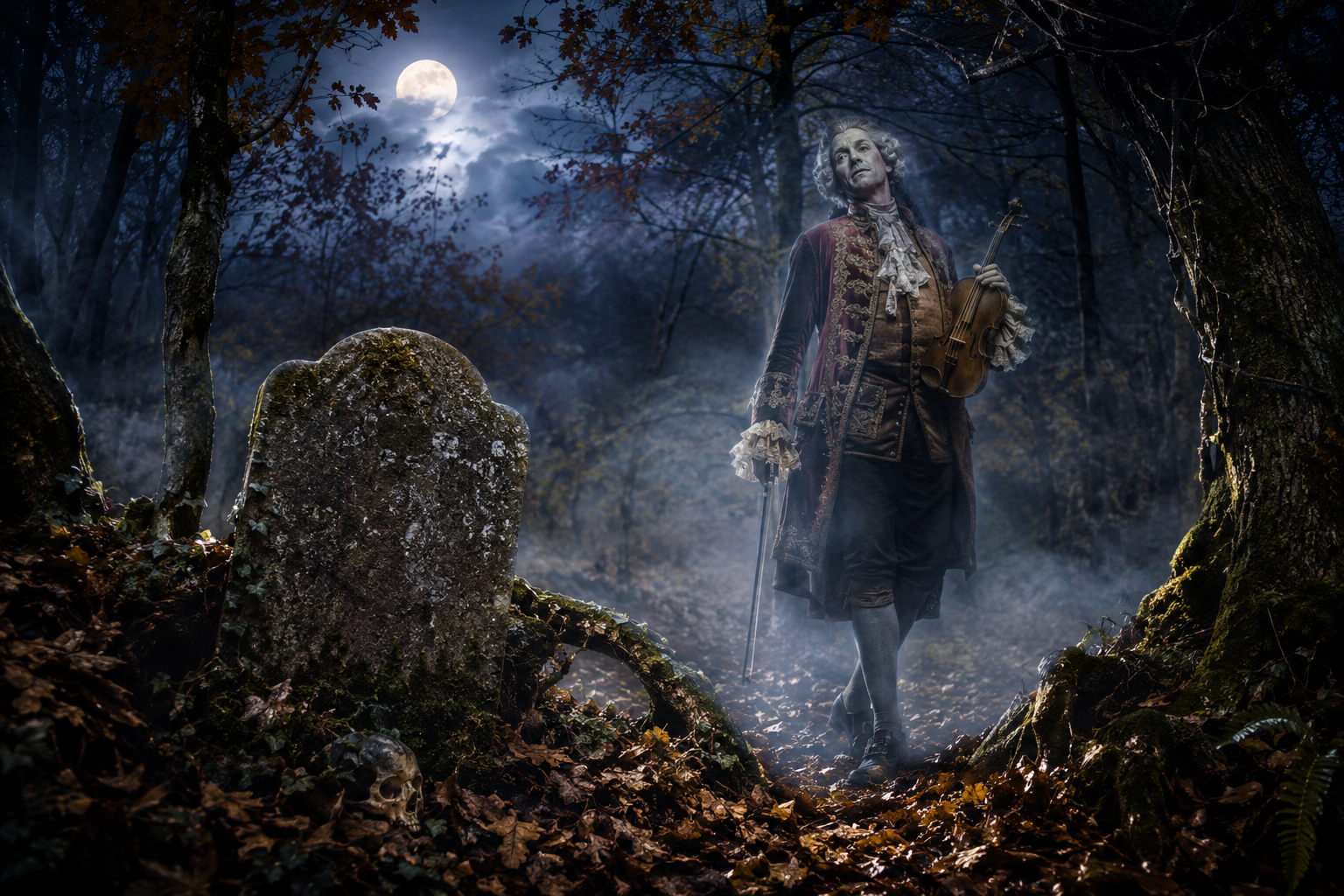
In the rolling countryside of Cheshire, not far from the ancient timber-framed beauty of Gawsworth Hall, there lies a small patch of woodland known as Maggoty Wood. It is not a large wood. You could easily miss it. Yet hidden among the trees is one of the oddest graves in England.
The stone belongs to Samuel Johnson, who died in 1773 at the grand old age of eighty-two. The inscription describes him not as a farmer, merchant or gentleman, but instead proudly announces:
“Afterwards ennobled with the grand title of Lord Flame.”
It all sounds quite ridiculous. And that was precisely the point. Johnson had spent his life making people laugh, shocking audiences and turning himself into a living performance. Even in death he remained committed to the act.
Born in 1691, Johnson earned his living as a dancing master, teaching the sons and daughters of respectable families how to move with grace and dignity. Yet there was far more to him than minuets and manners. He was a poet. A musician. A playwright. A born performer… But most of all, he possessed that dangerous quality found in many great eccentrics:
Johnson genuinely believed the world would be more entertaining if everyone would just behave a little bit less sensibly.
In 1729 he burst onto the London stage with a play called ‘Hurlothrumbo’, or ‘The Supernatural’, and even by eighteenth-century standards it was gloriously absurd. Critics struggled to decide whether it was genius, nonsense or some impossible combination of both. One observer described it as unmatched in its “bombast and turgid nonsense”, yet audiences flocked to see it night after night.
The play became one of the theatrical curiosities of the age. Johnson himself appeared in the production. His character was called Lord Flame. The role was flamboyant, outrageous and larger than life and the audience loved it. So did Johnson – perhaps a little too much. Because somewhere along the line, the distinction between actor and character appears to have blurred. Lord Flame would step off the stage accompanied by cheers and encores – and Samuel Johnson would never quite return.
When his theatrical fame faded, Johnson retired to Gawsworth. There he became a local celebrity. He entertained visitors, played music, recited poetry and delivered witticisms at country gatherings. Some accounts suggest he enjoyed the patronage of the local gentry and lived comfortably enough in his advancing years. But there was another side to his reputation. A side that seemed a little bit darker.
People began calling him “Maggoty.”
Today the word sounds unpleasant. Macabre even, but in the eighteenth century it meant something slightly different. To have “maggots in your brain” was to be full of odd notions, peculiar ideas and eccentric habits. It described someone delightfully strange. Someone unpredictable. Someone who danced to music nobody else could hear and Samuel Johnson embraced the description, just as he seems to have embraced almost everything.
Stories began to gather around him, villagers whispered about his eccentric routines. Some claimed he wandered the woods at night. Others insisted he was never happier than when performing before a bewildered audience.The boundary between the man and the legend steadily disappeared and, as so often happens, folklore moved in to occupy the gaps left by history.
Then came his final performance.
Most people are buried in churchyards but Samuel Johnson wanted no such thing. According to local tradition, he climbed onto the roof of Gawsworth New Hall, drew a bow and fired an arrow into the landscape. Where the arrow landed, he declared, would be his grave. (And before you mutter ‘shades of Robin Hood’ , I agree. We all know how stories blend into one another in the murky folkloric realms.)
Whether that really happened is impossible to say. What we do know is that when he died in 1773 he was buried exactly where he wanted to be: in a quiet woodland clearing far from consecrated ground, but even that was not enough. Johnson composed his own epitaph and it is witty, vain, funny. And it is oddly touching.
The inscription celebrates him as poet, musician, player and dancing master, while making jokes about people stealing his bones after the resurrection, because only Samuel Johnson could turn his own grave marker into a comedy routine. And there is something else about the place which is harder to explain…
When you visit Maggoty Wood on a grey autumn afternoon the atmosphere seems to change. The trees crowd close together. The sounds of the modern world seem distant. The grave sits quietly among leaves and shadow, looking less like a burial site and more like the final scene of a forgotten fairy tale. So it is perhaps unsurprising that ghost stories followed.
Local tradition holds that Maggoty Johnson never entirely left his woodland retreat. Walkers have reported strange feelings among the trees. Others speak of an unseen presence. Some claim to have glimpsed a figure moving between the trunks before vanishing when approached. And whether ghost, imagination or folklore given shape by the landscape, the stories persist.
I think that would have pleased him enormously. After all, what greater achievement could there be for a performer than to remain part of the show two hundred and fifty years after the curtain fell?
Samuel “Maggoty” Johnson occupies a rare place in English folklore. Most legends begin as stories. He began as a real man. Yet the longer you look at him, the more impossible he becomes. Playwright. Fiddler. Dancing master. Jester. Poet. Ghost. Lord Flame.
Maybe he was England’s last fool. Maybe he was its first performance artist. Or maybe he was simply a man who understood something the rest of us forget.
Life is short.
But history is much, much longer.
And if you’re going to be remembered, you may as well make sure nobody can quite decide whether you were brilliant or completely mad.
Samuel Johnson managed both.Which is why, all these years later, the trees of Maggoty Wood still whisper his name.