Some places seem almost designed to keep secrets.
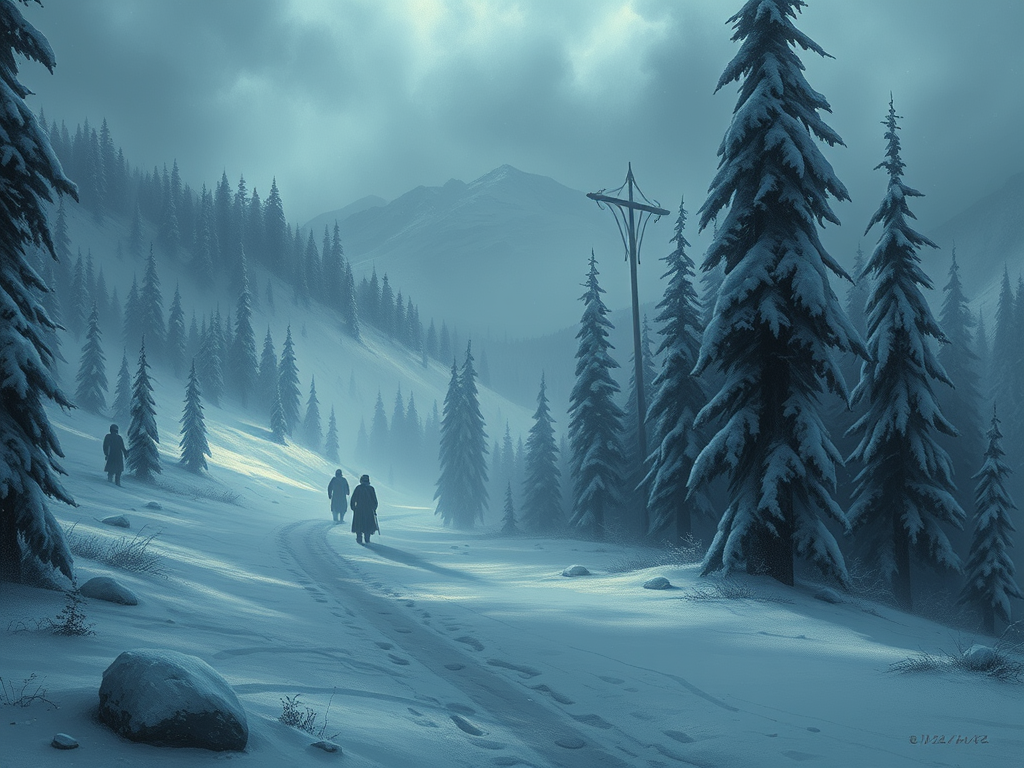
High above the Norwegian city of Bergen lies Isdalen – the Ice Valley. Hemmed in by steep, rocky slopes and cloaked in pine forest, it is a place where the weather changes without warning, mist gathers in the hollows and the wind whistles through the trees. Today, hikers speak of its strange atmosphere, earning it the nickname “Death Valley” after a number of accidents and suicides over the years.
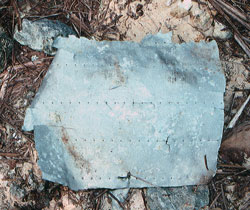
It was here, on 29 November 1970, that a father and his two daughters made a discovery that would become one of Europe’s most enduring mysteries. As they walked along a remote footpath, they noticed something blackened among the rocks. Drawing closer, they realised it was the burned body of a woman. The scene was deeply unsettling, much of her clothing had been destroyed by fire and around her lay melted plastic, a broken umbrella, rubber boots, jewellery and several bottles.
The smell of petrol lingered in the cold air. Although her body had been badly burned, investigators quickly realised something was terribly wrong. This was no ordinary accident. The woman carried no identification. There was no handbag. No passport. No purse. Every label had been carefully removed from her clothing. Whoever she was, someone had gone to considerable effort to make sure she could never be identified.
Or perhaps she had done it herself.
The Norwegian police immediately launched what would become one of the country’s largest investigations. The autopsy only deepened the mystery. The woman had died from a combination of severe burns and carbon monoxide poisoning, suggesting she had still been alive when the fire began.
Toxicology tests also revealed a large quantity of sleeping tablets in her stomach. Bruising around her neck raised the possibility that she had suffered some form of injury before the fire, although investigators could not determine whether it was inflicted before or during her death. The official conclusion was cautious. Her death could not be explained with certainty.
Within days, police made an extraordinary breakthrough.
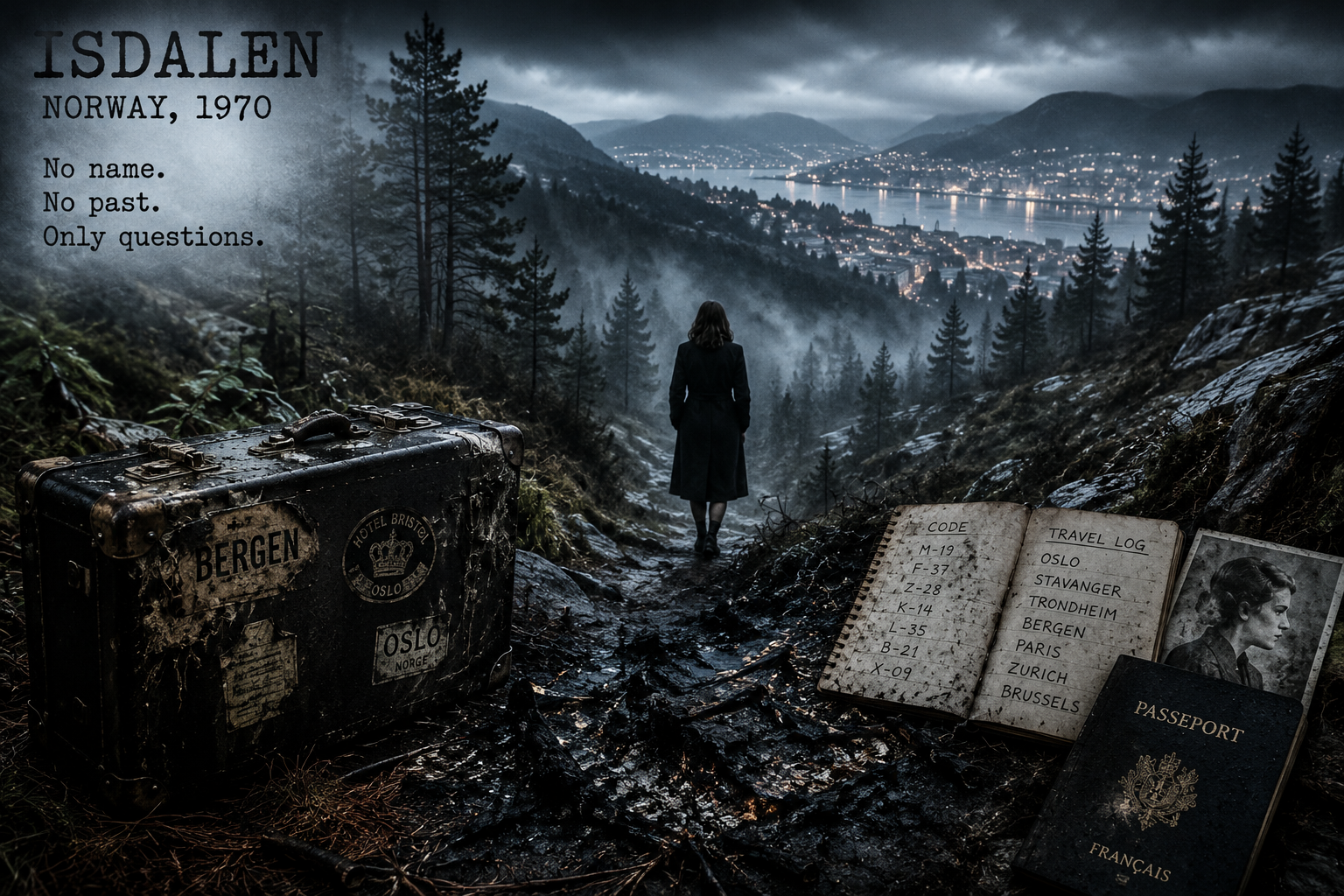
At Bergen railway station, employees remembered two unattended suitcases left in a luggage locker. Inside they found clothing, wigs, cosmetics, prescription glasses, maps, spoons, a notebook and a substantial amount of cash in several currencies. Crucially, they also discovered fingerprints matching those of the dead woman. The suitcases belonged to her.
Yet rather than solving the mystery, they transformed it into something far stranger. The clothing labels had all been removed. The cosmetics appeared carefully selected to alter her appearance. Several wigs suggested she regularly changed her hairstyle. Most curious of all was the notebook.
Its pages contained seemingly meaningless combinations of letters and numbers. Eventually investigators realised they were not random at all. The notebook was a coded record of her travels. By comparing hotel registrations, railway tickets and passport records, police painstakingly reconstructed her final months.
The unknown woman had travelled extensively throughout Norway and Europe. She had visited Oslo, Bergen, Stavanger, Trondheim and several smaller towns. She had also travelled through France, Switzerland, Belgium and Germany. Each time she checked into a hotel she used a different name. Among the aliases were Geneviève Lancier, Claudia Tielt, Vera Jarle and Fenella Lorck.
In total, investigators uncovered at least eight false identities, supported by multiple fake passports. Each identity carried subtle differences. Different hairstyles. Different professions. Different nationalities.Yet witnesses consistently described the same elegant woman.
She was well dressed. Perhaps in her thirties or early forties. Dark-haired, though sometimes blonde. Intelligent. Reserved. She spoke several languages fluently, including German, French and English, often with an accent nobody could quite place.
Hotel staff later remembered her unusual habits. She frequently requested rooms overlooking entrances or streets. She often changed rooms unexpectedly. She avoided speaking to other guests. Before leaving, she would carefully wipe surfaces and insist that staff not clean her room until after her departure.
These are precisely the kinds of details that have fuelled decades of speculation. Was she simply an intensely private traveller? Or someone trained never to leave traces behind?
As investigators retraced her movements, stranger stories emerged. Several witnesses reported seeing the woman accompanied by unidentified men. Others described heated conversations conducted in foreign languages. One taxi driver recalled driving her towards the very valley where her body would later be found.
Then there were the sightings around military installations. During the height of the Cold War, Norway occupied a strategically important position on NATO’s northern frontier with the Soviet Union. Some witnesses claimed the unknown woman had shown unusual interest in naval facilities and military activity. None of this proved she was a spy. But it ensured that the theory would never disappear. Indeed, Norway’s domestic intelligence service became involved in the investigation, though much of its work remains classified.
If she had been involved in espionage, she would hardly have been unique. The Cold War was fought as much with secrets as with soldiers. Across Europe, intelligence officers travelled under false identities, cultivated multiple personas and crossed borders carrying forged documents. Hotels, railway stations and anonymous rented rooms became the backdrop to a conflict in which very little was ever visible on the surface. Against that backdrop, the Isdal Woman seemed to fit the pattern almost too perfectly.
And yet there were problems. Professional intelligence officers rarely behaved recklessly. The aliases she used contained obvious similarities. Several of her disguises were surprisingly modest. No espionage agency has ever claimed her. No archival release has revealed her identity. No former intelligence officer has convincingly explained her role. The evidence hints at espionage. It never proves it.
Other theories have been proposed. Perhaps she was a courier. Perhaps she was involved in smuggling. Perhaps she belonged to an organised criminal network. Some have suggested she was fleeing an abusive relationship or attempting to disappear voluntarily. Others believe she simply suffered from severe mental illness. Each explanation accounts for some aspects of the evidence. None explains everything.
One of the greatest frustrations for investigators was the absence of modern forensic science. DNA profiling did not yet exist. International databases were primitive. Fingerprint records were incomplete. Much depended upon witness testimony and painstaking detective work.
Despite interviewing hundreds of people across Europe, police never identified her family. No one came forward to report her missing. It was as though she had appeared from nowhere.
Eventually, with no name to place upon the grave, she was buried in Bergen beneath a simple headstone. The mystery might have remained there forever. But history had other ideas.
Decades later, renewed investigations brought fresh technology to the case. Forensic experts re-examined preserved evidence using modern DNA analysis. Isotope testing of her teeth suggested she had probably spent her childhood in or around southern Germany before moving elsewhere during adolescence, consistent with someone displaced by the upheavals of the Second World War. Her distinctive dental work also pointed towards treatment carried out by dentists trained in central Europe. These findings narrowed possibilities.
They did not reveal her name.
In 2016, the public broadcaster NRK joined forces with the BBC to produce a major investigation and podcast, Death in Ice Valley. Journalists tracked down surviving witnesses, examined newly released files and followed fresh forensic leads. Their work generated worldwide interest and prompted new tips from members of the public. Yet despite all the renewed attention, the central question remained stubbornly unanswered.
Who was she?
The Isdal Woman occupies a curious place among unsolved mysteries. Unlike Jack the Ripper or the Zodiac Killer, there is no obvious villain to pursue. Unlike Amelia Earhart, there is no famous life to reconstruct. Instead, we are left with something quieter.
A woman who crossed Europe carrying several names but perhaps belonging to none of them.
Someone who travelled constantly, trusted almost nobody and died alone in a remote Norwegian valley.
Whatever her true story may have been, it ended without anyone who loved her stepping forward to claim her.
Perhaps they never knew where she went. Perhaps they were unable to speak. Or perhaps they, too, lived lives built upon secrets.
There is something profoundly human about that uncertainty. For all the speculation surrounding spies, secret codes and Cold War intrigue, the greatest mystery is also the simplest.
Every person has a name. Every life leaves traces in the memories of others. Yet somehow this woman slipped almost entirely between the cracks of history.
Half a century later, the valley still keeps its silence. The pine trees whisper in the wind. The mist still gathers among the rocks.
And somewhere within those shadows remains the story of a woman who travelled across Europe under many identities…
…and whose real one may never be known.