Content Warning
This article discusses historical murder, poisoning, executions and violence. It also explores the social and legal circumstances faced by women in seventeenth-century Italy, including themes of domestic abuse and coercive marriages.
As with many stories from this period, some details have become entwined with folklore and later retellings. Wherever possible, this article distinguishes between documented historical evidence and enduring legend.
Reader discretion is advised.
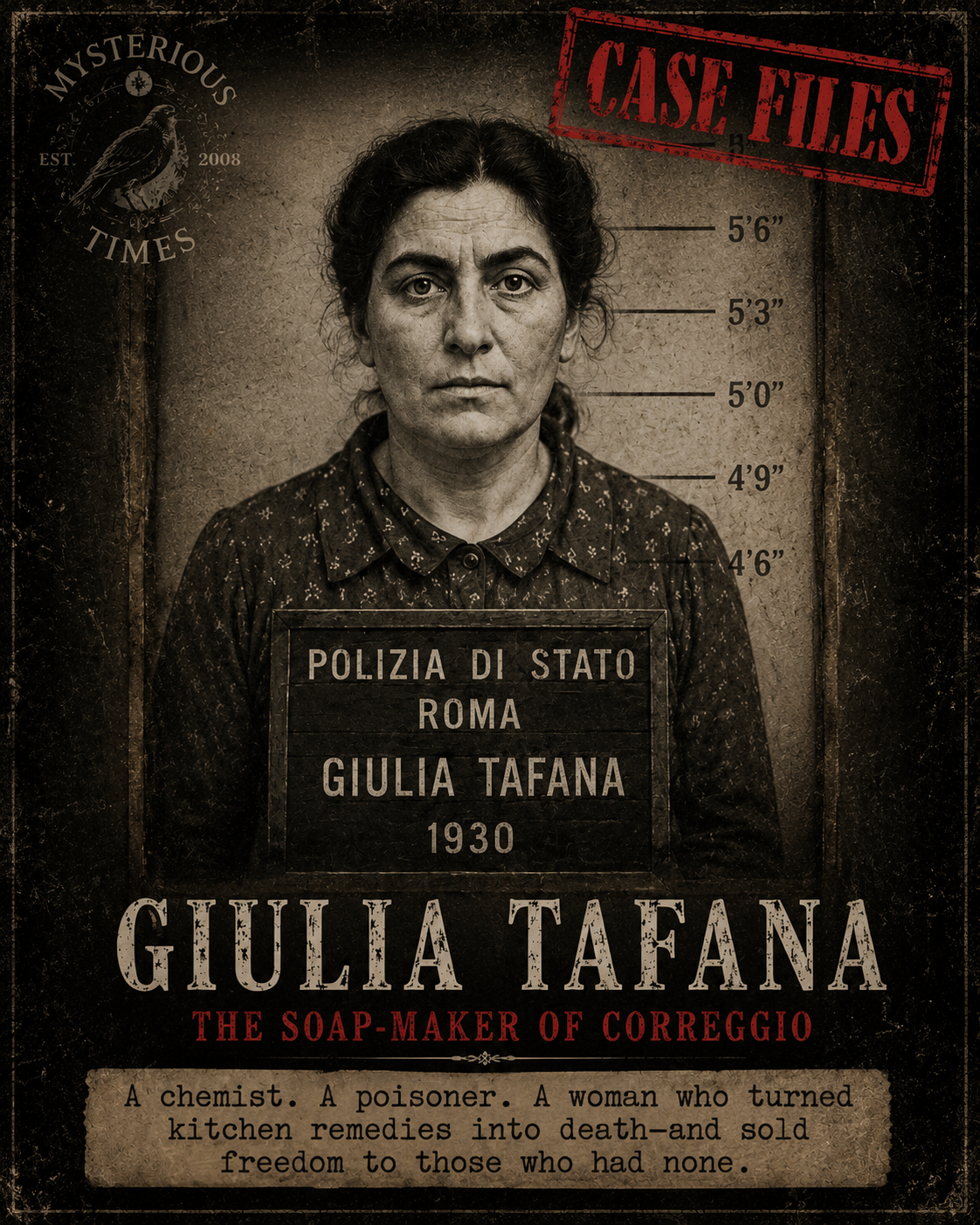
Todays story concerns a woman who was credited with the dubious title of one of histories most prolific serial killers. But as we know, history has a habit of polishing its villains until they gleam. The truth becomes tangled with rumour, rumour becomes folklore, and before long the real person disappears beneath centuries of retellings. Few women demonstrate this better than Giulia Tofana.
Pull up a chair…
Depending on who is telling the story, she was either one of history’s most prolific serial killers, a compassionate chemist offering desperate women their only escape, the head of a vast criminal conspiracy, or little more than a name attached to someone else’s crimes.
She has been credited with the deaths of anything from a handful of men to more than six hundred. She has been called a murderess, a feminist icon, a folk heroine and, perhaps most intriguingly of all, the patron saint of unhappy wives. The last title, of course, was never official. No church would ever canonise a poisoner. Yet in the folklore of southern Italy, and later in popular culture, that is almost exactly what she became.
The reality, as always, is considerably more complicated.
Seventeenth-century Italy was not a forgiving place for women. Marriage was rarely about love. It was a contract negotiated by families, property and status. Once married, a woman had remarkably few legal rights. Divorce was virtually impossible. Domestic violence was often tolerated as a private matter. An abusive husband was not necessarily seen as a criminal – in fact, he was frequently regarded as the master of his household.
Imagine living in that world. Imagine knowing that your future had already been decided, that your husband could control your finances, your movements and often your safety. Imagine there being no refuge, no legal protection and almost no chance of beginning again.
Against that backdrop, stories about Giulia Tofana begin to make a certain kind of sense. The traditional account tells us that she was born in Palermo, possibly the daughter of another alleged poisoner, Teofania d’Adamo, who was executed in 1633. Whether this family connection is genuine remains uncertain – modern historians have questioned almost every aspect of the story, suggesting that later writers merged several different women into one legendary figure. Indeed, Craig Monson’s extensive archival research argues that the woman later remembered as “Giulia Tofana” was actually Giulia Mangiardi, whose life became hopelessly entangled with later poisoning scandals.
What is much less disputed is the existence of Aqua Tofana.
This infamous poison was almost certainly real. Colourless. Tasteless. Slow acting. Modern toxicologists believe it probably contained arsenic alongside other toxic compounds, perhaps lead and belladonna. Rather than killing immediately, it mimicked the symptoms of natural illness. A victim might simply appear to decline over several days or even weeks, which made it, in an age before forensic science, an almost perfect weapon.
The poison itself carried an extraordinary disguise. It was allegedly sold in tiny cosmetic-style bottles bearing the image of Saint Nicholas and labelled as “Manna of Saint Nicholas.” To anyone inspecting the bottle, it appeared to be either perfume, devotional oil or medicinal cosmetics.
This irony has never been lost on storytellers.
A deadly poison hidden beneath the image of a saint who was famous for protecting vulnerable women became one of history’s darkest pieces of symbolism.
But this is where history begins giving way to folklore.
According to the most famous version of events, Giulia sold her poison almost exclusively to women trapped in violent or unbearable marriages. She supposedly instructed them to administer the liquid over several meals, allowing the husband to weaken gradually while appearing to succumb to illness.
The first dose produced mild discomfort. The second resembled influenza. The third left the victim desperately ill. The fourth finished the job. By then the unfortunate man had often had enough time to make peace with God, write his will and receive the last rites, making his death appear entirely natural. Whether this sequence was genuine medical observation or simply part of the legend is impossible to know, but it became central to the Aqua Tofana myth.
Then there is the astonishing claim that has echoed through nearly four centuries.
Six hundred dead husbands.
It is a wonderfully dramatic figure. It is also almost certainly impossible to verify. No contemporary records support such an enormous number of victims. The figure seems to have grown as later writers embroidered the tale, repeating increasingly sensational accounts until they became accepted as fact. This is why modern historians urge considerable caution whenever these numbers appear.
The story of Giulia’s downfall also varies depending on who is telling it. One legend says a nervous customer lost her courage after slipping poison into her husband’s soup and knocked the bowl from his hands before he could eat it. Another claim is that suspicious authorities eventually uncovered the network. My personal favorite claims is that Giulia sought sanctuary inside a convent, where she continued making poison until rumours spread that she had contaminated Rome’s water supply. An angry mob demanded her arrest. Yet others insist she confessed under torture before being executed alongside her associates. Yet archival evidence suggests something rather different.
Craig Monson argues that Giulia herself may actually have died peacefully in 1651, years before the famous executions connected with the Spana poison trials in 1659. Those later prosecutions centred upon Girolama Spana and several other women, whose activities became retrospectively merged with Giulia’s own story, and this confusion has fuelled centuries of mythmaking.
Victorian crime writers adored her. True crime authors repeated increasingly colourful tales. Novelists transformed her into everything from a calculating mastermind to a tragic avenger. But the real woman quietly disappeared beneath her own legend.
Was she a serial killer?
The answer to that is surprisingly simple. If she knowingly manufactured poison that killed innocent people, then morally it is difficult to escape that conclusion.
But was she also a saviour?
Quick answer? It depends entirely upon whose story you choose to tell. Modern readers naturally ask whether the husbands deserved their fate. Some undoubtedly were abusive. Others may simply have been… inconvenient.
The historical record rarely preserves the voices of either the women or the men. What survives instead is a collection of accusations, confessions extracted under torture, church records and centuries of embellishment. That silence leaves enormous spaces for folklore to grow. And grow it did.
Today Giulia Tofana has become something almost mythical. Across social media she is celebrated as a proto-feminist icon. Memes jokingly refer to her as “the girls’ girl of the seventeenth century.” Others call her the “patron saint of women with terrible husbands.” These are modern inventions, of course, but they reveal something fascinating. Every generation seems to reshape Giulia into whatever it most needs her to be and that tells us less about Giulia than it does about ourselves because history is rarely black and white.
Giulia Tofana almost certainly existed.
Aqua Tofana almost certainly existed.
Women trapped in impossible marriages certainly existed.
Beyond that, certainty begins to evaporate. Was she a ruthless entrepreneur dealing in death? A criminal who exploited desperate women? A reluctant supplier for those with nowhere else to turn? Or a largely ordinary woman whose life became absorbed into one of Europe’s greatest true crime legends?
We may never know, but what we can say is this: Four centuries later, Giulia Tofana still occupies that uneasy place where history and folklore meet. She reminds us that monsters are often made as much by storytellers as by their deeds, and that the most enduring legends are rarely those with the clearest evidence.
Sources:
Craig A. Monson, The Black Widows of the Eternal City: The True Story of Rome’s Most Infamous Poisoners (University of Michigan Press, 2020).
Mike Dash, “Aqua Tofana: Slow-Poisoning and Husband-Killing in 17th-Century Italy.”
Philip Wexler (ed.), Toxicology in the Middle Ages and Renaissance.
Folger Shakespeare Library, “Women and Early Modern Poison” (discussion of the myths surrounding Aqua Tofana).