If you’ve followed us beyond the hedge, walked the hidden paths and paid your respects to the Fairy Queen, there’s only one place left to go.
Home.
Not your home. Theirs.
Long before stories spoke of fairy kingdoms hidden beneath green hills, the ancient Britons imagined another world that existed alongside our own. It wasn’t a heaven in the Christian sense, nor was it a place of punishment. It was older than both. A land of eternal youth, endless feasts, shining halls and timeless beauty, where death held little sway and the boundaries between myth and reality became wonderfully blurred. The Welsh called it Annwn.
Pronounced ‘AN-noon’, Annwn appears throughout medieval Welsh literature, most famously in The Mabinogion, yet its roots almost certainly reach far deeper into Britain’s pre-Christian past.
By the time monks committed these stories to parchment, the traditions they recorded had already been whispered beside hearths for centuries. Annwn was never easy to describe because it refused to behave like an ordinary place. Sometimes it lay beneath the earth. Sometimes beneath a lake. Sometimes beyond the western sea. Sometimes it could be reached simply by crossing the wrong hill at the wrong time. Like so much of Britain’s folklore, its geography was deliberately uncertain. After all, if another world truly existed beside our own, why would it stay in one place?
Its ruler was Arawn, a king remembered not as a devil or tyrant but as a noble lord whose realm mirrored our own in strange and unsettling ways. One of the most celebrated tales tells how Prince Pwyll of Dyfed accidentally offended Arawn while hunting. Rather than punish him, Arawn proposed something extraordinary. The two men exchanged places for an entire year. Pwyll ruled Annwn and Arawn ruled Dyfed. Neither man’s subjects noticed the difference. When the year ended, both kingdoms were restored, and the two rulers parted as lifelong friends. It’s a remarkable story because it presents the Otherworld not as somewhere monstrous, but as somewhere familiar. Almost.
That single word echoes through countless fairy tales. Almost the same. Almost human. Almost home.
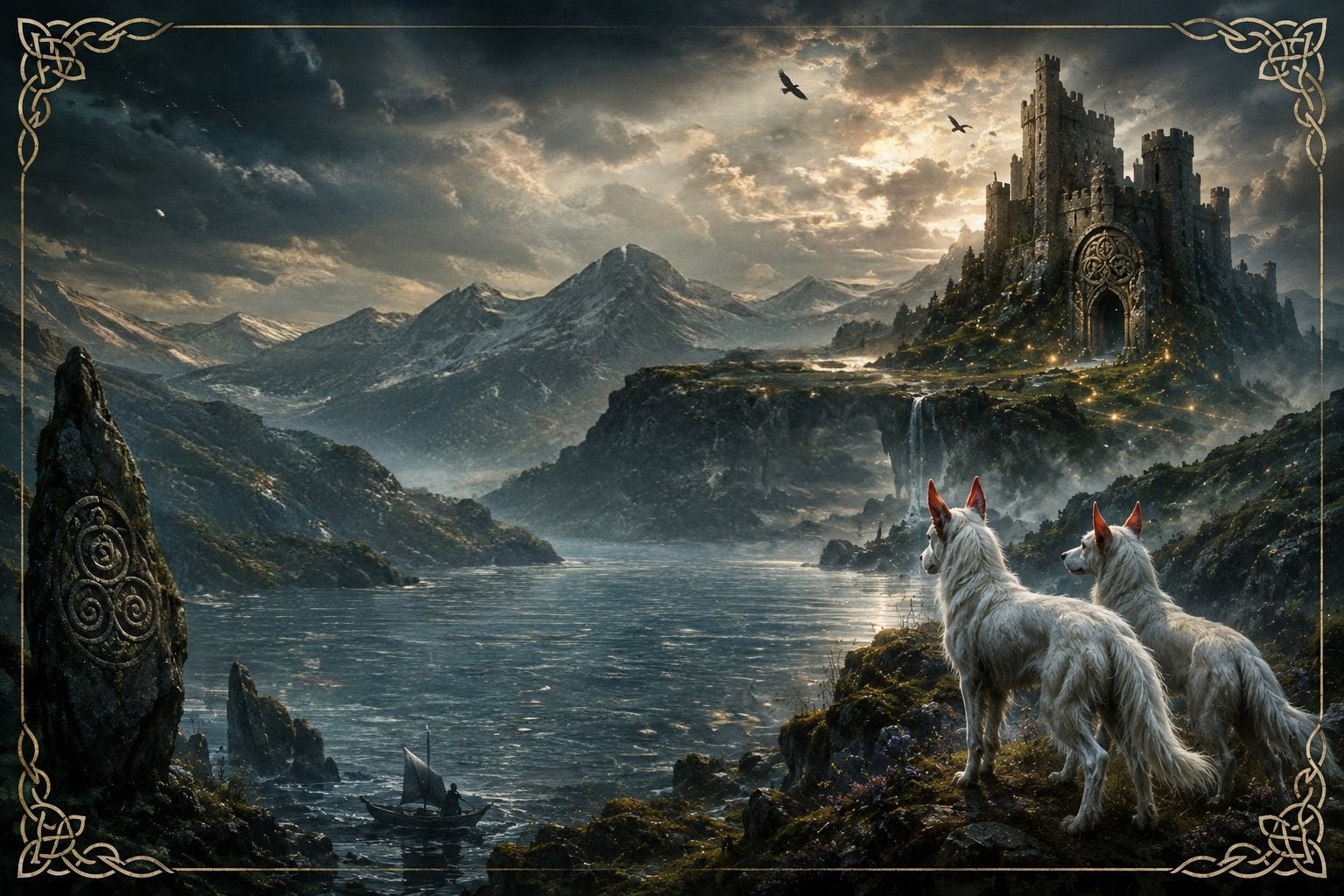
Nowhere is Annwn’s strangeness better captured than in its hounds. The Cŵn Annwn are among the oldest supernatural creatures in British folklore. Unlike the great black dogs that haunt lonely lanes and churchyards, these hounds are dazzling white with brilliant red ears, colours that in Celtic tradition often mark beings from the Otherworld. Their cries were said to drift across lonely hillsides or echo through mist-filled valleys, growing quieter the nearer they came.
To hear them was unsettling enough. To follow them was another matter entirely because the Cŵn Annwn didn’t deer or wolves, they hunted wandering souls.
In later folklore they became entwined with the Wild Hunt, that ghostly procession said to sweep across Britain’s skies on stormy nights. Depending upon where you lived, its leader might be Gwyn ap Nudd, Herne the Hunter, King Arthur or some other mysterious figure altogether. The names changed, the hunt didn’t, and always there were the hounds.
Like so much folklore, these stories seem to have flowed together over the centuries, each generation adding another thread. Fairy processions merged with ghostly riders. Ancient gods became fairy kings. Local hills became entrances to hidden kingdoms. It is impossible to say where mythology ends and folklore begins because, for the people telling these stories, there was never a clear dividing line. Everything belonged to the same enchanted landscape.
Annwn wasn’t reached by magic spells. It was reached by crossing boundaries. A misty ford, a forgotten cave, a hollow hill, a lonely island, a still lake – the threshold mattered much more than the destination.
But that idea should sound familiar by now. Throughout this week we’ve wandered along fairy roads, paused beneath solitary hawthorns and crossed ancient hedgerows. Again and again we’ve found the same theme emerging. The countryside wasn’t divided simply into fields and forests. It was divided into ‘here’ and ‘elsewhere’. The hedge marked one boundary. Annwn lay beyond another.
Maybe that’s why time behaves so strangely in stories of the Otherworld. A traveller joins a feast beneath a green hill and returns to discover decades have passed. A beautiful stranger invites a mortal to ride away, only for a lifetime to vanish in what seemed like an afternoon. These tales appear across Britain and Ireland with astonishing consistency, reminding us that the Otherworld obeyed its own rules. It wasn’t merely another country. It was another way of experiencing time itself.
Modern readers often ask whether people genuinely believed Annwn existed and again, that’s probably the wrong question. Folklore isn’t a map. It’s a way of understanding the world. Annwn gave meaning to ancient burial mounds whose builders had been forgotten. It explained mysterious lights seen over marshes and hillsides. It transformed lonely lakes into places worthy of respect. It encouraged humility before landscapes that were beautiful, dangerous and impossible to tame and in doing so, it preserved something precious. Wonder.
Even today, stand on a Welsh hillside as evening mist begins to gather and it’s easy to understand why such stories are still around. The valleys fill with shadow. Familiar paths disappear. Sounds travel strangely across the hills. Every ridge conceals another beyond it. The world feels larger, older, alive with possibility.
Whether Annwn exists is something each of us must decide for ourselves. Perhaps it’s no more than one of Europe’s great mythological landscapes. Perhaps it’s the distant memory of older beliefs carried through countless generations.
Or perhaps, just perhaps, our ancestors understood something we’ve largely forgotten. That every landscape has its mysteries. That some places deserve our respect.
And that not every path disappearing into the mist was ever meant to be followed.
(and you probably shouldn’t pet the dogs)