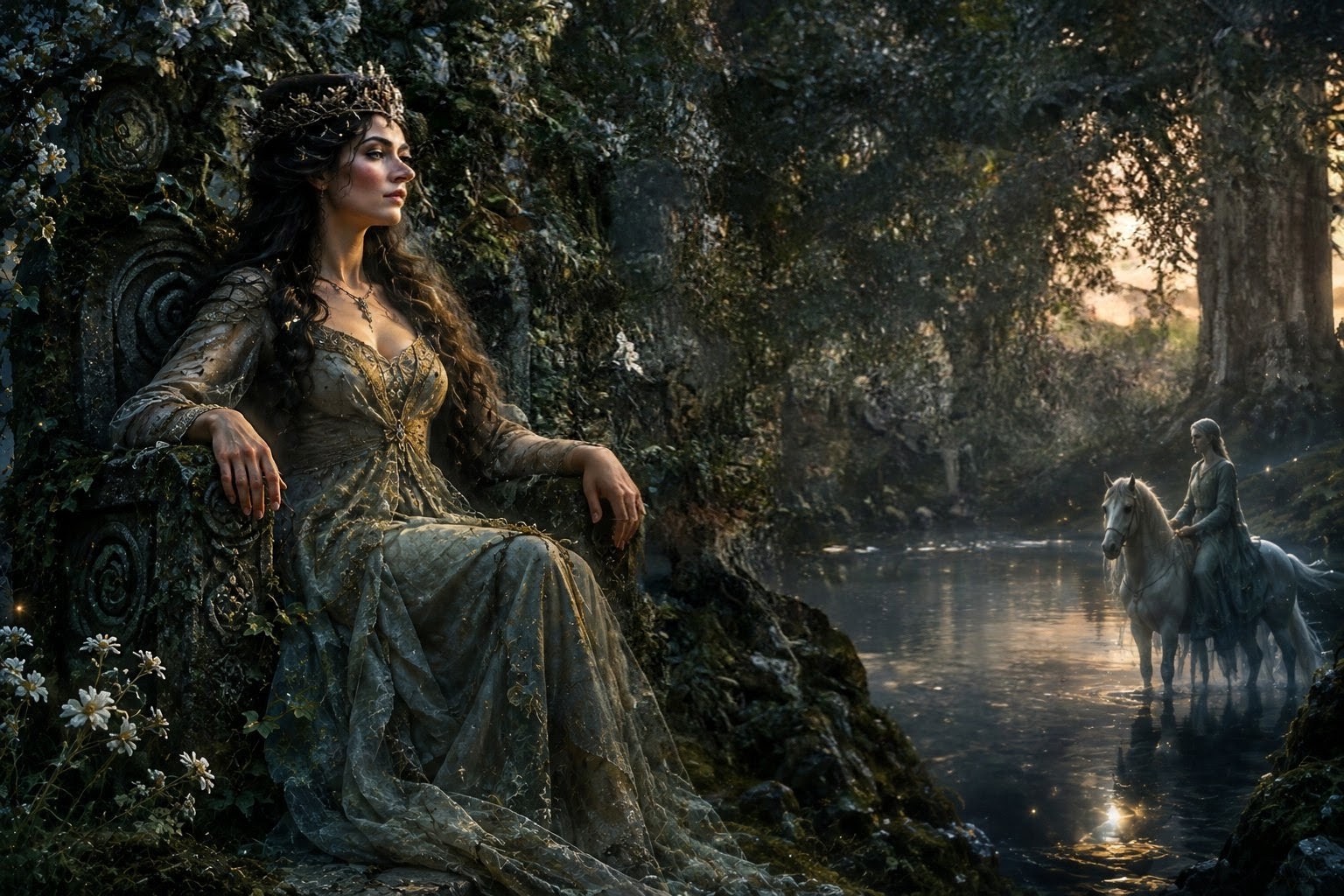
Ask someone to picture the Fairy Queen and they’ll probably imagine a tiny crowned woman with delicate wings, scattering stardust through an enchanted forest. It’s a beautiful image, but it’s one our ancestors would have struggled to recognise.
Long before Shakespeare introduced Titania to the stage, and centuries before Victorian artists covered greeting cards with smiling flower fairies, Britain already knew of queens who ruled an unseen world. They weren’t miniature. They rarely fluttered and they certainly weren’t harmless.They were powerful. Sometimes they were beautiful. Often, they were terrifying. And they were almost always encountered at the edges of the landscape, where the ordinary world seemed to brush against another. But the strangest thing about Britain’s Fairy Queen is that she refuses to have a single name. Travel through the folklore of these islands and you’ll discover countless women who seem to wear the same ancient crown.
In the Scottish Highlands, stories speak of fairy queens who presided over the Sìth, dwelling beneath green hills where music echoed through hidden halls. They appear not as mischievous sprites but as noble rulers, commanding respect from humans and fairies alike. Their courts were magnificent, their feasts irresistible and their invitations rarely wise to accept.
Cross into Ireland and the picture shifts once more. Fairy queens become entwined with the Aos Sí, descendants of the Tuatha Dé Danann, whose world exists alongside our own rather than beneath it. Here, the boundary between fairy, goddess and ancestral memory begins to blur until separating one from another becomes almost impossible.
In Wales, Rhiannon rides effortlessly between mythology and folklore. Although remembered today as a figure from the Mabinogion, later tradition often places her among the rulers of the Otherworld. Riding a white horse that no rider can catch, she seems less a fairy than something far older – a reminder that folklore has never cared much for neat categories.
Then there is Morgan le Fay. To some she is Arthur’s enemy. To others, his healer. To medieval writers she was a sorceress living on Avalon, an island forever suspended between this world and the next. Yet many folklorists see Morgan as another expression of Britain’s Otherworld queens – a guardian of hidden knowledge whose story gradually changed with every generation that retold it.
Even the Lady of the Lake belongs comfortably within this family. Emerging from still waters to bestow Excalibur upon Arthur before reclaiming it after his death, she inhabits the same liminal landscape as Britain’s fairy queens. Lakes, after all, have always been thresholds. Their calm surfaces conceal unknown depths, making them perfect gateways to another realm. Whether she was ever truly a fairy matters surprisingly little. She behaved like one.
The same mysterious qualities appear again and again. Queens of hills. Queens of lakes. Queens of forests. Queens who offer impossible gifts. Queens who demand impossible prices. Maybe these women were never intended to be understood as separate beings at all. Maybe they were just different faces of the same ancient idea.
That idea becomes even clearer when we look beyond Britain. Across Europe, tales speak of mysterious female rulers associated with wild places, the dead, the moon and the changing seasons. Names differ, customs change, but certain characteristics remain stubbornly familiar. They govern hidden realms. They command supernatural hosts. They reward courtesy and punish arrogance. Above all, they exist just beyond ordinary human reach. Folklore has a habit of repeating itself in different accents.
One of Britain’s darker traditions centres upon Nicnevin, a spectral queen associated in later Scottish folklore with the Wild Hunt. Riding across the night sky with a host of supernatural followers, she represents the untamed face of the Otherworld, where beauty and terror ride side by side. While scholars continue to debate her origins, she reminds us that Britain’s fairy queens were never simply guardians of flowers and butterflies. They ruled storms. Darkness. Winter. Even Death.
And then came Shakespeare…
When ‘A Midsummer Night’s Dream’ introduced audiences to Titania, the Fairy Queen gained perhaps her most famous literary identity. Shakespeare drew upon existing folklore but reshaped it for the stage, creating a romantic queen whose quarrels with Oberon enchanted audiences for centuries.
Victorian artists completed the transformation. Suddenly fairies became tiny. Butterflies replaced the ravens. Flower petals replaced the burial mounds. The ancient queens who once haunted lonely hills gradually faded beneath layers of glitter and lace. But the older stories never truly disappeared.
Walk through Britain today and you’ll still find hills known as fairy hills. Wells carry legends of mysterious ladies. Lakes whisper tales of beautiful women appearing from the mist before vanishing without a trace. Lone thorn trees stand untouched because local people would rather not discover whether the old stories contain even a grain of truth and that’s the remarkable thing about folklore. It evolves without ever quite letting go of its past.
Maybe there never was one Fairy Queen. Maybe every community just imagined her differently. Sometimes she emerged from a lake carrying a sword. Sometimes she rode across the sky with the Wild Hunt. Sometimes she welcomed guests beneath a green hill where time flowed strangely. Whatever her name, she always ruled the same place.
Not a kingdom marked on any map. But the mysterious country our ancestors believed began just beyond the hedge.

Leave a Reply