Imagine, if you will, that you have paid good money to watch two men get tied up in a cupboard.
Bear with me…
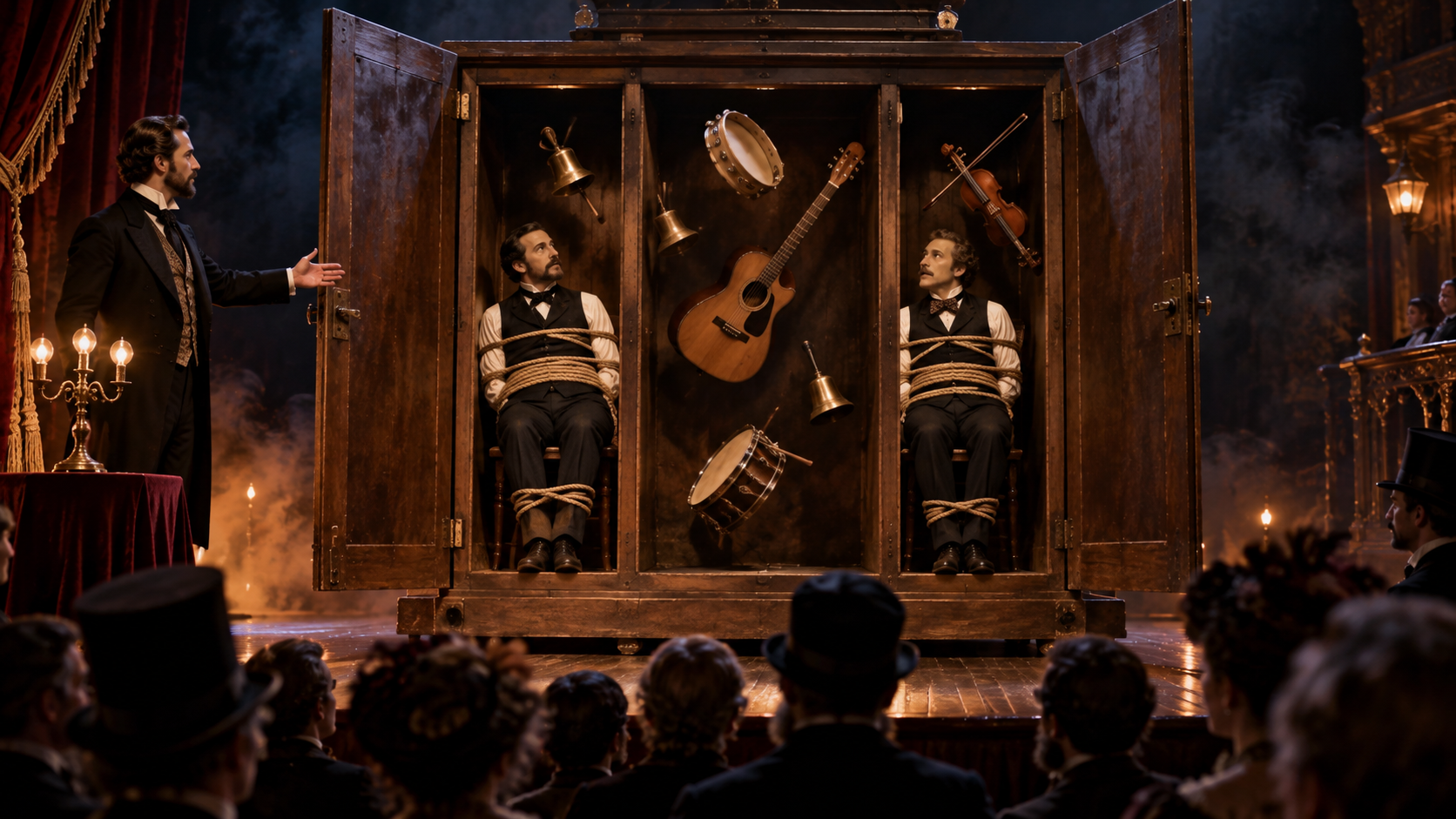
The cupboard contains musical instruments. The men are thoroughly restrained, the doors are shut and almost immediately all hell breaks loose inside. Bells ring, guitars play, tambourines rattle and things move around. Open the doors and there sit the brothers, apparently still tied up exactly as you left them.
So, what happened? Was it ghosts? Trickery? Two very bendy Americans with a talent for undoing knots?
Meet the Davenport Brothers. Hold on to your spirit boxes…
Ira and William Davenport came from Buffalo, New York, and began their strange career in the 1850’s, when Spiritualism was spreading rapidly through America. It has to be said that their timing was impeccable – the Fox Sisters had helped popularise the idea that the dead could communicate from beyond the grave through mysterious knocks and rappings. Séances were becoming fashionable. Mediums produced spirit messages, moving furniture and apparently disembodied noises. And into this – shall we call it an atmosphere? – walked Ira and William. Or, more accurately, they climbed into a cabinet.
Their most famous piece of equipment became known as the spirit cabinet. It was essentially a large wooden structure with doors through which the audience could see the brothers before they were enclosed inside. They would be tied up and members of the audience could inspect the ropes and, at various performances, assist with the tying. Musical instruments would be placed inside the cabinet with the brothers, then the doors were closed.
At that point, the ghosts would suddenly discover a previously unsuspected enthusiasm for musical theatre. Bells would ring, instruments sounded and tambourines would fly about, willy-nilly. Open the cabinet and there were William and Ira, still securely tied up. The brothers also performed dark séances, during which similar manifestations occurred when visibility was conveniently poor.
Now we reach the interesting bit:
Were the Davenports claiming spirits did it?
You would think that would be an easy question to answer. It isn’t. Of course.
The brothers became famous as spiritualist mediums. Spiritualists championed them as evidence of genuine supernatural phenomena. Newspapers discussed them in the language of Spiritualism and audiences went specifically to see manifestations that were being presented as mysterious. But the Davenports themselves were very slippery about the whole thing. Years later, Ira Davenport insisted that he and William had never publicly expressed a belief in Spiritualism. They didn’t tell audiences that what they were witnessing was definitely supernatural, but the didn’t tell them it was a magic trick either. They just performed it.
So, you can make your own minds up on this one, folks. It’s clever isn’t it? If you believe the spirits are playing the tambourine, the Davenports haven’t lied to you. If you think it’s a trick, they haven’t lied to you either. And if you pay for another ticket because you desperately want to work out which one it is, everybody wins.
But mostly the Davenports.
Harry Houdini, who later became friends with Ira, wasn’t entirely impressed by that defence. His view was essentially that although the brothers might not have personally announced themselves as genuine mediums, they were perfectly happy for other people to do it for them. Which seems fair. The distinction between claiming supernatural powers and allowing a whole publicity machine to imply them is a very fine line.
By 1864, The Davenports were ready for Britain and Britain was ready for them too. Unfortunately, Britain couldn’t decide whether to applaud them or dismantle the furniture looking for wires. Their performances attracted Spiritualists, sceptics, journalists, scientists, conjurors and members of the public who presumably just fancied watching Americans being tied to things. Arguments followed them around the country – some spectators were convinced. Others were furious. People examined the cabinet, inspected ropes and proposed explanations. Newspapers debated whether the phenomena were supernatural or fraudulent.
And then, in March 1863, the Davenports arrived in Cheltenham. Sitting somewhere in their audience was a young watchmaker called John Nevil Maskelyne. We’ve met him already. Maskelyne was interested in conjuring and, along with his friend George Cooke, became fascinated by what the Davenports were doing.
The traditional version of what happened next is simple. Maskelyne watched the brothers, spotted exactly how their trick worked, went away with Cooke, built another cabinet, reproduced the manifestations and exposed the Davenports as frauds.
Curtain.
Applause.
Ghosts defeated.
More recent examination of contemporary newspaper reports has shown that the story became considerably neater in later retellings than it appears to have been at the time. Maskelyne and Cooke certainly did reproduce apparently impossible cabinet phenomena without the assistance of spirits. If two men can be tied inside a cabinet and make instruments apparently play themselves using ordinary conjuring methods, then we no longer need ghosts to explain what the audience saw. But there is a small logical problem. Proving that you can fake something does not prove that somebody else faked it in exactly the same way.
The Spiritualists noticed this immediately. Maskelyne could demonstrate trickery until the cows came home. Believers could simply reply that this proved Maskelyne was a clever magician, not that the Davenports weren’t mediums. And so the argument carried on. There is something rather amusing about that. Maskelyne intended to demonstrate that supposedly supernatural phenomena could be recreated by entirely earthly means. Instead, everybody simply found something new to argue about. What we can say with confidence is that the encounter changed Maskelyne’s life.
He and Cooke began performing together, they developed their own illusions and eventually they became the Maskelyne and Cooke who took up residence at the Egyptian Hall in Piccadilly, helping to transform British stage magic in the process.So, in a roundabout way, the Davenport Brothers helped create two of the men who would become famous for exposing the sort of supernatural claims with which the Davenports themselves were associated – I do enjoy history when it ties itself in knots.
The Davenports, meanwhile, did not disappear in disgrace after Cheltenham – this is another problem with the tidy version.
They carried on. They toured. They travelled through Europe and later performed much further afield. Whatever sceptics thought of them, people continued paying to see what happened inside that cabinet.
William Davenport died in 1877. Ira lived until 1911, and before he died, another famous magician entered the story.
Houdini.
By then Houdini had developed a particular interest in fraudulent mediums. His later crusade against Spiritualist trickery would become almost as famous as his escapes. He got to know Ira Davenport and discussed the brothers’ methods with him. According to Houdini, Ira eventually explained the rope technique used in the Davenport performances and provided information that effectively confirmed the earthly nature of their supposedly mysterious manifestations.
Case closed? Of course not. This is Spiritualism we’re talking about.
Arthur Conan Doyle, creator of perhaps the most relentlessly logical detective in fiction, became one of Spiritualism’s most enthusiastic defenders. Doyle remained convinced that genuine psychic phenomena existed and later argued that the Davenports had possessed real mediumistic abilities.,So even after one Davenport had apparently discussed the methods with Houdini, people were still arguing about whether spirits had been involved. At this point I suspect the ghosts themselves would have become exhausted.
Perhaps the most interesting thing about the Davenport Brothers isn’t how the cabinet worked. We know enough about conjuring, escapology, rope techniques and misdirection to understand that apparently impossible things can happen on a stage without requiring anybody’s deceased Aunt Doris to operate the tambourine. What interests me is the space the brothers created around the performance. They didn’t quite say it was supernatural but hey didn’t quite say it wasn’t either. So Spiritualists filled the gap with spirits and sceptics filled it with fraud. Magicians filled it with explanations. Newspapers filled it with arguments.
And all the while, the Davenports filled theatres.
There is a temptation, looking backwards, to divide everyone neatly into believers and fraudsters. The reality, as always, was messier. Audiences were trying to understand phenomena they had never seen before. Spiritualism was new, exciting and controversial. Science was changing what people believed was physically possible. Stage magic was becoming increasingly sophisticated. And in the middle of all that uncertainty sat two American brothers inside a wooden cabinet.
Bang. Rattle. Crash.
Open the doors – Still tied up. Explain that.
John Nevil Maskelyne and Harry Houdini tried. Arthur Conan Doyle disagreed. And more than 160 years later, here we are still talking about them.
That may have been the Davenports’ greatest trick.
They didn’t need to convince everybody that the spirits were real.
They only needed to make sure nobody stopped arguing about it.