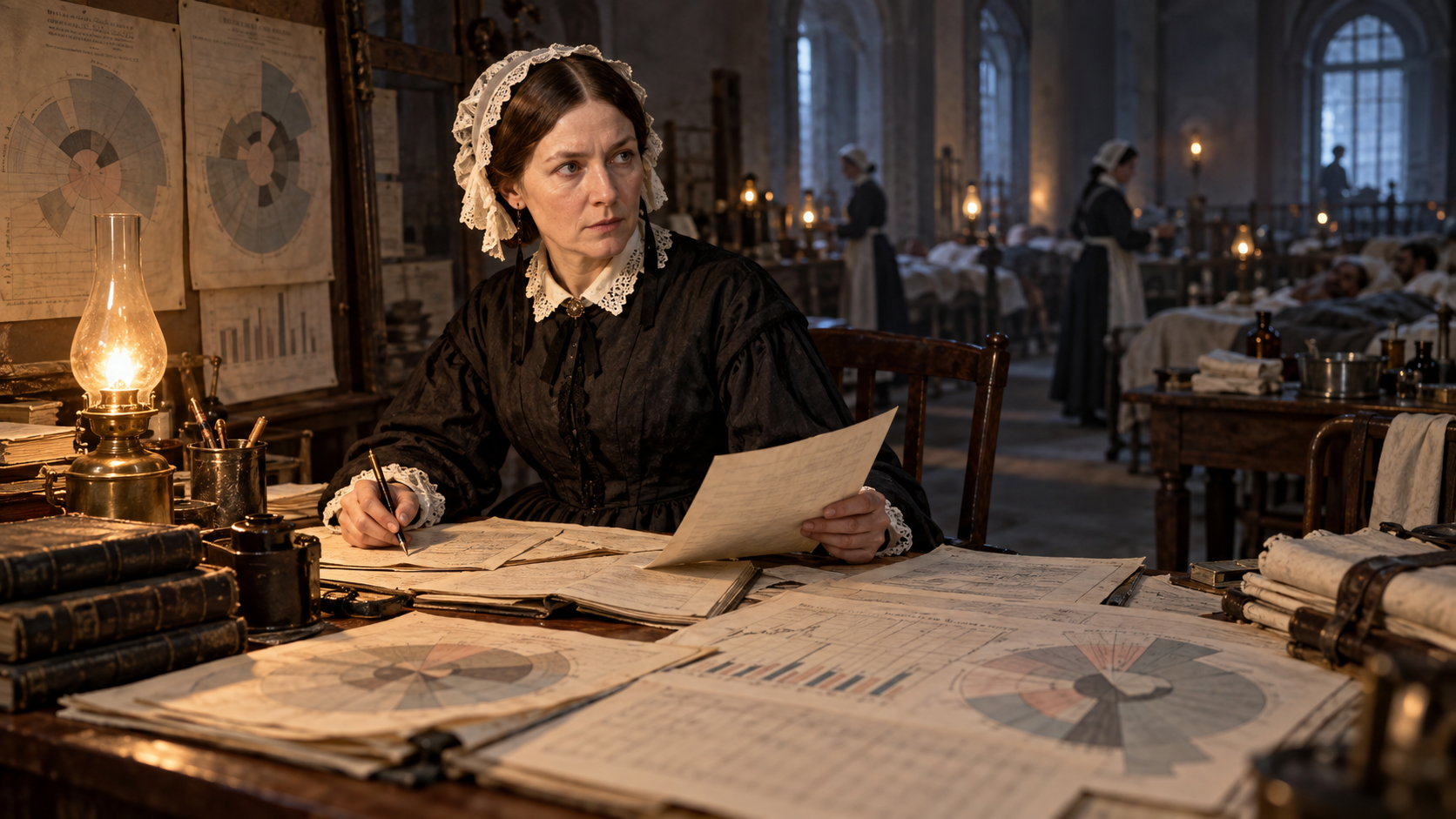
Ask anyone to picture Florence Nightingale and chances are they all describe the same image. A dark hospital ward, rows of wounded soldiers and Florence, sleeves rolled to her elbows, moving quietly between the beds with her lamp casting a comforting glow over the poor souls lying there. The Lady with the Lamp. Gentle, caring, selfless… almost saintly.

It’s a lovely image. It’s also done Florence Nightingale a bit of a disservice. Because while she absolutely was compassionate, compassion alone does not reform military hospitals, establish professional nursing or force the British Government to acknowledge that an awful lot of it’s soldiers were dying because the system supposed to look after them was failing spectacularly. For that you need intelligence, influence, money, an alarming quantity of paperwork and the sort of stubbornness that makes people in authority develop a nervous twitch when they see your name written on an envelope and Florence had all those things.
She was born in Florence, Italy on 12 May 1820 and, rather conveniently, named after the city. Her parents, William and Frances Nightingale, were wealthy and well connected, which meant Florence and her sister received an education far beyond that available to most girls at the time. Florence was able to study history, philosophy, languages and mathematics, and she was particularly good at the latter. Although what exactly a respectable young Victorian woman was expected to do with all this education was another question entirely. She was supposed to marry well, run a respectable household, entertain the right people and perhaps occupy herself with a little genteel charity work. Florence, however, had other ideas.
In 1837, when she was sixteen, she experienced what she described as a calling from God. Not a vision telling her to wander round hospitals looking picturesque with a lamp, but a conviction that she was supposed to devote herself to useful work. And Florence took that calling very seriously. Unfortunately, the useful work she eventually settled upon was nursing. Today, nursing is a respected profession requiring considerable training and skill. In Florence’s time, it was not considered a suitable occupation for a wealthy young woman. Hospitals could be dirty, chaotic and dangerous places, and nurses didn’t yet have anything like the professional standing the would later acquire. Her family were horrified, but Florence persisted. This persistence would become something of a theme. After studying at Kaiserwerth in what is now Germany and gaining practical experience elsewhere, Florence became superintendent of a London institution caring for sick gentlewomen in 1853. She proved very quickly that she wasn’t just good at caring for patients. She could organise. She reorganised working practices, improved conditions and demonstrated a formidable talent for administration.
Then came the Crimean War.
By 1854, reports were reaching Britain describing appalling conditions among wounded soldiers. At the Barrack Hospital in Scutari, in what is now Istanbul, men were packed into overcrowded wards without adequate food, bedding, clothing or medical supplies. The sewage system was dreadful. Ventilation was poor. Disease was everywhere. The Secretary at War, Sydney Herbert, asked Florence to lead a group of nurses to the military hospitals. She arrived at Scutari in November 1854 with thirty-eight women, and not everybody was thrilled to see them. Military hospitals were run by men accustomed to military hierarchies, and a determined woman arriving with thirty- eight nurses and some very definite opinions about how things ought to be done was not universally regarded as a blessing.
There were supplies, but bureaucracy could make actually getting hold of them absurdly difficult. Medical officers protected their authority and Florence had to negotiate, persuade, cajole and occasionally bulldoze her way through the whole mess – So she did. She organised kitchens to provide proper food for sick men. She established laundries so patients could have clean linen. She found clothing, bedding and equipment. She improved record keeping and created better systems for distributing supplies. She also wrote letters for the soldiers and arranged for their money to be sent home to their families – and yes. At night she walked through the wards checking on them. With a lamp. The soldiers adored her. The newspapers apparently loved the lamp. Hence ‘The Lady with the Lamp’ But the lamp isn’t actually the most interesting thing Florence Nightingale carried into battle. That would be the statistics. The death rate among soldiers during the Crimean War was horrific. Men certainly died from battle wounds, but enormous numbers died from diseases such as typhus, typhoid, cholera and dysentery. In some circumstances, surviving the battlefield only to end up in hospital was not necessarily an improvement.
When I was researching this article, I found a lovely, neat version of Florence’s story where she arrives in Scutari, rolls up her sleeves and cleans everything and the death rate immediately plummets. Her actual story is considerably messier. As history so often is. In reality, deaths remained terribly high during her first months there. The problems went far beyond dirty sheets and badly organised wards. Blocked drains, defective sewers, contaminated water and poor ventilation had created perfect conditions for disease. It wasn’t until 1855 when a government Sanitary Commission arrived and carried out essential work on the drainage, sewage and ventilation systems that mortality fell dramatically.
But that doesn’t diminish Florence’s role – quite the opposite, in fact. Because she understood what it meant. Clean linen and good nursing could only do so much if the water was contaminated, the drains didn’t work and hundreds of sick men were being crammed into an unhealthy building. So Florence returned to Britain determined to find out exactly what had gone wrong. She gathered data. lots and lots of data. She collected and analysed figures showing when soldiers died, where they died and what had killed them. There was just one problem. You can hand a politician a table full of inconvenient numbers and there is always the distinct possibility that the table will disappear beneath another pile of paperwork. Florence needed something harder to ignore. Enter the famous polar-area diagram, often called her rose diagram.

The diagram shows the causes of death among soldiers in the East, with coloured sections representing the scale of mortality. The enormous areas representing deaths from preventable disease dwarfed those representing deaths caused by wounds. It made the problem visible.
Florence did not invent the pie chart, despite a claim you will still occasionally see repeated. What she did do was understand the enormous persuasive power of presenting statistics visually, and the message was brutally simple. Disease had killed far more British soldiers than Russian weapons had. And those deaths weren’t inevitable. They were preventable.
In 1858, Florence became the first woman admitted as a member of the Statistical Society of London. She used her influence to campaign for reform throughout the armed forces, helping to drive changes in military sanitation, hospital design, record keeping and the treatment of sick soldiers.
Rather ironically, the women remembered for walking endlessly through hospital wards spent much of her later life confined to her rooms by chronic illness – but that didn’t stop her either. From her bed or sofa she produced reports, examined hospital plans, answered correspondence and fired detailed instructions at ministers, doctors, administrators and reformers. She cultivated useful allies and knew exactly how to use them. Florence Nightingale may have disappeared from public view, but behind the scenes she was still very much at work.
In 1859, she published Notes on Nursing, which dealt not only with nursing itself but with ventilation, cleanliness, light, noise, diet and careful observation of patients. She argued, essentially, that the first requirement of a hospital was that it should not make sick people sicker. Which sounds painfully obvious but unfortunately, Victorian hospitals had provided rather a lot of evidence that it needed saying. The Nightingale Training School for Nurses opened at St Thomas’ Hospital in London in 1860, funded by money donated by an admiring public. It’s graduates carried new standards of nursing across Britain and beyond.
None of this means Florence invented nursing. She didn’t. Women had been caring for sick people for centuries, and religious communities already had long traditions of organising nursing. Nor did Florence single-handedly fix the Crimean hospitals. Mary Seacole was there. So were nurses from religious orders, doctors, sanitary engineers and countless hospital workers whose names have disappeared from history. There is room for all of them. History doesn’t have to ration extraordinary women.
Florence’s interests eventually stretched far beyond British military hospitals. She spent decades studying sanitation and mortality in India despite never actually visiting the country, analysing reports and campaigning for improvements to water supplies, drainage, irrigation and public health. She was also very much a woman of her period. Her work existed within the machinery of the British Empire and sometimes reflected the paternalism and assumptions that came with it. She could be difficult, impatient and absolutely convinced that she knew best. The gentle angel wandering around with her lamp was probably easier to live with. But she would also have achieved considerably less.
In 1907, Florence Nightingale became the first woman to receive the Order of Merit. She died at her London home on 13 August 1910, aged ninety. Her family declined an offer for her to be buried at Westminster Abbey, and she was instead laid to rest at St Margaret’s Church in East Wellow, Hampshire.
And still we remember the lamp. Because the lamp gave Victorian Britain exactly the heroine it wanted. She was feminine, gentle, nurturing, safe. You could admire the Lady with the Lamp without having to think too hard about the rather more troublesome woman standing behind her. That woman challenged military authority and exposed government failure. She understood statistics well enough to turn them into a weapon against complacency and recognised that people weren’t simply dying because they were injured or sick. They were dying because the systems had failed them.
Florence Nightingale did indeed walk through the darkness carrying a light, but that wasn’t her greatest achievement.
She worked out why it was dark in the first place.
Then she set about fixing it.




It's amazing how one image can define a person's legacy. Nightingale's compassion really shines through in that iconic scene. Have you read about her other contributions to nursing and public health? She was such a pioneer!
Remote Reply
Original Comment URL
Your Profile
Why do I need to enter my profile?
This site is part of the ⁂ open social web, a network of interconnected social platforms (like Mastodon, Pixelfed, Friendica, and others). Unlike centralized social media, your account lives on a platform of your choice, and you can interact with people across different platforms.
By entering your profile, we can send you to your account where you can complete this action.
Hi, yes she was. What an absolute inspiration. Thanks for your comment 🙂