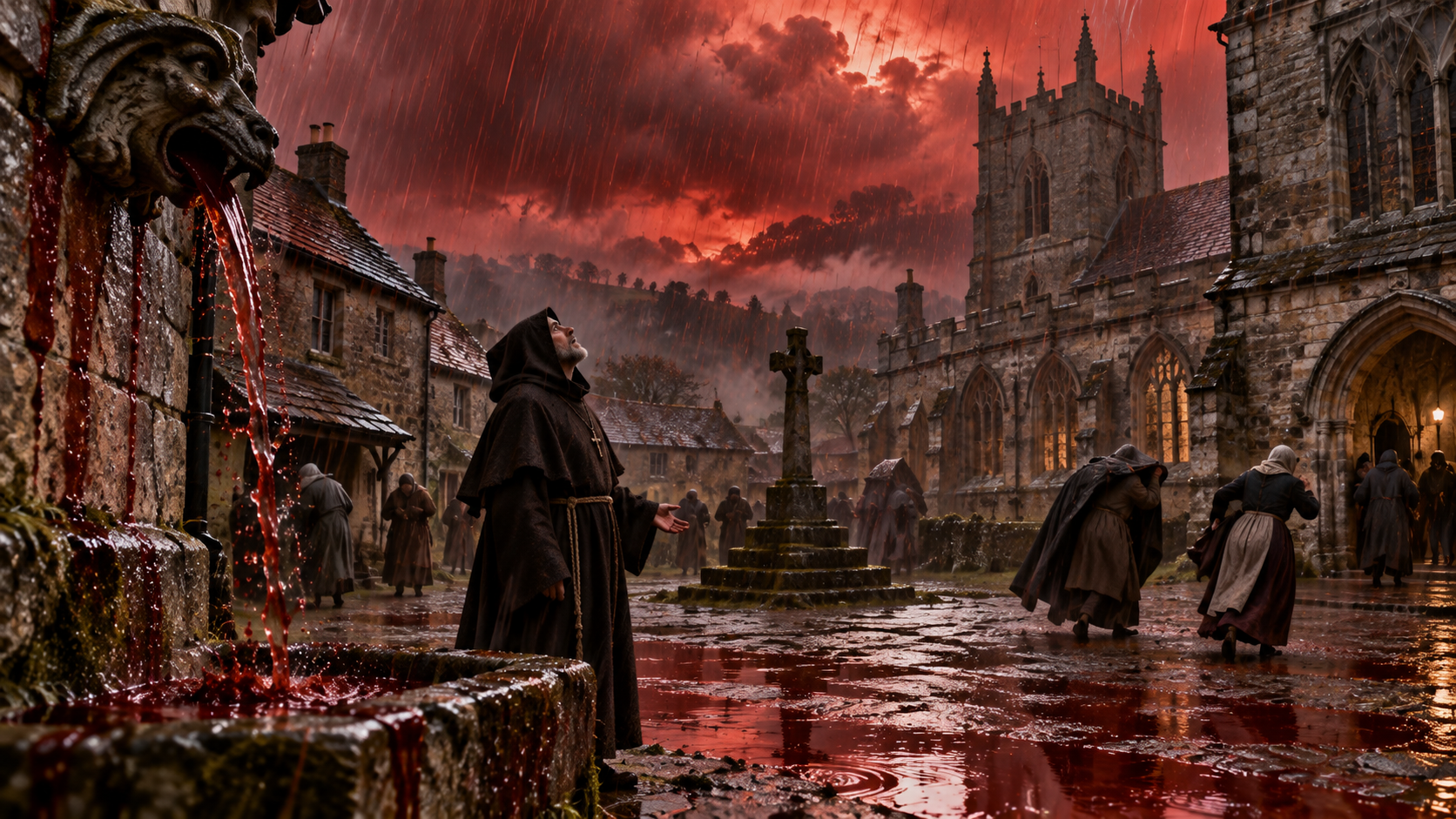
Imagine opening your door one morning and finding blood on the ground.
Not just a few drops. Puddles. Red streaks running from the roof. Crimson splashes across pale stone. Water collected overnight stained the colour of rust.
Then you look upwards. It has been raining.
For most of human history, this would not have been regarded as an interesting meteorological phenomenon. It would have been regarded as a very bad sign indeed. Blood falling from the sky appears repeatedly in historical accounts. Ancient writers recorded it among prophecies preceding disaster. Medieval chroniclers associated it with war, death, plague and divine displeasure.
Sometimes the rain itself was said to be blood. Sometimes bloody drops appeared on crops, buildings or clothing. Sometimes pools and rivers turned red. And when the natural world appeared to start bleeding, people understandably assumed that somebody was trying to tell them something.
The Romans were particularly fond of prophecies. Livy filled his history of Rome with extraordinary events reported before periods of crisis: strange births, statues sweating, animals behaving impossibly and showers of blood. To modern eyes, these lists can look like superstition. But to Roman eyes, they were evidence that the proper relationship between humanity and the gods had been disturbed. The important question wasn’t necessarily how blood had fallen from the sky. It was what Rome had done to deserve it.
Centuries later, Christian chroniclers inherited their own versions of the same anxiety. A red sky, bloody rain or red-stained landscape could be interpreted as a warning. War was coming. Someone important would die. God was displeased. Something had gone wrong. And to be fair to our ancestors, finding red rainwater outside your house without the faintest idea of atmospheric dust transport would be reasonably alarming.
Not every medieval writer simply accepted that literal blood had fallen, though. One particularly interesting account comes from 1223. Roger of Wendover, a monk and chronicler at St Albans, described an extraordinary occurrence involving what he called blood-coloured earth. Rather than simply declaring that the heavens had rained blood, the account described material which coloured the ground. Centuries before meteorologists could track dust clouds using satellites, somebody had noticed that perhaps the important thing wasn’t the water. Perhaps it was what the water had brought down with it. Because sometimes when Europe experiences so-called blood rain, part of Africa has arrived with it.
The Sahara produces enormous quantities of airborne dust. Fine mineral particles can be lifted thousands of metres into the atmosphere and transported astonishing distances by winds. Across North Africa, the Mediterranean and Europe. Sometimes considerably farther. We tend to imagine deserts as fixed landscapes but they aren’t. Tiny pieces of them are constantly moving. When a dust-laden air mass meets rain, water droplets collect those suspended particles and carry them back towards the ground the result can be red, orange, brown or yellowish rain. Cars become covered in rusty spots. Windows acquire reddish streaks. Snow can become discoloured. Puddles look distinctly unpleasant. And, if you happen to be standing in medieval Europe with no knowledge of Saharan atmospheric transport, it can look very much as though the sky has started bleeding.
The colour comes largely from minerals within the dust, particularly iron compounds. Iron is rather good at turning things red. The same broad chemistry helps give many desert landscapes their characteristic rusty colour. Mix sufficiently fine reddish mineral dust with rainwater and suddenly an ancient omen begins to look suspiciously like meteorology. Scientists were studying exactly this phenomenon by the beginning of the twentieth century.
In March 1901, an enormous dust event transported material from North Africa across parts of southern and central Europe. Reports appeared in Nature discussing the resulting “blood rains”. Observers recorded coloured skies, reddish deposits and dust collected after the event and instead of asking which god had been offended, scientists were asking where the particles had originated and how they had travelled. Same phenomenon. Completely different world. Modern satellites have made the journey much easier to see. Dust plumes from the Sahara can stretch for hundreds or thousands of kilometres. They cross seas and national borders without the slightest regard for either.
Britain gets Saharan dust too, although usually the result is less dramatic than the chronicles suggest. More often than not, the great celestial omen announcing war, plague and the collapse of civilisation turns out to be:
“Why is my car filthy?”
But this is where we need to be slightly careful. Knowing that Saharan dust causes red rain does not mean that every historical account of blood rain can be explained that way. Some may have been, but others may describe different natural phenomena entirely. Red algae and microorganisms can colour water. Pollen and spores can create strange deposits. Dust can originate somewhere other than the Sahara.
Some accounts may have grown in the telling. Some may be symbolic. And some chroniclers copied earlier chronicles, meaning that a wonderfully dramatic prodigy could acquire a surprisingly long life without necessarily occurring repeatedly. Historical blood rain is therefore not one phenomenon. It is a category. People saw something red where they expected water and interpreted it through whatever understanding of the world was available to them. And that interpretation could be powerful.
Imagine living in a society where unusual natural events were woven into ideas about divine judgement. The harvest matters. War is never far away. Disease can arrive without explanation. Most people have no idea what weather exists fifty miles away, never mind what is happening in North Africa. Then one morning the rain is red. You don’t see iron-rich dust. You see blood. And blood means something.
That is the part of these stories I find most fascinating. Science explains the mechanism, but it doesn’t erase the experience. The people who watched red water run from medieval roofs weren’t stupid, they were observing something genuinely unusual and trying to fit it into the world they understood. We do exactly the same thing, but we have satellites now and there is something wonderfully humbling about the modern explanation. The sky wasn’t bleeding. No supernatural warning had been written across the landscape. Instead, winds had reached down into one of the largest deserts on Earth, lifted unimaginably small particles of ancient rock, carried them across countries and seas, and delivered them somewhere completely different inside drops of rain. Honestly, that’s hardly less extraordinary.
A medieval chronicler might have seen an omen. A meteorologist sees atmospheric transport. I see both stories sitting on top of one another. One tells us what the weather was doing. The other tells us what people thought the universe was saying. And somewhere beneath both of them lies a simple fact.
Occasionally, it really does rain red.