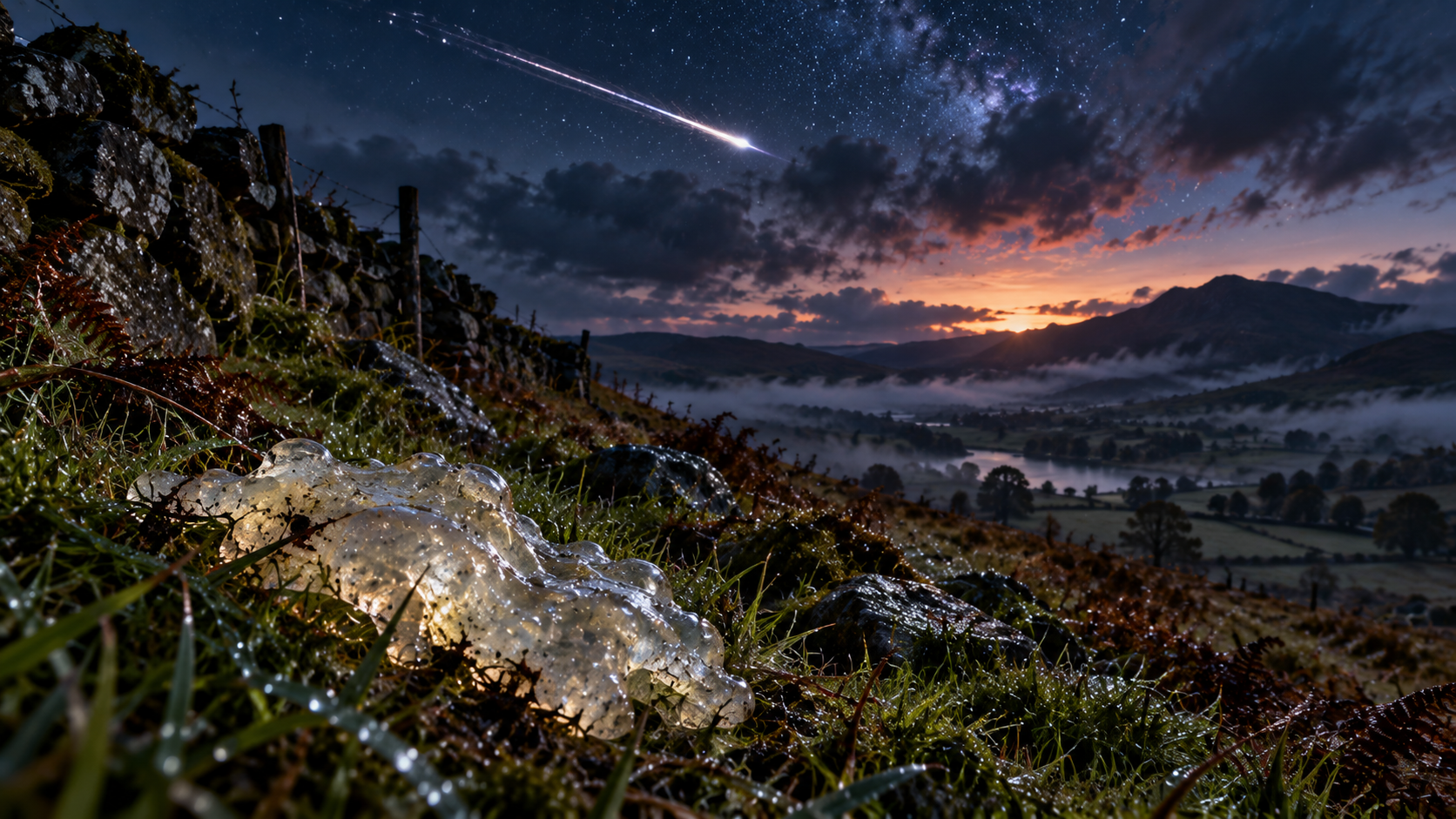
There are few discoveries more likely to ruin a pleasant country walk than finding a mysterious lump of translucent jelly in the grass. Especially when nobody can tell you what it is.
For centuries, people across Britain and Europe have reported strange gelatinous substances appearing on fields, hillsides and moorland. Sometimes they are clear. Sometimes whitish or grey. And sometimes they resemble frogspawn without the eggs. They appear unexpectedly, often after rain, and have an irritating tendency to collapse or disappear before anybody gets around to investigating them properly. Naturally, we blamed the stars. Because why wouldn’t we?
The substance became known by various names, including star jelly, star slime and astral jelly, but in Wales there is an altogether better name.
Pwdre sêr. Usually translated as “the rot of the stars.”
Which is magnificent.
The old belief was straightforward enough. A shooting star streaks across the night sky, later, a strange trembling mass of jelly is discovered on the ground – clearly, something has fallen from the sky. For people living before meteors were properly understood, the connection wasn’t unreasonable. Something bright had apparently dropped from the heavens. Something peculiar had subsequently appeared on Earth. One was therefore assumed to be the remains of the other.
The idea is old. References to mysterious gelatinous substances associated with stars, meteors or celestial phenomena appear in European writing for centuries. But star jelly has a problem. Nobody has ever convincingly demonstrated that there is one substance called star jelly, and that may be because there isn’t. Instead, we may have spent hundreds of years giving the same wonderful name to completely different things.
One of the usual suspects is Nostoc – we’ve met this stuff already, it briefly appeared during attempts to explain the Kentucky Meat Shower. Nostoc is a genus of cyanobacteria capable of forming gelatinous colonies. When conditions are dry, some colonies can become dark, shrivelled and extremely difficult to notice. Then it rains and they absorb water. They swell. Suddenly there is a lump of strange jelly sitting somewhere that apparently contained nothing the day before. If you didn’t know it had been there all along, it could look remarkably like something had arrived overnight. Or fallen from the sky.
That probably explains some star jelly, but almost certainly not all of it.
Slime moulds have also been suggested. So have jelly fungi. Various algae and bacterial colonies can produce gelatinous masses.
And then we reach the explanation that has probably caused more people to wish they’d never poked the mysterious jelly with a stick.
Frogs.
More specifically, the gelatinous material associated with amphibian reproduction. Frog and toad spawn contains jelly which expands enormously when exposed to water. If a predator eats an amphibian but leaves or regurgitates some of the reproductive material, that jelly can swell after exposure to rain. What appears to be an inexplicable blob deposited from the heavens may therefore be the remains of somebody else’s dinner. Nature is marvellous, but nature is also disgusting. What I particularly love about this explanation is that it isn’t simply a modern scientist arriving centuries later to spoil a perfectly good piece of folklore. Naturalists were considering versions of it a very long time ago.
In 1926, zoologist H. A. Baylis wrote to Nature about pwdre sêr – “the rot of the stars” – after earlier discussion of mysterious jelly. Baylis made an important point. There was no reason to assume that everything given this name was the same substance. Some examples might be slime moulds and others might be Nostoc. And he drew attention to a suggestion dating all the way back to 1667 that some mysterious jelly might originate from frogs eaten by birds. So more than three and a half centuries ago, somebody was already looking at celestial slime and thinking:
Possibly crow vomit.
Science can be terribly romantic.
But that old observation gets to the heart of the mystery. Star jelly may not be a biological mystery at all, it may be a classification problem.
Imagine three people walking across Britain at different times. One finds a swollen colony of Nostoc after heavy rain, another finds a slime mould, the third discovers the hydrated remains of amphibian tissue left by a predator. All three find something translucent, gelatinous and unexpected lying on the ground. All three ask the same question.
“What the hell is that?”
And folklore gives all three the same answer.
Star jelly.
Once that happens, completely unrelated natural substances become part of the same tradition. Then the tradition reinforces itself. Someone sees a meteor. The next morning somebody discovers jelly. The two events become connected. The story is told. The next mysterious blob is interpreted through the story that already exists, and suddenly the countryside is littered with decomposing stars.
Folklore doesn’t necessarily require the underlying observation to be false. People really do find strange jelly. The mistake may simply be assuming that all strange jelly must have the same cause. And even today, individual reports can remain frustratingly difficult to identify.
The problem is often timing. A photograph of a translucent blob isn’t particularly useful. Nostoc, slime mould, fungal material and animal tissue can all look very different under a microscope while appearing remarkably similar in a slightly blurry photograph taken beside a footpath. By the time somebody with the right expertise arrives, the material may have dried out, decomposed, washed away or been eaten. Or somebody may have poked it repeatedly with a stick. There is also the irresistible gravitational pull of mystery. “Hydrated cyanobacterial colony” is accurate, but “Rot of the stars” sounds considerably more exciting – I know which headline I’m clicking.
Explaining individual examples doesn’t destroy the folklore. If anything, it makes star jelly more interesting. There probably isn’t one mysterious substance falling from the heavens and there are numerous perfectly terrestrial processes capable of producing something so peculiar that generations of people have looked at it and decided it cannot possibly belong here. That tells us something important about folklore. Sometimes a legend survives because nobody can explain the phenomenon and sometimes it survives because the phenomenon keeps happening.
Rain falls.
Nostoc swells.
Frogs meet unfortunate ends.
Slime moulds appear.
Somebody walking across a field finds a trembling lump of translucent material where they are absolutely certain there was nothing yesterday, and somewhere in the human imagination, a shooting star has just landed. Personally, I hope we never entirely lose that thought. I am perfectly happy knowing that the mysterious jelly beside the footpath probably has a mundane biological explanation. But if I’m walking home one night and see a meteor streak overhead, then find a strange glowing blob in the grass the following morning?
I’m calling it pwdre sêr.
And I’m definitely not touching it.