The first time Elin Morgan saw the candle, she thought someone was coming up the lane.
It was a little after eleven on a wet November evening, and she was standing at the kitchen window, waiting for the kettle to boil. Beyond the glass, the narrow road wound between black hedges and disappeared into the darkness beneath the trees. There were no streetlamps in Cwm Derwen, nor had there ever been. The village was barely more than a handful of cottages huddled together beneath the mountains, with a chapel, a public house and a churchyard whose leaning stones seemed forever engaged in some private conversation.
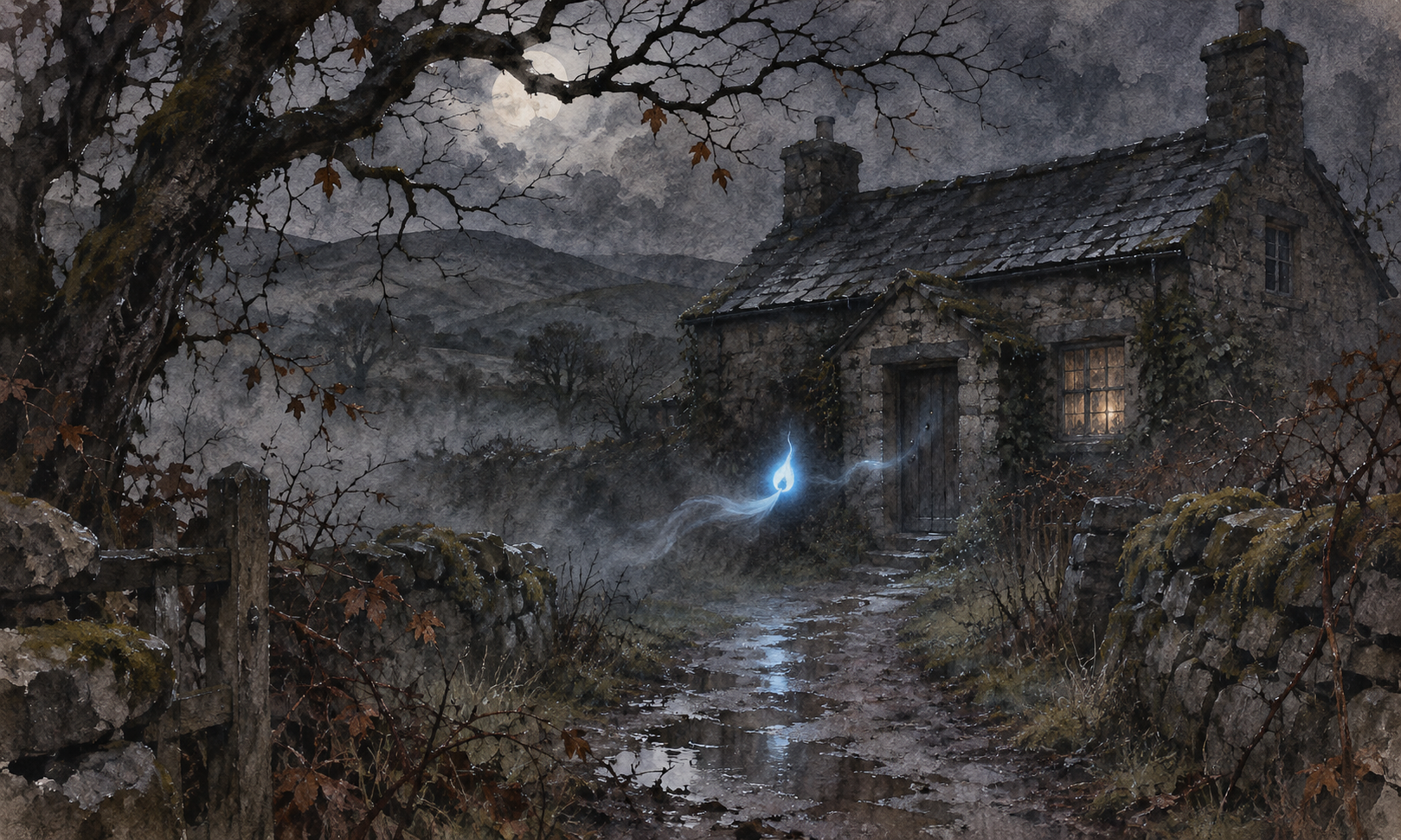
The light appeared just beyond the turning to Bryn Cottage, moving steadily towards her through the rain. It was small and pale, with a peculiar bluish colour, and seemed to float at about the height of a man’s waist. Elin watched it for several seconds before realising there was nobody beneath it. No dark figure holding a lantern, no pale hand shielding a flame from the weather. Just the light itself, travelling slowly along the lane as though it had somewhere particular to be.
She opened the window. Cold air rushed into the kitchen, carrying the smell of wet earth and rotting leaves. The light stopped. For a moment it hung motionless above the road, trembling slightly, before retreating into the darkness beneath the trees. Then it vanished altogether.
Elin stood staring after it until the kettle began to scream.
The following morning, she mentioned the incident to Mrs Pritchard, who kept the village shop and considered herself an authority on practically everything, including matters that were none of her business. The older woman was weighing out half a pound of tea when Elin described the light. At first she appeared merely curious, but when Elin explained where she had seen it, her expression changed.
“Whereabouts, exactly?”
“Just by the gate. It came up from the turning and stopped outside the cottage.”
Mrs Pritchard set down the scoop.
“Blue, you say?”
“Pale blue. Almost white.”
“And there was nobody carrying it?”
“Nobody I could see.”
The shopkeeper glanced towards the window, although there was nothing outside but a cart passing through the rain.
“You’ll have seen a corpse candle, then.”
Elin laughed, supposing it was a joke, but Mrs Pritchard did not smile.
“My grandmother used to speak of them. Canwyll corff, she called them. They come before a death, travelling the way the coffin will be carried. Sometimes you’ll see one for a child, sometimes a whole procession of lights for a family. They say the little ones burn low to the ground.”
“Well, this one was quite high,” Elin replied, trying to sound amused.
“Was it, indeed?”
Mrs Pritchard folded the tea into its paper.
“Best not to look for it again.”
By lunchtime, everybody in Cwm Derwen knew what Elin had seen. By evening, nobody would speak to her about it.
Elin had come to the village three months earlier, following the death of her aunt, who had left her Bryn Cottage and its contents. At twenty-eight, unmarried and possessed of a modest income, she had found herself with the unusual luxury of being answerable to nobody. The cottage was comfortable enough, if rather damp, and she had taken considerable pleasure in sorting through her aunt’s possessions, discovering old letters, forgotten photographs and the occasional inexplicable object tucked away in drawers.
There was, however, one room she had not opened.At the far end of the upstairs passage stood a small door painted the same dark green as the skirting boards. It was locked, and none of the keys in her aunt’s household bunch would fit. Elin had supposed it was an old storage cupboard, perhaps boarded up long ago. She had intended to ask the carpenter to look at it, but there had always been something more pressing to do.
That evening, shortly before eleven, she heard footsteps on the stairs.
They were slow and uneven, accompanied by the unmistakable creak of the third tread. Elin was sitting beside the parlour fire with a book in her lap, and at first she assumed the noise came from the settling of the old house. But then it came again. A footfall, a pause, another footfall, and finally a faint scraping sound from the passage above.
She took a candle and went to investigate.The upstairs rooms were empty. Nothing had moved, and the passage was silent, but when she reached the green door she noticed something peculiar. There was a little water on the floor beneath it, no more than a few dark drops upon the boards. She touched one with her finger and found it cold.
The next evening, the corpse candle returned.
This time it came closer, passing through the gate and travelling halfway up the garden path before stopping. Elin watched from behind the curtains, her breath clouding the glass. The flame was no larger than the one upon her mantelpiece, but it gave off a strange, steady radiance that seemed to illuminate the rain without casting any light upon the ground.
It lingered for nearly a minute.
Then, very slowly, it turned towards the house.
Elin stepped away from the window.
The flame continued towards her, advancing another few feet before stopping again. She heard a faint sound, like someone drawing a wet finger across a pane of glass, and then the light was gone.
By morning there were footprints in the garden.
They were small, perhaps those of a child, and led from the gate to the place where the candle had stopped. There were none returning.
Elin went directly to the Reverend Thomas Llewellyn, who had been minister of the village chapel for nearly forty years and was generally considered a sensible man. She found him in his study, surrounded by books and the smell of pipe tobacco. He listened without interruption as she described the light, the footsteps and the strange marks in the garden.
When she had finished, he removed his spectacles and polished them carefully.
“There are many old beliefs in these valleys, Miss Morgan. Most are harmless enough, provided one does not dwell upon them.”
“Then you don’t believe in corpse candles?”
He considered the question.
“I believe that fear can make ordinary things appear extraordinary.”
“And the footprints?”
“Perhaps a child came into your garden.”
“At midnight?”
“Children have been known to behave foolishly.”
He smiled, but the expression did not reach his eyes.
Elin was about to leave when she remembered the locked room.
“Did you know my aunt well?”
“Mrs Hughes? Certainly. A remarkable woman.”
“Was she always alone?”
The minister’s hand stopped moving.
“Why do you ask?”
“Only because there’s a room upstairs that she kept locked. I wondered whether it had belonged to someone.”
For several moments he said nothing.
Then he replaced his spectacles and looked directly at her.
“Your aunt was a good woman, Miss Morgan. Whatever you may discover about her life, I hope you’ll remember that.”
Elin left the chapel more troubled than when she had entered.
On the third night, the candle reached the front door.
She had been waiting for it, although she would not have admitted as much. At ten minutes to eleven she extinguished the parlour lamps and sat in the dark, watching the garden. The rain had stopped, and a thin mist lay across the path.
Beyond the gate the lane was empty.
At eleven precisely, a pale blue flame appeared beneath the trees.
It moved with dreadful certainty, neither hurrying nor hesitating, and passed through the gate without disturbing it. Elin watched as it travelled up the garden path, drawing closer and closer until it floated directly outside the front door.
There it remained.
She could see its light beneath the door, a narrow blue line that trembled against the tiles.
Then came three soft knocks.
Elin did not move.
The knocks came again, a little louder.
She stood, intending to retreat into the kitchen, but something made her stop. From the other side of the door came a voice, so faint that at first she mistook it for the wind.
“Please.”
It was the voice of a child.
Elin’s hand went to the latch.
“Who’s there?”
No answer came.
She opened the door.
The garden was empty. There was no light, no child, and nothing upon the path except a little pool of water. But lying on the threshold was a small brass key, blackened with age and tied to a length of faded blue ribbon.
She knew at once which door it would open.
Upstairs, the green door yielded almost without resistance. Beyond it lay a narrow bedroom, scarcely larger than a cupboard, with a little iron bedstead beneath the window. There was a wooden chair, a cracked washbasin and a shelf containing three picture books. Everything was covered in dust, yet the room smelled strangely fresh, as though someone had only recently opened a window after a long rain.
Above the bed hung a faded sampler worked in red and blue thread.
MARI ELLEN HUGHES, AGED 9 YEARS, 1881.
Elin stared at the name.
Her aunt had never married. She had never spoken of children, nor had anyone in the village mentioned a girl living at Bryn Cottage.
On the chair stood a small wooden box.
Inside lay a bundle of letters tied with ribbon, a child’s silver thimble, and a photograph of a dark-haired little girl standing beside a woman Elin recognised as her aunt, although much younger. The girl was smiling uncertainly at the camera. She had one hand tucked into the woman’s skirt and the other pressed against her chest.
Behind the photograph was a folded piece of paper.
Elin opened it.
November 17th, 1889.
I have done what they asked of me. May God forgive us all.
There was no signature.
Elin read the words twice before noticing another sheet tucked beneath the lining of the box. It was a letter, addressed to her aunt in the minister’s handwriting.
My dear Margaret,
I beg you to leave this matter undisturbed. What was done was done for the safety of the village, and no purpose can be served by bringing it into the light. The child was already lost to us. You must believe that.
Yours in Christian fellowship,
T. Llewellyn.
Elin sat upon the little bed, the letter trembling in her hands.
The minister had been lying to her.
And somewhere downstairs, the front door began to knock.
She remained in the little bedroom until morning, too frightened to go down and too frightened to sleep. The knocking continued intermittently until dawn, sometimes soft and pleading, sometimes so violent that she expected to hear the door split upon its hinges. Once, very distinctly, she heard the child’s voice call from the hall.
“Auntie Margaret?”
Then, after a long silence, it whispered something worse.
“Why did you leave me there?”
At first light Elin went to see Mrs Pritchard.
The shopkeeper was alone, stacking tins behind the counter. When Elin laid the photograph before her, the older woman turned pale.
“Where did you get that?”
“In my aunt’s house. Who was she?”
Mrs Pritchard glanced towards the door.
“Put it away.”
“Not until you tell me.”
“Miss Morgan, please.”
“Who was Mari Ellen?”
The woman gripped the edge of the counter so tightly that her knuckles whitened.
“My grandmother spoke of her,” she said at last. “She was a strange little thing. Quiet, mostly. They said she could see things other folk couldn’t.”
“What things?”
“Deaths.”
Elin felt the room grow colder.
“She’d tell people when someone was going to die. Sometimes she’d describe the funeral before there’d been so much as a cough in the house. They called her a witch, though she was scarcely more than a baby.”
“And what happened to her?”
Mrs Pritchard looked down.
“One winter there was sickness in the valley. Fever. It took twelve people in less than a month. The child had been seen walking the roads at night with a candle, and every house she passed lost someone before the week was out.”
“Coincidence.”
“Perhaps.”
“What happened to her?”
Elin repeated.
The older woman’s voice dropped almost to a whisper.
“They took her to the old quarry above the village. There was a mine passage there, long abandoned. They said if they shut her away, the deaths would stop.”
Elin stared at her.
“They locked a child in a mine?”
“Your aunt tried to stop them. She begged the men to let the girl go. But the fever had taken the minister’s wife, and the people were frightened. They thought the child had brought something dreadful among them.”
“And nobody helped her?”
Mrs Pritchard began to cry.
“They closed the entrance with stones. Your aunt went back the next morning, but the men had already finished. She said she could hear Mari Ellen crying behind the wall.”
Elin felt suddenly sick.
“How long?”
“I don’t know.”
“How long did they leave her there?”
“I don’t know!”
The older woman’s voice broke.
“Nobody ever spoke of it again.”
That afternoon, Elin climbed the hill to the abandoned quarry.
It lay a mile above the village, hidden among bracken and blackthorn. The old workings had collapsed in places, and the entrance to the passage was almost entirely concealed by fallen stone. She found it only because someone had recently cleared away part of the undergrowth.
There were fresh footprints in the mud.
And beside the entrance, tucked into a crevice between two stones, lay a little blue ribbon.
Elin knelt beside the blocked passage and pressed her ear to the rock.
For a long time she heard nothing but the wind among the trees.
Then came a faint scratching.
She scrambled backwards, nearly falling.
“Hello?”
The scratching stopped.
“Is someone there?”
A small voice answered from behind the stones.
“Are you going to let me out?”
Elin ran.
By the time she reached Bryn Cottage, dusk was gathering across the valley. She locked the doors, drew every curtain and lit every lamp in the house. The rooms glowed with warm yellow light, yet she could not shake the terrible cold that had settled inside her.
At nine o’clock, someone knocked on the front door.
It was Reverend Llewellyn.
He stood upon the step with his hat in his hands, looking suddenly much older than his years.
“I understand you’ve been asking questions.”
Elin did not invite him inside.
“You knew what happened to that child.”
His face sagged.
“Yes.”
“And you helped them?”
He closed his eyes.
“I was a younger man then. I had lost my wife. Three children lay dying in their beds, and every morning there was another bell tolling from the church. People were desperate.”
“So you murdered a little girl?”
“We believed she was already dead.”
Elin stared at him.
“What?”
The minister’s lips trembled.
“That was what she told us. She said she had died in the fever, but that something had brought her back. She said the candle had come for her and would not leave until she followed it.”
Elin could scarcely understand what she was hearing.
“We thought she was possessed,” he continued.
“We thought the deaths would stop if we kept her away from the village.”
“And did they?”
He looked towards the darkening lane.
“Yes.”
For a moment neither spoke.
Then Elin remembered the photograph, the child’s uncertain smile and the little hand pressed against her chest.
“What happened to her after you sealed the passage?”
The minister shook his head.
“We heard her crying for three nights.”
“And then?”
“Nothing.”
Elin stepped back from the doorway.
“You should leave.”
“Miss Morgan, I must warn you. Whatever is coming to your house, you must not let it in. The girl was not what she appeared to be.”
“She was nine years old.”
“She had been nine years old for longer than any of us could remember.”
The minister turned and hurried away into the gathering darkness.
Elin stood watching him until he disappeared around the bend.
At eleven, the candle came again.
This time it was not alone.
A second flame moved behind it, then a third, then another, until the lane was filled with little blue lights travelling silently through the mist.
Some floated high above the ground, while others burned scarcely a foot above the road.
They moved in a solemn procession, passing the chapel, the public house and the darkened cottages without hesitation.
Every light was travelling towards Bryn Cottage.
Elin watched from the parlour window, unable to move.
The procession passed through her gate.
One by one the flames approached the house, gathering upon the path until the garden seemed filled with stars. The first candle floated towards the front door, stopped upon the threshold, and waited.
Then came the knocking.
Three soft taps.
Elin crossed the hall.
She could hear breathing on the other side of the door, the shallow, uncertain breathing of a frightened child.
“Please,” whispered the voice.
Elin closed her eyes.
For three nights she had imagined what might happen if she opened the door. She had pictured something terrible standing outside, some twisted thing wearing the shape of a little girl, waiting to be invited across the threshold.
But she thought of the quarry, of the cold stones and the darkness beyond them. She thought of a child calling for her aunt, begging to be released, while the whole village pretended not to hear.
Her hand closed around the latch.
“I’m sorry,” she whispered.
She opened the door.
The child standing on the step wore a white nightdress stained with earth. Her dark hair hung in wet strands about her face, and her bare feet were blue with cold. She looked no older than nine, although her eyes were terribly old.
In one hand she carried a little brass candlestick.
Its flame burned blue.
“Are you Margaret?” the child asked.
“No, darling. Margaret’s gone.”
The little girl’s expression changed.
“Did she die?”
“Yes.”
“Did they bury her?”
“Yes.”
The girl looked down at the candle.
“Then I was too late.”
Elin crouched before her.
“Too late for what?”
The child lifted her eyes.
“To tell her where they put me.”
A terrible understanding began to form.
“The quarry?”
The girl shook her head.
“No. That’s where they put the other one.”
Elin felt the blood drain from her face.
“The other one?”
The child’s expression was almost apologetic.
“The one they thought was me.”
Behind her, the candles began to move.
Elin heard a sound from the village, a distant scream that rose sharply into the night before being cut short. Then came another, and another, each one farther away than the last, until the whole valley seemed to be crying out.
The child looked towards the lane.
“They wouldn’t listen,” she said sadly.
“I told them I was dead. I told them something else was walking about in my skin.”
Elin stumbled backwards.
The little girl stepped across the threshold, carrying her candle before her.
“And now it’s hungry again.”
From the upstairs passage came the slow creak of a floorboard.
Then another.
Something was moving behind the green door.