The ancient Greeks knew that good fortune could be a dangerous thing, particularly when it persuaded someone they were untouchable. Waiting for those who grew too arrogant was Nemesis, the goddess of righteous indignation, retribution and the restoration of balance. But she was far more than a divine dispenser of revenge, and her story reveals something fascinating about how the ancient world understood justice.
There is a wonderful little lesson running through Greek mythology, and it concerns the sort of person who becomes so thoroughly impressed with themselves that they forget the rest of the world exists. Perhaps they’ve won a battle, accumulated a fortune, inherited a kingdom or acquired enough power to make everybody around them nervous. Whatever the circumstances, success has gone to their head, and they’ve begun to believe that the ordinary rules of human existence no longer apply to them. The ancient Greeks had a word for this kind of outrageous arrogance, hubris, and they had a goddess who took a particular interest in what happened next. Her name was Nemesis, and if you were the sort of person who believed yourself beyond consequences, she was precisely the goddess you didn’t want taking an interest in your affairs.
These days, when we describe somebody as our nemesis, we usually mean an enemy, a persistent rival or that one infuriating individual who seems determined to make our lives difficult. The word has become so thoroughly associated with personal conflict that it’s easy to forget its original meaning. Nemesis wasn’t simply an ancient Greek version of a vengeful woman waiting for an opportunity to settle a score. She represented righteous indignation at undeserved good fortune, excessive pride and behaviour that upset the proper balance of things. She was concerned with proportion, restraint and the consequences of forgetting one’s place in the wider order of the world. It wasn’t necessarily success that attracted her attention, but the arrogance that sometimes accompanied it. A farmer who enjoyed a particularly good harvest had no automatic reason to fear Nemesis, but a farmer who decided that his prosperity made him superior to everybody else might have been wise to reconsider his attitude.
To find Nemesis among the earliest surviving Greek accounts of the gods, we must turn to Hesiod, whose Theogony was composed around the eighth or seventh century BCE. Hesiod describes her as a daughter of Nyx, the goddess of Night, which places her among a decidedly formidable collection of divine relatives. Nyx was also the mother of figures associated with Death, Sleep, Doom, Deceit, Strife and Old Age, and one suspects that family gatherings were not particularly cheerful occasions. Yet the important thing about Nemesis’s place among these beings is that she wasn’t merely another character in an entertaining story about divine quarrels. Like many of her siblings, she embodied something the Greeks understood as a fundamental part of existence. Death would come, old age would arrive, strife would trouble humanity, and those who behaved with outrageous arrogance might eventually discover that their good fortune had limits.
Nemesis also appears in Hesiod’s Works and Days, where she is associated with Aidos, another personification whose name is difficult to capture in a single English word. Aidos encompasses ideas of shame, modesty, reverence and the sense of restraint that prevents people from behaving disgracefully. Hesiod imagines a dreadful age in which Aidos and Nemesis abandon humanity, leaving people without the moral inhibitions that ought to govern their conduct. The wicked prosper, justice is disregarded, family bonds deteriorate and the vulnerable are left to suffer. It is a bleak picture, but it reveals something important about the goddess. Nemesis wasn’t simply waiting to punish people after they had done something dreadful. Her presence represented part of the moral order that encouraged people to recognise limits before they overstepped them. Without that sense of accountability, Hesiod suggested, human society would become a thoroughly unpleasant place to live.
Of course, Nemesis wasn’t confined to poetry and philosophical ideas. She was a goddess who received actual worship, and one of her most important sanctuaries stood at Rhamnous, in the northeastern part of Attica, not far from Marathon. The site is particularly interesting because it provides us with archaeological evidence of her cult, including the remains of temples, inscriptions and fragments of an important sculptural monument. Nemesis was worshipped there alongside Themis, the goddess associated with divine order, established custom and what was considered right and proper. Their association makes considerable sense when we consider their respective responsibilities. Themis represented the order that ought to exist, while Nemesis could be understood as a power concerned with the consequences of disturbing it. These weren’t merely abstract notions to the people who visited their sanctuaries. They were part of the religious and moral framework through which ancient communities understood the world.
Rhamnous also provides us with one of the most satisfying stories associated with Nemesis, although it comes with a warning about the difference between a wonderful historical anecdote and something we can actually prove. In 490 BCE, the Persians invaded Greece and were defeated by the Athenians at the Battle of Marathon. Centuries later, the Greek traveller and writer Pausanias recorded a tradition that the Persians had been so confident of victory that they brought a block of fine Parian marble with them, intending to use it for a monument celebrating their conquest. Unfortunately for the invaders, the Athenians won, and the marble was supposedly used to create a statue of Nemesis instead. It is difficult to imagine a more appropriate fate for a monument intended to commemorate a victory that never happened. The conquerors arrive with the materials for their own glorification, only to see them transformed into an image of the goddess who punishes excessive pride.
It is a magnificent story, and one can quite understand why it survived, but Pausanias was writing in the second century CE, more than six hundred years after the Battle of Marathon. His account tells us that the tradition existed in his time, not that we can independently establish what the Persians brought with them in 490 BCE. The sanctuary and its famous statue, however, were very real. Ancient writers disagreed about the sculptor responsible for the image, with Pausanias attributing it to Pheidias and other traditions connecting it with Agoracritus of Paros, a pupil of Pheidias. Modern scholarship generally favours Agoracritus, and surviving fragments of the statue and its base have allowed researchers to investigate its original appearance. The goddess was represented with dignity and grandeur rather than as a wild-eyed figure consumed by rage, which is perhaps a useful reminder that divine retribution did not necessarily need to look particularly angry.
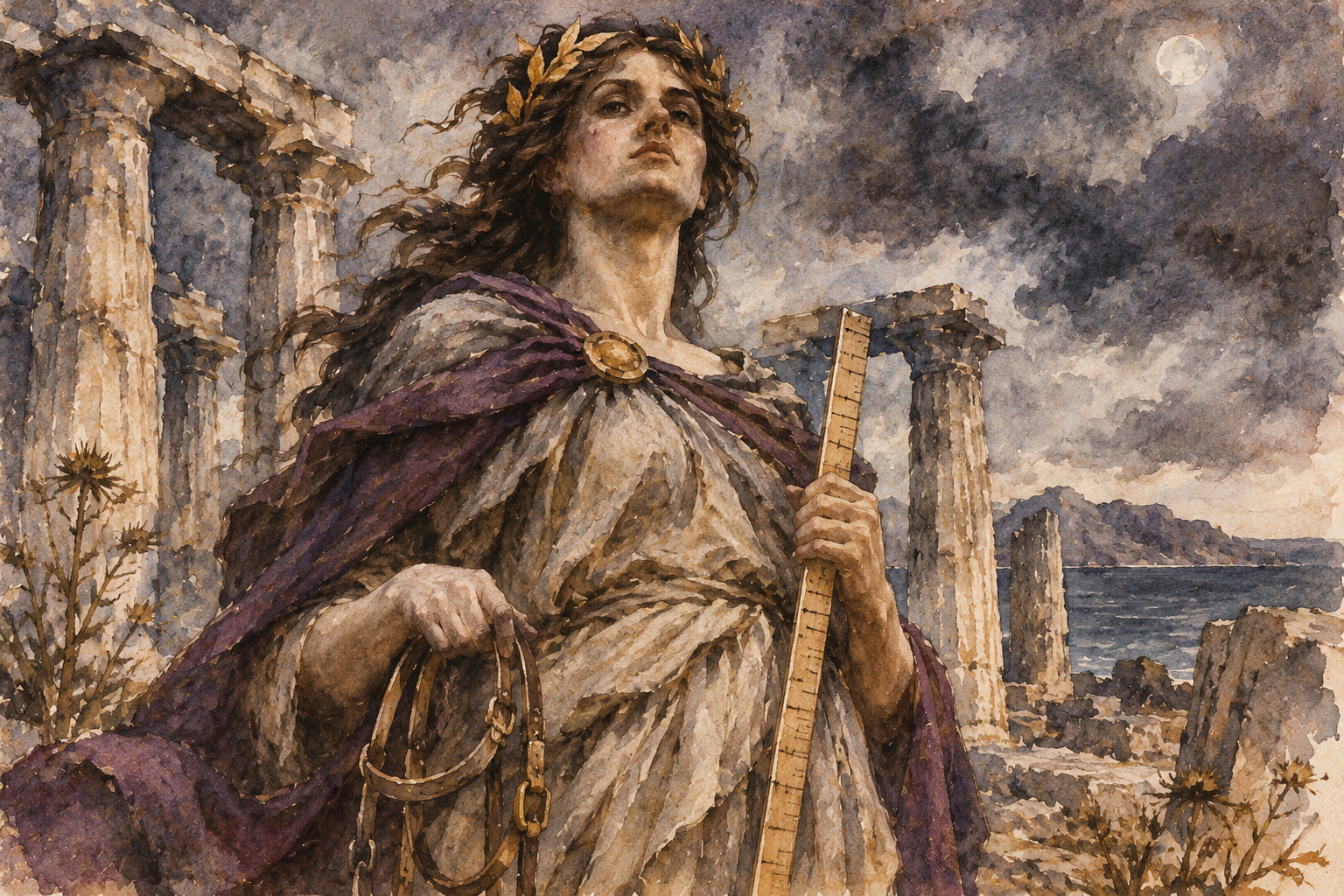
The symbols associated with Nemesis developed over time, and later representations sometimes show her with a measuring rod, a bridle, a wheel, a sword or a scourge. These objects offer a fascinating glimpse into the ways people understood her powers. The measuring rod suggests proper proportion and the setting of limits, while the bridle evokes restraint and control. The wheel recalls the unpredictable turning of fortune, that uncomfortable reality in which today’s triumphant ruler may become tomorrow’s defeated exile. The sword and scourge are rather more direct reminders that the restoration of balance might not be a pleasant experience for whoever had disturbed it. None of these attributes should be treated as a single, unchanging collection carried by the goddess throughout antiquity, but together they demonstrate how her identity expanded and acquired different emphases in different periods.
Nemesis also appears in one of the more peculiar traditions concerning Helen of Troy. Most people are familiar with the story in which Helen is the daughter of Zeus and Leda, but Greek mythology has never been especially interested in maintaining a consistent family tree. Another tradition, preserved in material associated with the lost epic Cypria and in later accounts, identifies Nemesis herself as Helen’s mother. In versions of this story, Zeus pursues Nemesis, who attempts to escape him by transforming herself into different creatures. The tale eventually involves Zeus taking the form of a swan, an egg being produced and Leda becoming involved in Helen’s birth or upbringing. The details vary between sources, and the divine pursuit and coercion involved are rather less romantic than some modern retellings would have us believe. Nevertheless, the connection is intriguing, particularly when we remember that Helen’s story became entangled with the Trojan War and the destruction of powerful kingdoms. It is tempting to see the daughter of Nemesis as an instrument through which pride and ambition bring terrible consequences, although we should distinguish that interpretation from anything the surviving sources explicitly establish.
If one Nemesis seems quite sufficient, the inhabitants of ancient Smyrna apparently thought otherwise. Pausanias records that the city honoured two Nemeses, both regarded as daughters of Night, and their worship was associated with local traditions concerning the city’s foundation. The existence of these twin goddesses is a useful reminder that ancient Greek religion was not a tidy system in which every deity possessed one fixed identity and one universally agreed collection of stories. Religious traditions varied between communities, and the same divine figure might acquire different attributes, relationships and functions depending on where she was worshipped. Nemesis could represent righteous indignation in one context, the reversal of excessive good fortune in another, and a protective or regulating power within the religious life of a particular city.
Her worship continued into the Roman world, where she acquired further associations with fortune, competition and the unpredictable reversals of human life. Images and inscriptions attest to her presence across parts of the empire, and she became connected with settings in which victory and defeat were matters of immediate concern. The world of competitive spectacle was particularly suited to a goddess who reminded people how quickly fortune could change. A champion might enjoy the cheers of a crowd one day and suffer a humiliating defeat the next, while a powerful patron could discover that influence and wealth offered no guarantee of success. Yet even here, Nemesis should not be reduced to a goddess who simply made winners lose. Her significance lay in the relationship between fortune, human behaviour and the limits of power, concepts that mattered enormously in societies where status and public reputation were often fiercely contested.
There is, however, an important distinction between the ancient understanding of Nemesis and the modern idea of justice. We tend to imagine justice as something that ought to be impartial, proportionate and concerned with whether a person has actually done wrong. Ancient Greek attitudes towards divine indignation and excessive prosperity were not always so straightforward. Extraordinary good fortune could itself provoke anxiety, particularly when it appeared to place someone too far above their fellow human beings. The idea that prosperity might attract divine resentment is not especially comfortable to modern sensibilities, and it would be misleading to pretend that Nemesis always operated according to principles we would recognise as fair. She was associated with retribution and the correction of excess, but those concepts belonged to a religious worldview very different from our own.
That complexity is one of the reasons I find her so interesting. It would be easy to turn Nemesis into a rather satisfying figure who appears whenever somebody unpleasant needs taking down a peg or two. The arrogant king loses his throne, the cruel tyrant is defeated, and the insufferably wealthy individual discovers that money cannot buy immunity from embarrassment. There is certainly a place for that sort of story, and Greek mythology provides plenty of examples of powerful people discovering that their confidence was misplaced. But Nemesis represented something more enduring than the pleasure of seeing a thoroughly objectionable person get their comeuppance. She belonged to a way of thinking in which human beings were expected to understand that their achievements, possessions and authority existed within limits. The world was not theirs to command simply because they had enjoyed a run of good fortune.
Perhaps that explains why her name survived long after her temples ceased to function and her worship disappeared. We still speak of a person meeting their nemesis, of an inevitable reckoning or of arrogance finally bringing about its own downfall. The ancient goddess has become a familiar part of our language, even among people who know little about Greek religion. Her name appears in literature, drama, political commentary and everyday conversation, usually at the moment when somebody who seemed untouchable discovers that they are not. The details have changed, and the goddess herself has largely disappeared behind the modern meaning of the word, but the underlying idea remains remarkably recognisable.
There is something wonderfully human about that persistence. Nearly three thousand years after Hesiod wrote about the daughter of Night, we are still fascinated by the relationship between pride, power and consequences. We still watch people become so convinced of their own importance that they disregard advice, ignore warnings and assume that the ordinary rules no longer apply to them. And when their carefully constructed certainty finally collapses, we still reach for the same ancient word. Nemesis has become the name we give to that uncomfortable moment when good fortune runs out and arrogance discovers its limits.
I rather like to imagine her as she might once have stood at Rhamnous, dignified and composed, with the sea beyond the sanctuary and the wind moving through the surrounding landscape. Not shouting, not raging and certainly not rushing about looking for minor offences to punish, but quietly representing a principle that the ancient Greeks considered essential to the proper order of things. Wealth might disappear, kingdoms might fall, reputations might crumble and even the most powerful ruler would eventually discover that he was mortal. The goddess did not need to hurry, because time and fortune were perfectly capable of doing much of her work for her.
And perhaps that is the most enduring lesson of Nemesis. Success is not a crime, ambition is not necessarily a failing, and there is nothing inherently wrong with enjoying the rewards of hard work or good fortune. The trouble begins when people mistake those rewards for proof that they are somehow better than everybody else, or that the consequences of their behaviour are somebody else’s problem. The ancient Greeks gave that dangerous assumption a divine adversary, a daughter of Night who embodied the limits of human arrogance. Her temples may be ruined, but the warning has survived remarkably well. After all, the people most desperately in need of a reminder that they are not above the rules are usually the very last people willing to hear it.