Nobody in Peak Forest could agree how deep Eldon Hole went, although there was no shortage of people willing to tell you what lived at the bottom. Some said the Devil kept a second home down there, away from the noise and inconvenience of Hell. Others maintained that the shaft was bottomless, which seemed a curious arrangement for a hole in the ground, but was generally accepted as fact by anyone who had never troubled themselves to investigate. A goose was once said to have disappeared into its depths and emerged days later from Peak Cavern, miles away, with most of its feathers missing and a very poor opinion of humanity. It was a great tale, much improved by successive tellings, but it was not the one that troubled Ellen Ashmore. Ellen had never believed in the Devil’s goose. She had, however, believed her father.
Thomas Ashmore had been a quiet man, given to hard work, plain speaking and an occasional pint of bitter when circumstances permitted. Before Ellen was born, he had allowed himself to be lowered into Eldon Hole at the invitation of a visiting gentleman who wanted to discover its depth. The gentleman had offered him two sovereigns, a considerable sum for a labouring man with a wife and three children, and Thomas had accepted without consulting anyone. He was lowered on a rope by six men who, according to his account, spent the first half of the expedition laughing and the second half praying. When they finally pulled him out, he was unconscious, bleeding from the nose and missing one of his boots. He recovered sufficiently to walk home that evening but was never quite the same again. He would not go underground, refused to enter a cellar and became violently distressed whenever anyone mentioned Eldon Hole in his presence. When asked what he had seen, he would only shake his head and say that some questions were better left unanswered.
By the time Ellen was old enough to understand such things, her father had grown accustomed to his fears. He continued working, raised his family and rarely spoke of his adventure. But he had one peculiar habit. Every winter, he would fetch an old length of rope from the shed, examine it carefully and tie three knots in the end. He would then untie them, coil the rope and put it away. Ellen had watched this little ceremony for years before finally finding the courage to ask him what it meant. Her father had looked at her for a long time before taking her hands in his. ‘If ever you hear someone calling from a place they oughtn’t to be,’ he told her, ‘you make certain it’s them before you answer.’ She had laughed, thinking he was teasing her, but he squeezed her fingers until she stopped. ‘And if they call you by name, lass, don’t ever tell them they got it right.’
Thomas died the following spring, taking whatever knowledge he possessed to the grave. His family buried him in the churchyard, sold his few possessions and carried on as families generally do when the person who held them together is gone. Ellen eventually married a joiner from Castleton and settled in a little cottage on the road towards Peak Forest. She had two children, lost one to fever and watched the other grow into a cheerful, broad-shouldered young man named Samuel. Her husband’s death left her with a small income, a troublesome chimney and a son who believed himself old enough to make his own decisions. By the autumn of 1891, Samuel was twenty-three, engaged to a girl from Sparrowpit and perpetually short of money. It was therefore entirely unsurprising that he should come home one Thursday evening announcing that a gentleman had offered him a sovereign to help conduct an experiment at Eldon Hole.
Ellen dropped the plate she was drying. Samuel stared at the broken crockery, bewildered by her reaction, and explained that nobody was planning to descend the shaft. The gentleman, a Mr Vane from Manchester, intended merely to lower a weighted rope until it touched the bottom. Samuel and two other men had been hired to assist, and the entire business would be completed before supper. Ellen listened, said very little and spent the night sitting beside the kitchen fire with her father’s old rope across her knees. By morning, she had made up her mind. If Samuel insisted on going, she would go with him. He protested that he was perfectly capable of helping a gentleman lower a piece of iron into a hole without his mother standing over him, but Ellen replied that she had spent twenty-three years keeping him alive and saw no reason to abandon the practice now.
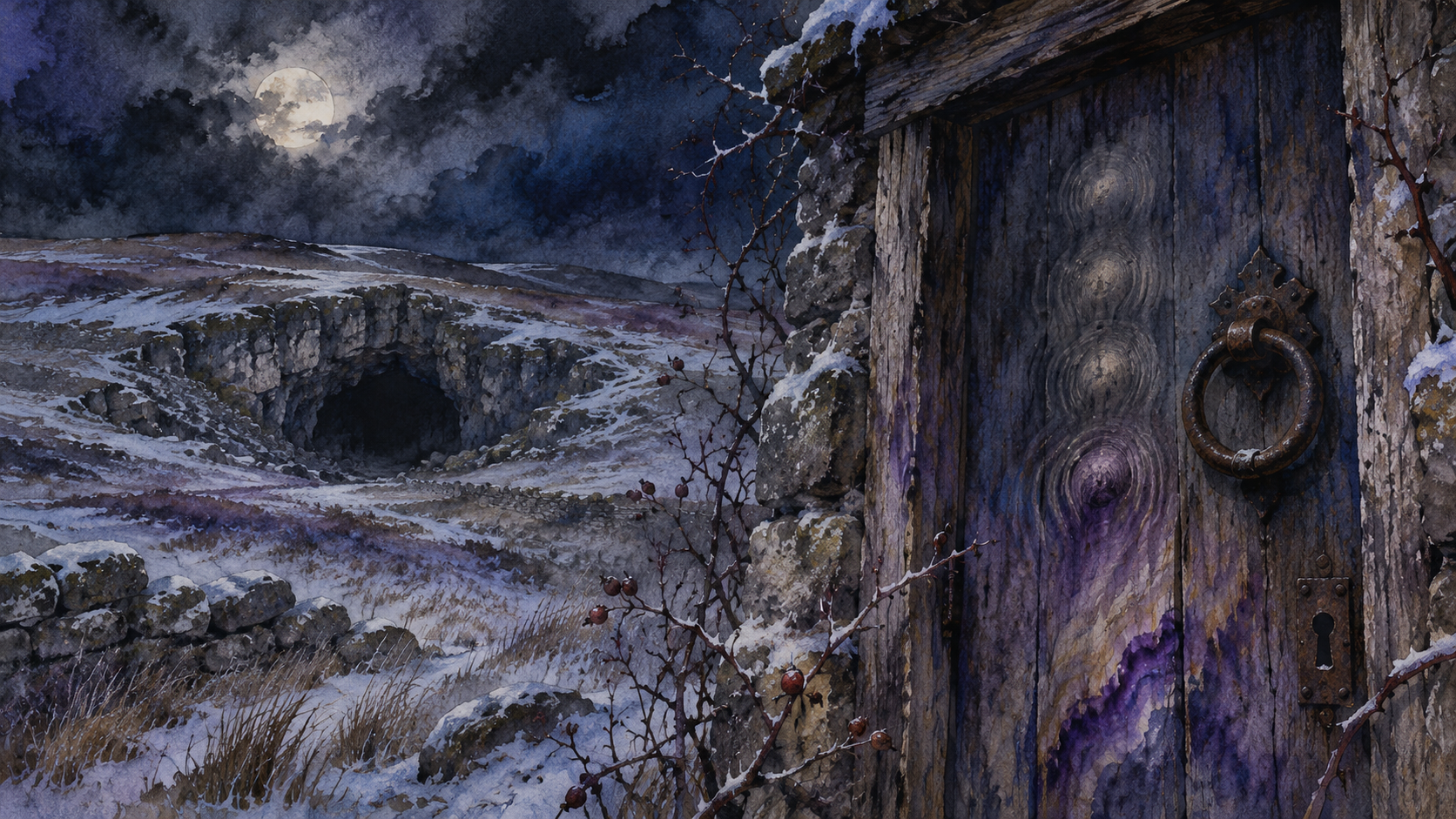
They reached Eldon Hill shortly after ten, under a sky the colour of dirty wool. The grass was wet, and a thin mist crept across the uneven ground, gathering around the limestone as though reluctant to continue downhill. Mr Vane was already there, accompanied by a younger man with a notebook, two labourers and several enormous coils of rope. He was a handsome gentleman with an impressive moustache and an even more impressive opinion of himself. When Ellen introduced herself, he greeted her politely enough, although he made it clear that he considered her presence unnecessary. The purpose of the expedition, he explained, was to establish the true depth of the celebrated chasm and put an end to centuries of ridiculous superstition. Ellen looked into the opening, where the daylight seemed to fall away without illuminating anything, and told him she wished him every success.
The first part of the experiment went smoothly. An iron weight was secured to the rope and lowered over the edge, while Mr Vane’s assistant measured the lengths being paid out and recorded them in his notebook. The men worked carefully, occasionally stopping to listen for the sound of the weight striking rock. Each time, the rope continued downwards, sliding through their hands with scarcely any resistance. Mr Vane grew increasingly delighted. He spoke of discoveries, scientific progress and the ignorance of country people who mistook natural formations for supernatural horrors. Ellen remained silent. She stood a little way from the others, watching the rope disappear into the darkness, and tried not to remember her father’s face when he spoke of the place.
After some time, the rope stopped moving. Samuel gave it an experimental tug and announced that the weight must have reached a ledge. Mr Vane instructed him to raise it a few feet and lower it again, which he did, but the rope remained stubbornly taut. The gentleman knelt beside the opening and peered down, shading his eyes against the weak daylight. He called for a lantern, although there was little hope of its illuminating more than the first few yards of the shaft. As Samuel bent to fetch one, Ellen heard something from below. It was faint, almost lost beneath the wind, but unmistakable.
Three knocks.
She closed her eyes. Her father had always knocked three times on the cottage door when he returned from work, a little signal that saved her mother from getting up unnecessarily. When Ellen and her brothers were children, they had copied it endlessly, tapping on tables and windowpanes until their mother threatened to send the lot of them outside. It had been such an ordinary part of their childhood that Ellen had scarcely thought about it since. Now, standing beside the black mouth of Eldon Hole, she heard those same three knocks rising from somewhere in the earth.
The men were arguing about whether the weight had become lodged between two rocks. None of them appeared to have noticed the sound. Ellen stepped closer to the edge, careful to keep her feet firmly planted on the grass. A cold draught rose from the opening, carrying the damp mineral smell of deep places and something else, something faintly sour that reminded her of old cloth shut away too long. She heard the knocks again, followed by a man’s voice, so quiet that she thought at first she had imagined it. ‘Ellie, lass. Give us a hand.’ She stumbled backwards, and Samuel caught her elbow before she fell. He asked what was wrong, but she could only stare at him. Her father had been dead for nearly thirty years, yet she had heard his voice as clearly as if he had been standing beside her.
Mr Vane had finally decided to recover the equipment. He ordered the men to haul on the rope, and they began pulling it upwards, hand over hand. For the first few yards, it came easily enough, but the weight soon increased until all four men were straining against it. Samuel wrapped the rope around his forearm and leaned backwards, his boots slipping in the wet grass. The line trembled between their hands, not with the irregular movement of an iron weight catching on the rock, but with a steady, deliberate pressure. Something was pulling from below. Mr Vane swore that the weight must have become entangled in some submerged obstruction, a curious explanation considering that nobody had mentioned water. Ellen moved towards her son and told him to let go.
He did not hear her. The rope jerked violently, dragging one of the labourers to his knees, and from the darkness came a noise that made Ellen’s blood turn cold. It was laughter. Not the deep, rolling laughter of some imagined devil, but the thin, delighted giggling of a small child. The sound echoed up the shaft and faded into a succession of whispers, too many to distinguish, as though a crowd of people had gathered somewhere far below and were all speaking at once. Mr Vane went pale. His assistant dropped the notebook and crossed himself. The laughter stopped, and a man’s voice rose from the depths, calling Samuel by name.
‘Sammy, love. Come and fetch me.’
Ellen knew that voice too. She had heard it every day for seventeen years, in sickness and health, through the birth of two children and the burial of one. It belonged to her dead husband.
Samuel froze. The rope slipped through his hands, burning his palms as he stared into the shaft with an expression Ellen never forgot. She seized him by the shoulders and shook him hard enough to make his teeth rattle. ‘That’s not your father,’ she told him. ‘Whatever you hear, don’t answer it.’ He looked at her with frightened, bewildered eyes, and for one terrible moment she thought he might pull away and run towards the opening. Instead, he released the rope and stumbled backwards, nearly falling over Mr Vane’s equipment.
The line was moving again, but no one was pulling it. It slid slowly over the lip of the shaft, inch by inch, as though something below were reeling it in. Mr Vane watched in horror as one of the coils began unwinding across the grass. He made a sudden grab for it, perhaps unwilling to abandon his expensive equipment, and the rope snapped tight, dragging him towards the opening. His assistant caught him around the waist, and the two labourers rushed to help, but the force pulling from below was extraordinary. Ellen could hear the rope creaking under the strain, and beneath that sound came the voices again, rising and falling in a dreadful imitation of human conversation.
Then her father spoke again.
‘You know what to do, Ellie.’
For a moment, she was a child again, standing in the kitchen while her father tied three knots in the end of an old rope. She could see his hands, broad and work-worn, and remember the smell of tobacco on his coat. She had spent half her life wondering what had happened to him in that terrible place, what he had seen that frightened him so badly he could never bring himself to speak of it. Suddenly, she understood. Her father had not been afraid of the darkness or the depth. He had been afraid of the voices. He had heard them when he was lowered into the shaft, had answered them, and had spent the rest of his life terrified that something might one day answer back.
Ellen reached into her basket and withdrew the short, sharp knife she used for cutting twine. Samuel shouted a warning, thinking she meant to approach the edge, but she was already kneeling beside the rope where it crossed the grass. She caught it firmly in one hand and began sawing through the fibres. The men were shouting now, Mr Vane struggling desperately as his boots slid over the wet limestone, while something below continued drawing him towards the opening. Ellen worked with frantic determination, cutting strand after strand until the rope was reduced to a few threads. From the shaft came a great, furious cry, a sound so deep and unnatural that it seemed to vibrate through the ground beneath them.
The final strands parted.
Mr Vane fell backwards into the arms of his assistant, and the severed rope whipped away across the grass. For the briefest moment, Ellen saw it hanging above the opening, suspended in the cold air as though held by an invisible hand. Then it disappeared into the darkness. The cry stopped. The wind died away, and an extraordinary silence settled over Eldon Hill. Nobody moved. Even Mr Vane, who had spent the morning lecturing them about the foolishness of superstition, seemed to have lost the power of speech. At length, Samuel knelt beside his mother and helped her to her feet. She put the knife back into her basket, brushed the grass from her skirts and told him they were going home.
They walked back to Peak Forest without speaking much. Mr Vane and his assistant followed at a distance, carrying what remained of the equipment and looking considerably less enthusiastic about the advancement of science. At the first opportunity, the gentleman departed for Manchester, leaving Samuel’s sovereign with the landlord of the local inn and expressing no desire to repeat his experiment. The two labourers refused to discuss what had happened, although one reportedly began attending church with renewed enthusiasm. Samuel returned to his work, married his sweetheart the following spring and never again went near Eldon Hole. As for Ellen, she placed her father’s old rope back in the shed and tried to forget the voices. For a while, she succeeded.
It was almost Christmas when the knocking began.
At first, she thought it was the wind rattling the loose boards outside her bedroom. The noise came shortly after midnight, three gentle taps followed by a long silence. On the second night, it came again, a little louder and nearer the house. By the third, Ellen was lying awake waiting for it. She had considered telling Samuel, but the young couple were expecting their first child, and she had no wish to burden them with something she could neither explain nor understand. Instead, she kept the fire burning late, checked the bolts on the doors and reminded herself that old houses made all manner of noises in winter.
On Christmas Eve, she was sitting alone beside the hearth when someone knocked at the front door.
Three times.
Ellen did not move. The sound came again, patient and familiar, and she felt tears prick her eyes. She could almost picture her father standing outside, rubbing his hands together against the cold, waiting for someone to let him in. Then a voice spoke from the other side of the door.
‘Ellie, lass. It’s your dad.’
She pressed her hands together in her lap and stared into the fire. The voice sounded tired, rather than threatening, and carried the same gentle Derbyshire accent she remembered from childhood. ‘I’ve come a long way, love. Aren’t you going to open up?’ Ellen closed her eyes. She wanted to believe him. More than anything, she wanted one last moment with the man who had carried her on his shoulders, taught her to mend a fence and held her hand when she was frightened. But she remembered the rope moving across the grass and the terrible strength of whatever had been pulling from the darkness.
‘My dad’s dead,’ she said quietly.
The voice outside sighed. ‘Aye, lass. I know.’
For a long time, neither of them spoke. The fire settled in the grate, and the clock ticked steadily on the mantelpiece. Ellen could hear something shifting on the doorstep, a faint scraping noise accompanied by what sounded like wet rope being dragged across stone. Finally, the voice spoke again, softer than before.
‘You never did ask what I saw down there.’
Ellen swallowed. Her father had been right. Some questions were better left unanswered, and she had waited nearly thirty years to discover whether he had meant it. She rose from her chair, crossed the room and stood beside the door, close enough to feel the cold coming through the cracks around its frame.
‘No,’ she said. ‘And I’m not asking now.’
Something moved on the other side. She heard a long, slow breath, followed by three faint taps against the wood. Then the footsteps retreated, dragging something heavy behind them. Ellen remained beside the door until the clock struck one, listening to the silence and wondering whether she had done the right thing.
When morning came, she opened the door to find the ground covered in fresh snow. The lane was undisturbed, and no footprints approached or led away from her cottage. For a moment, she allowed herself to believe that she had dreamed the whole business. Then she looked down.
On the doorstep lay a short length of old rope.
Someone had tied three knots in the end.
And from somewhere beneath the frozen earth came the faint, unmistakable sound of knocking.
Author’s note: Eldon Hole is a real limestone chasm near Peak Forest, Derbyshire, long associated with tales of a bottomless abyss, the Devil and dangerous descents. This story is an original work of fiction inspired by those traditions. The characters and events described here are imaginary.