Every 23 November, England’s blacksmiths once celebrated their patron saint with feasting, singing, peculiar disguises and enough noise to wake the dead. Meet Old Clem, the unlikely hero of one of our most gloriously eccentric forgotten traditions.
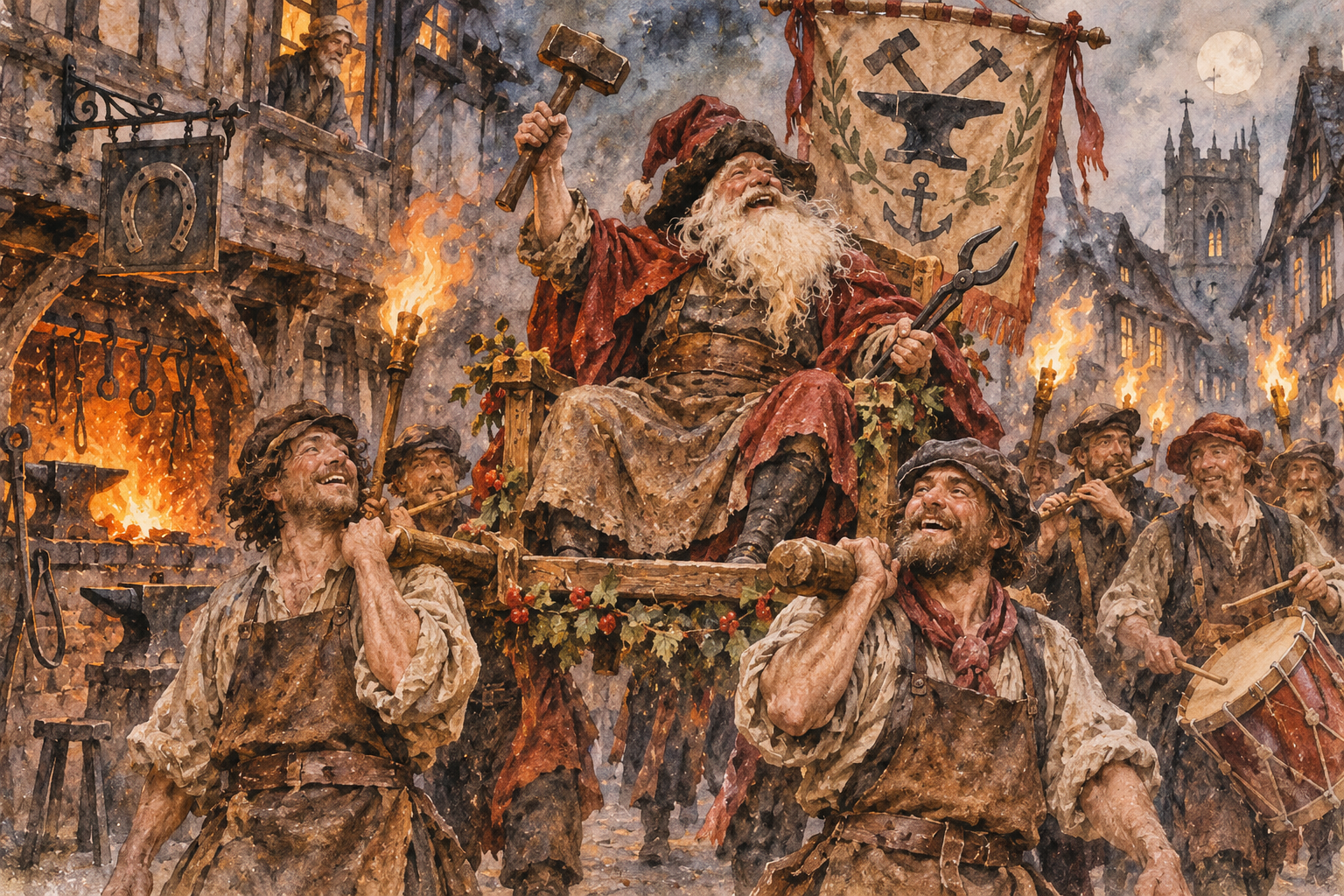
Imagine walking through the streets of Woolwich on a cold November evening, sometime in the early nineteenth century, when the ordinary business of the town is suddenly interrupted by the sound of drums, fifes and a considerable amount of enthusiastic shouting. Around the corner comes a procession of young men carrying torches, banners, flags and an assortment of alarming-looking weapons. In their midst, borne aloft upon a great wooden chair, sits an elderly gentleman with a magnificent white beard, a peculiar wig and a face that nobody can quite recognise. He is holding a hammer and a pair of blacksmith’s tongs, and he appears to be enjoying himself enormously. The procession stops outside a public house, somebody makes a speech, money changes hands, and the whole cheerful company moves on to the next establishment.
Welcome to St Clement’s Day, when England’s blacksmiths put aside their hammers, temporarily abandoned their forges and took to the streets in honour of a saint who, rather improbably, had become one of the most important figures in the folklore of their trade.
His name was Clement, although to the men who celebrated him he was affectionately known as Old Clem, and his annual festival fell on 23 November. For generations, the day was an occasion for feasting, drinking, singing, collecting gifts and generally making an enormous nuisance of oneself in the most good-natured fashion possible. In parts of southern England, particularly Sussex, Kent and the great naval dockyards along the Thames and Medway, it developed into a remarkably elaborate celebration involving costumed processions, traditional songs and the rather startling practice of making anvils explode.
The historical St Clement was an early bishop of Rome, traditionally identified as one of the first successors to St Peter. He lived during the first century AD and became the subject of several stories concerning his life and martyrdom. According to one later tradition, he was condemned to death by being thrown into the sea with an anchor fastened around his neck. The anchor subsequently became his familiar emblem, appearing in religious art and churches dedicated to him, including St Clement Danes in London.
Quite how this early Christian bishop came to be associated with England’s blacksmiths is not entirely clear. Later folklore supplied him with all manner of remarkable achievements, including the invention of various forms of metalworking, but these were imaginative additions to his reputation rather than events from his historical life. The association may have been strengthened by the anchor, a great iron object intimately connected with the smith’s craft, although the full origins of his patronage remain uncertain.
Whatever the explanation, by the early modern period Clement had become firmly established as the blacksmiths’ saint, and his feast day was an occasion worth celebrating.
The most entertaining surviving description of the festivities comes from Woolwich Dockyard, where the apprentices developed an elaborate ceremonial procession in his honour. Writing in his Every-Day Book in 1826, the antiquarian William Hone preserved an account of the custom that gives us a wonderfully detailed picture of proceedings.
One of the senior blacksmiths’ apprentices was chosen to impersonate Old Clem. He was dressed in an enormous greatcoat, his head covered with a wig made from oakum, the loose hemp fibres used in shipbuilding, and his face concealed behind a mask. A long white beard completed the transformation, making him look suitably ancient and distinguished, although one suspects the effect was somewhat undermined by the behaviour of his companions.
The newly appointed Old Clem was seated in a large wooden chair decorated with bunting, topped by representations of a crown and anchor, and surrounded by painted or illuminated panels depicting subjects associated with the trade. These included blacksmiths at work, Britannia with her anchor and, rather magnificently, Mount Etna, the legendary home of Vulcan, the Roman god of fire and metalworking.
A wooden anvil was positioned before him, while he carried a hammer and tongs. His assistant, also disguised, was equipped with a wooden sledgehammer, and together they presided over a procession accompanied by musicians, torchbearers and assorted attendants carrying banners and other ceremonial objects.
It was hardly a modest affair.
Six men carried Old Clem through the streets, accompanied by a drum and fife, while the procession visited blacksmiths, dockyard officials and public houses. At suitable intervals, the company paused to deliver speeches, sing traditional verses and invite contributions towards the evening’s entertainment.
Old Clem himself was expected to give an appropriately grand account of his achievements. In Hone’s version, the disguised apprentice announced himself as the founder of the metalworking arts, claimed to have visited Vulcan’s forge beneath Mount Etna and described an astonishing series of travels through distant lands before arriving at Woolwich to inspect the work of his fellow smiths.
It was a delightful piece of ceremonial nonsense, combining classical mythology, Christian tradition and the considerable confidence of an apprentice enjoying his one day of magnificence.
His assistant then encouraged the assembled company to contribute money and beer to the festivities, reminding everyone that the blacksmiths had come to celebrate their patron saint and expected a suitably generous reception.
Once the procession had made its way around the town and collected enough money, the apprentices retired to a public house, where they spent their earnings on a communal supper.
One cannot help admiring the efficiency of the arrangement. A group of young men organised a procession, elected one of their number to play a saint, visited everyone likely to have money and then used the proceeds to enjoy an excellent dinner. It was folklore, entertainment and fundraising combined, and all without the inconvenience of a modern committee meeting.
Nor were such celebrations confined to Woolwich. At Chatham Dockyard, blacksmiths and apprentices followed a similar custom, dressing one of their number as an elderly man and carrying him through the streets to collect contributions for a feast. The tradition was sufficiently established to be recognised in accounts of dockyard life, and historical records show that the blacksmiths’ annual celebrations were taken seriously enough to be reflected in their working arrangements.
Under regulations introduced in 1723, dockyard smiths were entitled to an additional day’s pay on St Clement’s Day in connection with allowances for their customary celebrations. This is a particularly interesting detail, because it demonstrates that the festival was not simply an informal gathering of apprentices. It was a recognised part of the occupational culture of men whose labour was essential to the operation of Britain’s naval dockyards.
And essential it certainly was. Blacksmiths manufactured and repaired the metal fittings, chains, anchors and countless other objects upon which ships depended. Their work was hot, demanding and often dangerous, requiring considerable physical strength and a high degree of practical skill. The forge was a place of relentless labour, with hammers striking anvils, bellows feeding the fire and iron being worked into the shapes required by the shipwrights and sailors.
Against this background, an annual feast offered more than a welcome opportunity for amusement. It was an expression of pride in the craft, a celebration of shared identity and a chance for apprentices and experienced workers alike to participate in traditions that belonged specifically to their trade.
But if Woolwich and Chatham supplied the elaborate processions, the blacksmiths of Sussex contributed something altogether noisier.
They fired their anvils.
The custom involved producing a loud report from an anvil using gunpowder, transforming an ordinary piece of workshop equipment into a remarkably effective means of announcing the festivities to the surrounding countryside. The practice was described in the nineteenth-century Folk-Lore Journal and in subsequent studies of blacksmiths’ traditions, and it appears to have survived in parts of Sussex well into the modern period.
The result must have been spectacular, particularly in villages where the sudden explosion would have echoed between houses and across the fields. It was also, needless to say, an extremely hazardous pastime, and one that occasionally attracted the disapproval of local authorities.
The same craft that produced horseshoes, farm implements and iron fittings apparently saw no contradiction in celebrating its patron saint by making an enormous bang.
In Sussex, the festivities were closely associated with the blacksmith’s workshop and the local public house. Sometimes an effigy of Old Clem was displayed outside an inn, while elsewhere a costumed representative led a procession through the streets. The celebrations could include songs, communal meals and the collection of contributions, all reinforcing the bonds between craftsmen and the communities they served.
A particularly charming account comes from Twyford in Hampshire, where the antiquarian Gordon P. G. Hills recorded local St Clement’s Day traditions in a paper on blacksmiths’ folklore. He described the old custom of firing anvils, the use of effigies and processions, and the importance of collecting money for an evening feast. By the time he was writing in the early twentieth century, some practices had already disappeared or were remembered chiefly by older inhabitants, but the tradition remained sufficiently familiar to warrant a detailed account.
And Old Clem was not the only November visitor who expected something to eat.
In Staffordshire and Sussex, children also participated in customs known as Clementing or Clemmening, travelling from house to house and singing verses in exchange for apples, pears, nuts, money or other small gifts. The songs varied from place to place, but the general idea was unmistakable. A little seasonal entertainment was offered in the hope of receiving something pleasant in return.
One Staffordshire verse began with the cheerful appeal of ‘Clemany! Clemany!’, before asking for fruit and other provisions. Other versions reminded householders that Clement’s Day came only once a year, an observation which presumably made generosity seem a little less burdensome.
The custom resembles several other traditional English seasonal rounds, in which children or groups of neighbours travelled through their communities singing, performing or requesting contributions. Such practices helped mark the changing year, particularly during the colder months when agricultural activity slowed and communal gatherings became increasingly important.
Interestingly, St Clement’s Day was once regarded in some traditional calendars as the beginning of winter. It fell at a time when the days had grown short, the countryside was settling into the darker season and communities were preparing for the long weeks ahead. A feast accompanied by fire, music and good company must have been especially welcome.
The blacksmith’s place in folklore extended far beyond his annual festival. For centuries, the smith had occupied a distinctive position within European society, possessing the remarkable ability to transform hard metal through heat, strength and skill. To those unfamiliar with the workings of the forge, the process could seem almost magical. A seemingly useless lump of iron emerged from the flames as a knife, a horseshoe, a key or an intricate piece of workmanship.
It is hardly surprising that smiths became associated with powerful supernatural figures. Vulcan and his Greek counterpart Hephaestus were divine craftsmen, while northern European tradition gave us Wayland the Smith, a legendary metalworker whose abilities bordered upon the miraculous. English folklore also preserved stories of St Dunstan, another saint associated with metalworking, who supposedly seized the Devil by the nose with a pair of red-hot tongs.
One can imagine why blacksmiths might have enjoyed such stories. There was something deeply satisfying about belonging to a profession whose legendary representatives could forge thunderbolts, create enchanted objects or administer a thoroughly deserved punishment to the Devil himself.
Yet we should be cautious about assuming that the celebrations of Old Clem were direct survivals of ancient pagan ceremonies. The presence of Vulcan and other mythological figures in the songs and speeches demonstrates how freely later communities borrowed from older traditions, but it does not establish an unbroken line of ritual practice stretching back to antiquity. The surviving evidence is much stronger for the celebrations of working blacksmiths in early modern and nineteenth-century England than for any proposed prehistoric or pagan origin.
By the later nineteenth century, the old customs were beginning to fade. Changes in industrial organisation, the decline of traditional apprenticeships and the transformation of working life gradually weakened the communal practices that had sustained the festival. At Chatham, the procession was eventually restricted to the dockyard itself before disappearing during the 1870s. Elsewhere, celebrations survived only in fragments, in remembered songs, local gatherings or the occasional ceremonial firing of an anvil.
Not everywhere forgot Old Clem, however. In Sussex, enthusiasts and local tradition-bearers have maintained or revived aspects of the old festivities, including celebrations associated with Hastings and the bonfire societies of the county. The persistence of these customs reminds us that folklore is not simply a collection of stories preserved in dusty books. It is something people do, adapt, reinvent and occasionally drag out into the street accompanied by drums and considerable enthusiasm.
Perhaps that is why Old Clem deserves to be remembered. His festival was not attached to a royal court, a great political event or a grand national ceremony. It belonged to working people, to apprentices and craftsmen whose skills were essential to everyday life but whose names rarely appeared in the history books.
For one day each year, the men who spent their working lives beside the forge became the centre of attention. Their patron saint was carried through the streets, their achievements were celebrated, and the ordinary rules of labour gave way to music, laughter and a well-earned feast.
There is something wonderfully human about that.
So, if you happen to pass an old blacksmith’s forge on 23 November, spare a thought for the men who once gathered there to honour Old Clem. Imagine the glowing coals, the smell of hot iron, the sound of hammers and the sudden appearance of a thoroughly ridiculous old gentleman being carried through the streets by a gang of enthusiastic apprentices.
And should you hear a tremendous bang echoing across the countryside, it might be worth remembering that, historically speaking, blacksmiths were not always content to celebrate their patron saint quietly.
Old Clem is coming, and he expects a proper welcome.