There is something wonderfully British about looking at a potentially catastrophic weather event and deciding that what it really needs is a funfair. We have a remarkable talent for making the best of dreadful circumstances, preferably with something to eat, something to drink and an opportunity to charge other people for the privilege. And nowhere was this national characteristic more spectacularly demonstrated than in February 1814, when the River Thames froze over and the inhabitants of London responded by building what amounted to a small town on top of it. There were market stalls, drinking establishments, dancing, fairground amusements, printing presses and enough dubious commercial enterprises to suggest that the entrepreneurial spirit was alive and well, even if the river wasn’t going anywhere. There may even have been an elephant, although we shall come to him shortly.
The winter of 1813–1814 had been a particularly unpleasant one, even by the standards of an age accustomed to considerably colder winters than those we generally experience today. Britain was still experiencing the effects of the climatic period commonly called the Little Ice Age, during which prolonged spells of severe cold were more frequent, and London’s inhabitants had already endured weeks of freezing temperatures, heavy snow and considerable disruption. The Thames was especially vulnerable to freezing because it was a very different river from the one we know today. It was wider, shallower and slower-moving, while the medieval London Bridge, with its nineteen narrow arches and enormous supporting piers, effectively acted as a partial dam. Ice and debris accumulated around the structure, further restricting the flow of water, until sufficiently severe weather could transform great stretches of the river into a frozen landscape.
The Thames had frozen before, of course, and Londoners had been holding winter entertainments upon its surface for centuries. The Great Frost of 1683–1684 had produced an especially magnificent fair, complete with shops, games, roasting meat and even a commemorative printing press visited by Charles II. But the winter of 1814 would produce the last great Frost Fair, and, as it turned out, one of the most extraordinary. By the end of January, enormous masses of floating ice had accumulated between London Bridge and Blackfriars Bridge, becoming increasingly solid as the cold continued. On 31 January, crowds gathered to watch adventurous pedestrians cross the frozen river, and contemporary accounts record that as many as seventy people were observed making the journey from Queenhithe to the opposite bank. By 1 February, enterprising watermen had begun advertising safe passages across the ice, and the great transformation was underway.
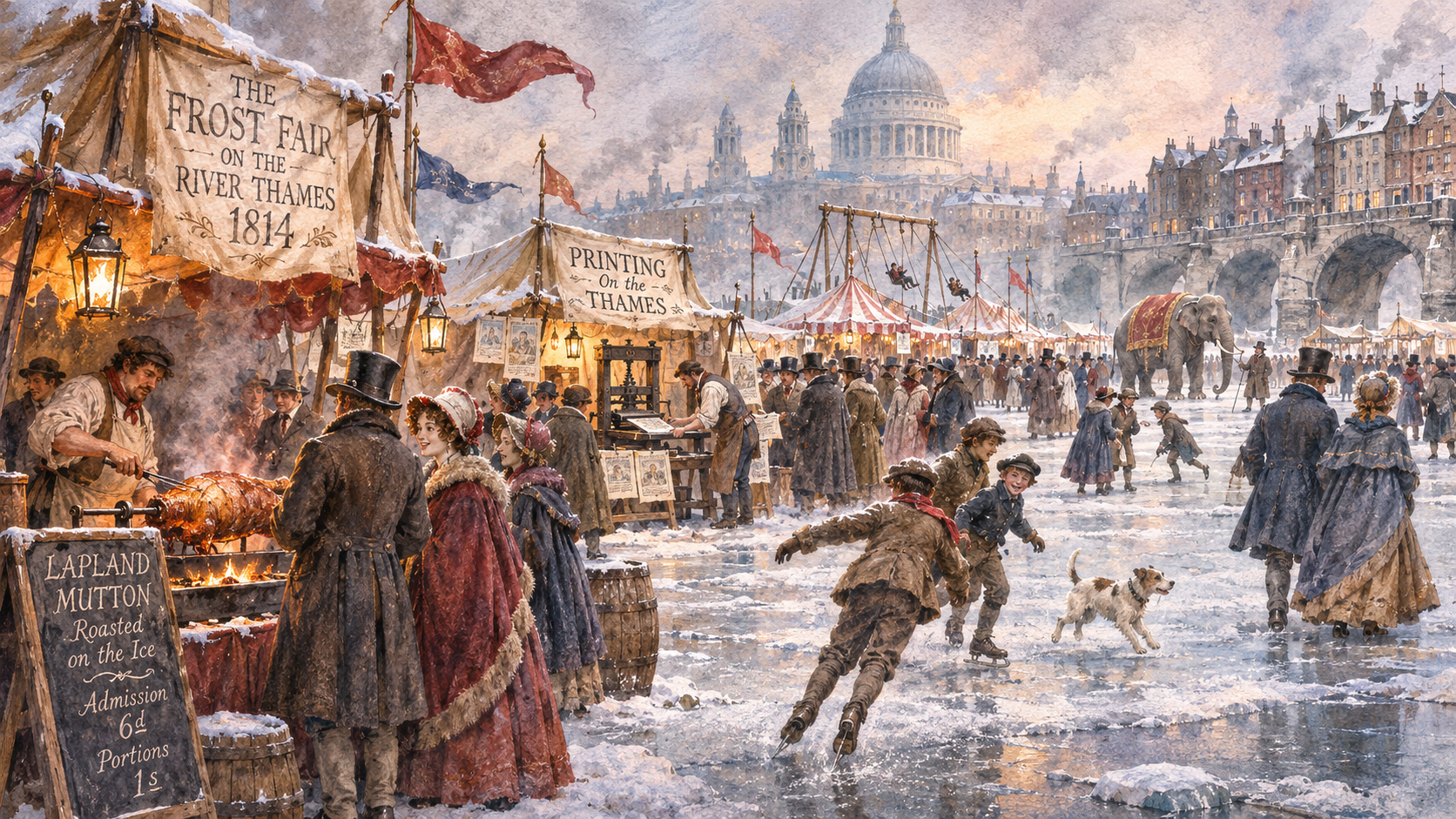
Within an astonishingly short time, the frozen river had become a bustling thoroughfare. A broad route running between London Bridge and Blackfriars was christened the City Road, while traders erected booths and tents on either side, decorating their establishments with flags, banners and cheerful signs. There were stalls selling gingerbread, beer, gin and all manner of refreshments, while visitors wandered among the attractions, slipping, sliding and presumably wondering whether the entire enterprise was quite as sensible as everybody seemed to think. Some of the watermen, whose ordinary livelihoods had been interrupted by the frozen river, found a profitable alternative in charging admission to the fair. Visitors reportedly paid two or three pence to gain access, and a further gratuity might be expected when they wished to return to dry land. One contemporary account claimed that certain watermen made as much as six pounds in a single day, a considerable sum at the time, proving that even a frozen river could provide a surprisingly lucrative business opportunity.
The food was another attraction, although the organisers appear to have understood the commercial value of making a spectacle out of something relatively ordinary. One enterprising individual roasted a small sheep over a coal fire contained in a large iron pan, charging spectators sixpence simply to watch the proceedings. Once the unfortunate animal had been cooked, portions were sold for a shilling each under the wonderfully exotic description of ‘Lapland mutton’. Quite what distinguished this particular sheep from any other beyond the fact that it had been roasted in the middle of a frozen river is difficult to establish, but the novelty evidently appealed to the crowds. Other accounts describe oxen and sheep being roasted whole, while stalls offered hot drinks, pies, sweetmeats and whatever else the vendors thought they could persuade their increasingly cold customers to purchase. The atmosphere must have been extraordinary, with smoke rising from cooking fires, the smell of roasting meat drifting across the ice and hundreds of voices competing with the cries of tradesmen determined not to miss their opportunity.
There was entertainment aplenty, too. Swings were erected, skittles were played, musicians performed and people danced to the sound of fiddles. Some of the more inventive revellers even made use of boats and barges stranded in the ice, transforming them into temporary venues for entertainment. Others took advantage of the unusual surface for skating, sliding and races, while gambling stalls offered opportunities to lose one’s money without having to venture into any of London’s more established dens of iniquity. Contemporary observers were not entirely impressed by the honesty of the gaming establishments, and one description of the fair suggested that customers might find themselves relieved of every penny, including the money needed to pay for their passage back to shore. There is something reassuringly familiar about that particular complaint. Apparently, the British fairground tradition of discovering that an apparently simple game is considerably more expensive than anticipated was already well established.
Perhaps the most remarkable businesses operating on the ice, however, were the printing presses. By 2 February, between eight and ten presses had reportedly been established on the frozen Thames, producing everything from verses and commemorative cards to personalised souvenirs recording the owner’s visit. For a few pennies, a visitor could purchase a printed keepsake bearing the date and the extraordinary claim that it had actually been printed upon the river itself. Some printers employed elaborate decorative borders, while others produced witty verses celebrating the Great Frost or making jokes about the freedom of the press, which was, quite literally, operating in the middle of the Thames. These little pieces of ephemera were not simply novelty items. They were tangible evidence of an event so unusual that their purchasers evidently wanted future generations to know they had been there.
And future generations have indeed benefited from their enthusiasm, because original Frost Fair souvenirs survive in museum collections today. The London Museum preserves several remarkable examples, including a printed keepsake produced opposite Queenhithe Stairs on Friday 4 February 1814. Another, printed on 5 February, takes the form of an amusing notice ordering Jack Frost to surrender his occupation of the river immediately, with the notice supposedly issued by a character called A Thaw. It is a delightful glimpse into the humour of the period, and one cannot help admiring the ingenuity of printers who recognised that a temporary inconvenience to London’s shipping industry could be transformed into a market for commemorative stationery. There was even a book called Frostiana, published during the extraordinary winter, which gathered accounts of the freezing Thames and other examples of severe weather. Whatever else may be said about the Frost Fair, it was exceptionally well documented for an event that lasted only a handful of days.
And now we must address the elephant.
According to a story repeated in numerous accounts of the Frost Fair, an elephant was led across the frozen Thames somewhere near Blackfriars Bridge, demonstrating just how solid the ice had become. It is an absolutely magnificent image, and one that deserves to be true. Unfortunately, establishing precisely when this happened, who owned the elephant or where the animal had come from is rather more difficult. The tale appears regularly in modern retellings, but I have been unable to identify a contemporary newspaper report or eyewitness account confirming that an elephant actually made the crossing. This is particularly interesting because the surviving descriptions of the fair are otherwise remarkably detailed. They record sheep, donkeys, printing presses, drinking booths, accidents and all manner of relatively unremarkable incidents, yet the elephant appears to have escaped the attention of the contemporary chroniclers. That does not prove the story is false, of course, but until somebody produces convincing evidence, I think we must leave our enormous friend standing rather uncertainly on the riverbank.
What certainly did occur was a rather less amusing series of accidents, for the Thames was never quite as reliable a foundation as the enthusiastic fairgoers might have wished to believe. Even during the opening days, dangerous gaps remained between sections of ice, and a young plumber named Davis reportedly drowned after attempting to cross near Blackfriars Bridge while carrying lead. Several other people narrowly escaped similar fates, including three young Quaker women whose unexpected encounter with the freezing water became the subject of some rather uncharitable contemporary amusement. On 4 February, an elderly man and two boys found themselves floating helplessly downstream when their section of ice broke away from the main body, although they were subsequently rescued by boatmen near Billingsgate. It was a sobering reminder that beneath the bustling fairground, the Thames remained a tidal river with considerable power.
By Saturday 5 February, the weather had begun to change. A southerly wind brought milder conditions, and although thousands of visitors continued to enjoy the festivities, the ice was becoming increasingly unstable. Four donkeys were reportedly observed trotting along the frozen thoroughfare, producing considerable amusement among the spectators, while the drinking tents remained busy and the gamblers continued to ply their trade. But the thaw was gathering strength, and by evening the ice was beginning to crack and break apart. Booths and printing presses were swept away, traders scrambled to retrieve their possessions, and the extraordinary little settlement that had appeared almost overnight began to disappear just as quickly. Two young men drowned after venturing onto a detached piece of ice near Westminster Bridge, despite warnings about the danger.
The following morning brought one final, extraordinary incident. A booth erected near Queenhithe had been left in the care of several men, but when the thaw and tide carried it away during the early hours of 6 February, the occupants found themselves drifting helplessly downstream. To make matters considerably worse, a fire broke out inside the structure when its neglected flames caught the covering. The men escaped into a passing lighter, which was subsequently smashed against Blackfriars Bridge, although contemporary accounts indicate that all nine eventually reached safety. It was an appropriately chaotic conclusion to an event that had begun with the simple observation that the river looked solid enough to walk upon.
The Frost Fair of 1814 was the last great celebration of its kind on the Thames, although the river experienced further severe freezing conditions in later years. The disappearance of the fairs was not simply the result of changing weather. During the nineteenth century, major engineering works transformed the river, including the replacement of the old London Bridge with a new structure whose wider arches allowed the water to flow more freely. Dredging and the construction of the Thames Embankment also altered the river’s depth, width and current. Combined with the longer-term changes in Britain’s climate, these developments made the spectacular freezes of earlier centuries increasingly unlikely. London’s frozen winter playground became a historical curiosity, preserved in paintings, engravings, printed souvenirs and the occasional thoroughly improbable story about an elephant.
There is something rather magical about the Frost Fair, despite the genuine dangers and the hardship that accompanied the severe winter. For a few extraordinary days, the familiar geography of London was turned upside down. A river that had carried merchants, sailors, passengers and cargo for centuries became a street, a marketplace, a dance floor and a printing office. People who ordinarily travelled above the water in boats found themselves walking beneath the bridges, looking up at the city from an entirely unfamiliar perspective. Even the most ordinary activities must have felt wonderfully strange when performed in a place where they had no business taking place.
And although I am perfectly happy to admire the ingenuity of those Georgian Londoners, I think I shall continue to enjoy my winter fairs on something considerably more substantial than a frozen tidal river. Preferably with a mug of mulled wine, a roaring fire and absolutely no chance of finding myself floating past Blackfriars Bridge in a burning refreshments tent.
Although, if somebody can prove the elephant was there, I would dearly love to meet him.
Sources and further reading
- Frostiana; or, A History of the River Thames in a Frozen State (London, 1814). Read the historical text.
- London Museum, Frost Fairs: Festivities on a Frozen River Thames.
- London Museum, Frost Fair Keepsake, 4 February 1814.
- London Museum, Frost Fair Keepsake, 5 February 1814.
- William Andrews, Famous Frosts and Frost Fairs in Great Britain (1887). Project Gutenberg edition.
- University of Reading Special Collections, Carnivals on the Water: The Thames Frost Fairs.