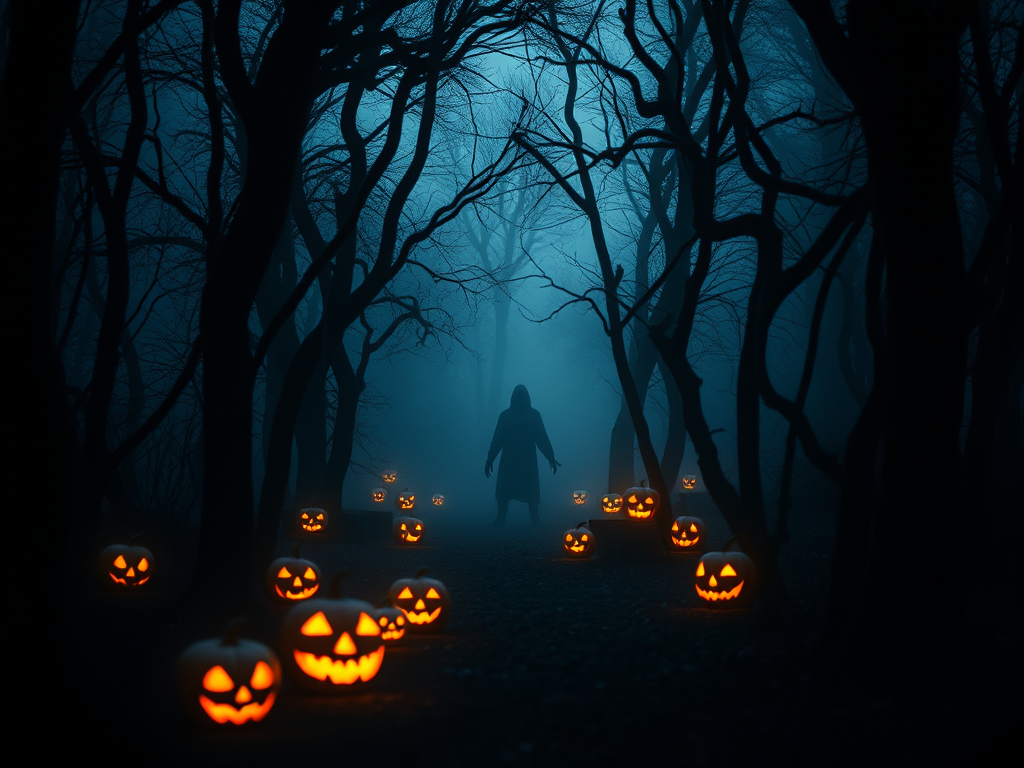
The fear of the supernatural is one of humanity’s oldest and most complex anxieties. It is a fear that resides deep within us, rooted in our psychology and in the ways our ancestors tried to make sense of the unexplainable world around them.
Halloween, as a holiday, is almost a celebration of this fear; it is a time when we embrace the eerie, the ghostly, and the unknown, revelling in things that would otherwise cause discomfort or fear. But why do we fear the supernatural, and why is Halloween the time when we choose to confront it? To explore this, we need to understand how the supernatural has played a role in human history, how these fears are woven into the fabric of our cultures, and how Halloween serves as a unique occasion where these fears are allowed, just for a moment, to come to life in a controlled and often enjoyable way.
The origins of supernatural fear trace back to the earliest human societies, where people relied on myths and legends to explain the natural and often dangerous world around them. Thunderstorms, illness, crop failures, and death, all were mysteries for which ancient people sought explanations, often finding answers in gods, spirits, or demons. The idea that there might be unseen forces at work in the world brought a kind of fearful respect for nature’s unpredictability. But it also brought a belief in entities that lived outside human understanding, entities that could not be controlled, entities that could be malevolent.
Ancient humans lived in close harmony with the land and the seasons, deeply attuned to the cycles of life and death, and for them, the veil between the physical and the spiritual world was thin. They didn’t have the scientific explanations we rely on today, and this lack of understanding often made people look for supernatural causes to explain frightening and tragic events. Fear of the supernatural, then, was a way to make sense of things that couldn’t otherwise be explained.
As humans developed more complex societies, these beliefs evolved. Different cultures across the world developed their own folklore, each with its unique array of supernatural beings. In European traditions, there were vampires and witches, creatures that inspired both fear and fascination. In other cultures, there were jinn, nature spirits, and demons. Each culture had its own stories about spirits who returned from the dead, about the consequences of angering a god, or about the dangers of interacting with the supernatural.
What is fascinating is that nearly every culture has developed a belief in some kind of supernatural being or force, suggesting that the fear of the unknown and the supernatural is a near-universal human trait. While the specifics vary widely, the fear at the core remains the same, a fear of what we cannot see, of things that do not follow the rules of our natural world, of things that might seek to harm us without us ever knowing why.
Halloween taps into this rich cultural history of supernatural belief. Halloween’s origins lie in the ancient Celtic festival of Samhain, a time when people believed that the boundary between the world of the living and the world of the dead was especially thin. During Samhain, people would light bonfires and wear costumes to ward off spirits, hoping to protect themselves from any malevolent beings that might cross over from the spirit world. This was a night when people embraced their fears, but with caution. They acknowledged the spirits but hoped to keep them at a distance.
Even when Samhain later merged with Christian traditions to become All Hallows’ Eve and eventually Halloween, the themes of ghosts, spirits, and other supernatural beings remained central. The fear of these beings became a part of Halloween’s identity.
Today, we celebrate Halloween in a much different way, but we still put up skeletons and ghost decorations and tell scary stories. Halloween has become a way for us to acknowledge these age-old fears, to play with them, and to remember that the supernatural still holds a certain fascination over us.
Why, though, do we still fear the supernatural even in an age where we have so many scientific explanations for things that were once mysterious?
One reason is that fear of the supernatural is deeply embedded in our psychology. Evolutionarily, humans are hardwired to be cautious of the unknown. When we hear a noise in the dark, our first instinct is often fear, because, in ancient times, such a reaction might have saved us from a lurking predator. Even though we know there isn’t a ghost or monster in the room, a strange sound can still send a chill down our spine.
This fear response has been crucial for human survival; it kept our ancestors vigilant and aware of potential threats in their environment. The supernatural embodies that feeling of uncertainty and potential threat. It taps into our instinctive need to be on guard, to protect ourselves from things that might cause us harm, even if they exist outside our understanding.
But it isn’t just fear that draws us to the supernatural; it is also curiosity. Humans have always had a fascination with what lies beyond, with things we can’t see or fully understand. Ghosts, spirits, and other supernatural beings represent a world that exists beyond our senses, and for many (me included) they offer a glimpse of what might await us after death.
The supernatural raises questions about what it means to be human, about the soul, about existence beyond our physical bodies. In a strange way, the supernatural allows us to confront our own mortality.
Halloween becomes a time when we can explore these questions in a way that is both safe and entertaining. By dressing up as ghosts or watching horror movies, we can experience the thrill of fear without real danger. Halloween gives us the opportunity to face these questions about life and death, and to do so in a way that feels playful rather than threatening.
Another reason the supernatural continues to captivate us is because of the social aspect of fear. Fear is often heightened when it is shared. There is a reason that horror movies are more enjoyable when watched with friends, or that haunted houses feel scarier when we are surrounded by others.
Halloween has become a time when communities come together to celebrate fear collectively. Haunted houses, corn mazes, and Halloween parties all allow people to share in the experience of fear in a way that feels almost like a ritual. We may laugh or scream, but the shared experience brings a sense of camaraderie. Together, we are braver, and Halloween becomes an occasion for bonding over shared scares.
Halloween’s appeal is also rooted in its ability to allow us to become something else for a night. Costumes are an essential part of the holiday, and they allow us to play with identity and to become something other than ourselves. When people dress as witches, vampires, or monsters, they are temporarily stepping into the role of the things they fear.
This act of becoming the very thing that frightens us is almost cathartic. For a night, we can shed our ordinary lives and adopt a new persona, one that might be fearsome, powerful, or mischievous. This can be thrilling, as it allows us to explore the darker sides of our personalities without consequences.
The act of dressing up also distances us from the real fears that the supernatural might hold. By embodying the thing that scares us, we gain a sense of control over it. This is why Halloween is such a unique time; it gives us a chance to confront our fears in a way that feels safe and even empowering.
The commercialization of Halloween has also played a role in how we perceive and experience the supernatural today. Decorations, horror movies, and haunted attractions have turned Halloween into a holiday that is as much about entertainment as it is about fear. While some may argue that this commercialization has diluted Halloween’s original meaning, others would say it has made the holiday more accessible.
Horror movies, in particular, have become a way for people to experience the fear of the supernatural without real danger. These films tap into our most primal fears – the dark, the unknown, the idea of malevolent forces – and package them in a way that feels thrilling rather than terrifying.
Halloween has become a time when people can seek out these scares, knowing that they are ultimately in control. The rise of haunted attractions and ghost tours also allows people to experience the thrill of the supernatural in a setting that feels both immersive and safe. By commercializing Halloween, we have found ways to enjoy our fears and even to profit from them.
For many, Halloween has become a beloved holiday precisely because it allows us to confront our fears in a way that feels enjoyable. It is a time when we can explore the supernatural without feeling truly threatened. We can laugh at our fears, play with them, and use them as a source of entertainment.
But beneath the surface, Halloween is still a reminder of those age-old questions that have haunted humanity for centuries. It is a reminder of our fascination with the unknown, of our fear of death, and of the thin line that separates the world of the living from the world of the dead. Halloween allows us to play on that boundary, to confront the things we cannot explain, and to do so with a sense of fun and adventure.
In the end, the fear of the supernatural is as much a part of us as our need for food or shelter. It is a fear that speaks to something deep within us, a fear that has been passed down from generation to generation.
Halloween offers a way for us to explore this fear in a way that feels both safe and thrilling. It is a time when we can remember the stories of our ancestors, when we can acknowledge the mysteries of life and death, and when we can laugh in the face of our deepest fears.
Halloween, with all its costumes, decorations, and traditions, is a celebration of that fear – a chance for us to come together and remind ourselves that the supernatural, no matter how frightening it might be, will always hold a place in our hearts and minds.
So each year, as October 31st rolls around, we gather once again to celebrate the unknown, to laugh at our fears, and to remember that, sometimes, it is the things we cannot see that have the greatest power over us.


Leave a Reply