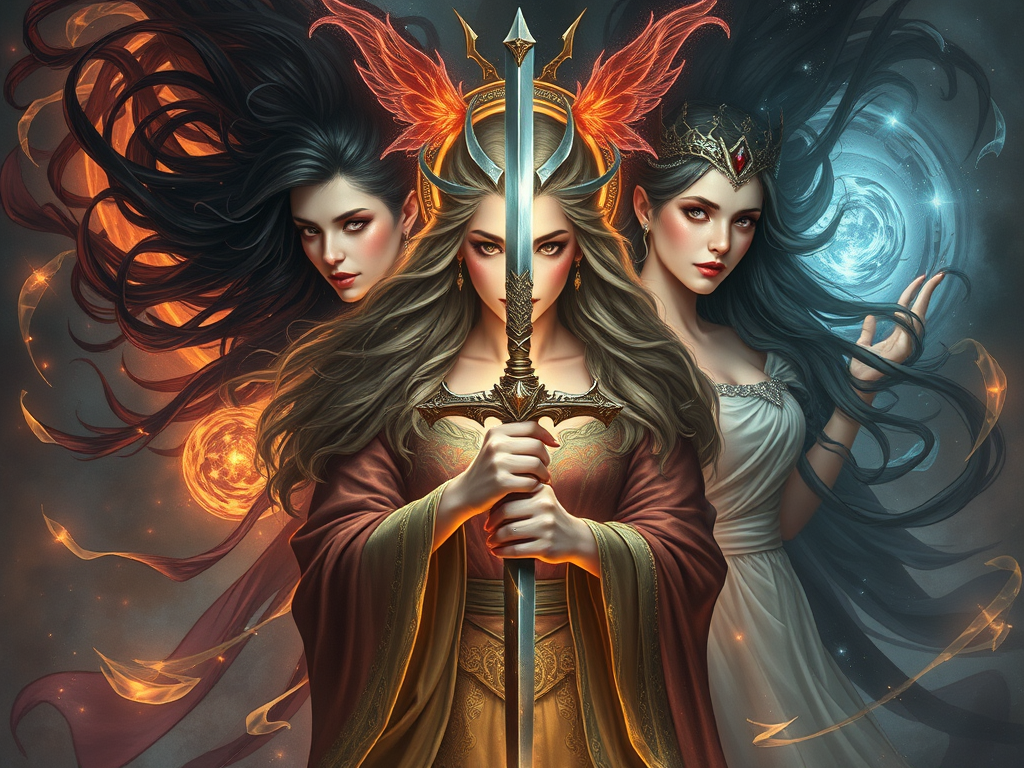
The Arthurian legends are full of knights, magic, and mystery, but some of the most intriguing characters are the women who move through these stories.
Hellewes, Nimue, and Morgan le Fay stand out as powerful, magical figures who don’t quite fit into the roles laid out for them by the male-dominated world of King Arthur and his knights. These women – witches, enchantresses, or fairies – represent something deeper, often tied to ancient concepts of feminine power and mysticism.
While they’ve often been cast as villains or dangerous seductresses, looking closer reveals them as symbols of the divine feminine: a power that’s mysterious, intuitive, and impossible to fully control.
Hellewes, though less well-known than Nimue or Morgan le Fay, is still a fascinating figure in Arthurian lore. Her story unfolds in The High Book of the Grail, where she falls hopelessly in love with Sir Gawain. But Gawain doesn’t return her feelings, and Hellewes, instead of being a damsel in distress, turns to magic to either win his love or destroy him. Her love for Gawain becomes an obsession, and her magical powers – fuelled by emotion – begin to spiral out of control. She represents a side of feminine power that can be chaotic when unacknowledged, dangerous when rejected.
Hellewes isn’t just an angry sorceress. She’s a reminder of the creative and destructive forces that lie within the feminine, especially when that power is suppressed or misunderstood.Hellewes is a figure who taps into something primal: the idea that desire, when unfulfilled, can become something dark and uncontrollable.
But even in her eventual death, there’s a sense of tragic loss, as if ignoring her passion and magic was a mistake – one that reflects the broader idea that the feminine, if not respected or embraced, has the potential to turn inward and collapse.
Her character illustrates the age-old fear and fascination with feminine desire and power, forces that can’t simply be brushed aside or ignored.
Nimue, or the Lady of the Lake, offers a different take on feminine power. She’s most famous for two key roles in the Arthurian stories: giving King Arthur his magical sword, Excalibur, and later trapping Merlin in an enchanted prison.
Nimue’s magic isn’t wild like Hellewes’ but more controlled, more rooted in wisdom. She’s not out of control, but she operates outside the structured, male-dominated world of Arthur and his knights. Merlin, Arthur’s great advisor, represents traditional patriarchal wisdom, but Nimue, with her intuitive magic, outwits him. Her trapping of Merlin can be seen as an act of reclaiming female power – an assertion that the mysteries of the feminine are beyond male understanding or control.
But Nimue isn’t just a figure of subversion. She’s also a protector and guide. She gifts Arthur Excalibur, the symbol of his kingship, and in some versions, raises Lancelot, Arthur’s most trusted knight. These nurturing qualities balance her more dangerous side, showing the dual nature of the feminine. Like the water she’s connected to – calm but also deep and potentially dangerous – Nimue represents the feminine’s ability to give life and guidance while also holding secrets and power that can’t easily be grasped or contained.
Morgan le Fay, however, is the most complex and well-known of the three. Her character evolves over time, from healer to villain, and her story is deeply tied to the shifting views on female power in medieval Europe. In the earliest versions of the legend, Morgan is a healer, skilled in magic and devoted to helping Arthur and his knights. But as her role grows, she becomes more antagonistic, often plotting against Arthur and the kingdom of Camelot.
Morgan’s shift from healer to dark sorceress mirrors how many ancient goddesses, once worshipped for their power, were demonised as Christianity took hold in Europe. Early on, goddesses could embody both life-giving and destructive forces, but over time, these powerful female figures were increasingly seen as dangerous.
Morgan’s journey reflects this shift, as the divine feminine – once revered for its complexity – becomes feared, especially when it can’t be controlled.
Morgan is often cast as a villain, but even in her darkest moments, she’s never weak. She’s not simply an evil witch; she’s a figure of immense strength and autonomy, rooted in older traditions of female magic that don’t fit into the rigid morality of Arthurian chivalry.
Her name, “le Fay,” connects her to the world of fairies, beings tied to nature and forces beyond human understanding. This link places her in the realm of the divine feminine, which, like nature itself, is neither wholly good nor evil but something deeper, more primal, and not bound by human rules.
Taken together, Hellewes, Nimue, and Morgan le Fay represent different aspects of the divine feminine in Arthurian legend. Hellewes is the embodiment of unfulfilled desire and the chaos that can come from ignoring feminine power. Nimue reflects the nurturing, guiding side of the feminine, but with an edge of untamable mystery. And Morgan le Fay, with her deep connection to ancient magic, stands for the full force of female autonomy, a power that both creates and destroys.
These women operate outside the traditional roles expected of them in the Arthurian world. They aren’t simply queens, wives, or mothers; their power is rooted in magic and in their connection to the natural world. And it’s this power that makes them both alluring and dangerous to the men around them.
But what’s crucial is that their magic doesn’t come from men or depend on male approval. Their power is their own, drawn from deeper, older sources of feminine wisdom and strength.
Their stories remind us of the ways in which the divine feminine has been misunderstood, feared, and, at times, suppressed throughout history. But no matter how much their power is feared or rejected, it remains a vital force in both the myths of the past and in modern interpretations of their characters.
Hellewes, Nimue, and Morgan le Fay continue to captivate because they embody a power that transcends time, feminine energy that is mysterious, complex, and ultimately unstoppable. Today, their stories resonate even more deeply as we continue to grapple with the tension between patriarchal structures and the enduring, uncontainable power of the feminine.



Leave a Reply