Britain is not particularly famous for vampires.
We have ghosts by the cartload. Black dogs lurking on lonely roads. Witches, boggarts, screaming skulls, headless horsemen and enough spectral monks to populate a moderately successful monastery.
But vampires?
For those, we generally look east.
There is, however, one English vampire which has stubbornly refused to die. Appropriately enough.
Search for the Vampire of Croglin Grange today and you will usually encounter something presented as a remarkably detailed historical incident.
In 1875 we are told, three siblings named Amelia, Edward and Michael Cranswell rented an old house in Cumberland. One oppressive summer night, Amelia was attacked in her bedroom by a hideous creature which came from the direction of the churchyard. Her brothers pursued it but it escaped.
The following March it returned, and this time one of the brothers shot it. The creature fled to a family vault, where the following day the siblings discovered a shrivelled corpse bearing a fresh bullet wound. They burned it, as you would.
It is one of Britain’s most famous vampire stories. There is just one rather substantial problem.
The earliest written account doesn’t say that. It doesn’t mention Amelia Cranswell. It doesn’t mention Edward or Michael either and it certainly doesn’t say the attack happened in 1875. Because it couldn’t have done. Because the complete story had already been told by then.
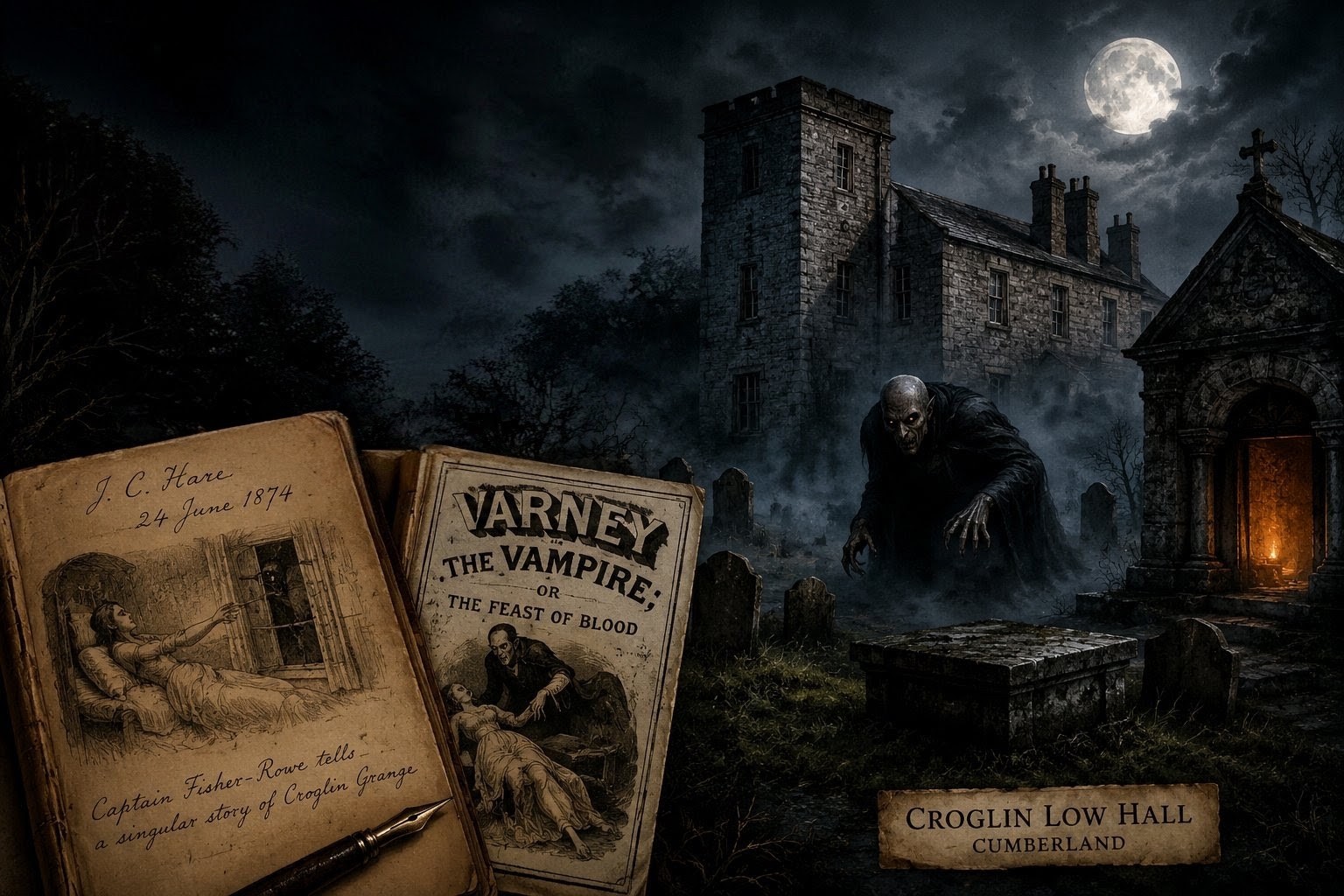
The earliest source I have located is Augustus J. C. Hare’s ‘The Story of My Life’, Volume IV, published in 1900. But Hare didn’t claim to have invented the tale. He recorded it in a journal entry dated ’24 June 1874, when Captain Edward Rowe Fisher – later Fisher-Rowe – told him what was apparently a family story.
Hare records Fisher saying that his family had possessed an ancient Cumberland property called Croglin Grange for hundreds of years. Eventually the family became too prosperous for the curious old house and moved south to Thorncombe near Guildford, letting Croglin to three tenants. Hare describes them only as “two brothers and a sister.” No Cranswells, no Amelia, no Edward, no Michael and no date for the events.
The tenants settled happily into Croglin and became popular locally. After their first winter came an exceptionally hot summer. One evening the siblings sat outside until late. Eventually they retired to their rooms. The sister could not sleep. From her bed she could see across the moonlit grounds towards the churchyard. Then she noticed two lights amongst the trees. They moved and slowly they came towards the house until she realised they were not lights at all, but the eyes of something approaching across the lawn.
Hare describes a hideous brown face with flaming eyes. The terrified woman tried to reach her bedroom door but found herself paralysed with fear. Then she heard it.
Scratch.
Scratch.
Scratch.
The creature was at the window.
Soon the scratching changed to a picking noise. It was removing the lead surrounding one of the panes. The glass fell into the room. A long bony finger reached through the gap and opened the fastening. The creature entered. It crossed the bedroom, twisted its fingers into the woman’s hair, dragged her head over the side of the bed and bit her violently in the throat. Only then did her voice return.
She screamed.
Her brothers rushed from their rooms but found her door locked from inside. They fetched a poker, forced their way in and found their sister unconscious and bleeding. The creature had escaped through the window. One brother pursued it across the moonlit grounds until it disappeared towards the churchyard. The sister recovered and the family travelled to Switzerland.
Remarkably, she eventually insisted they return and her explanation deserves preserving:
“lunatics do not escape every day.”
The following March, the scratching returned and this time the brothers were prepared. The creature fled across the lawn and one brother shot it in the leg before watching it disappear into a vault in the churchyard.
The next day the vault was opened in the presence of the tenants. Inside, coffins had supposedly been broken open and their contents scattered. One remained intact.
Inside lay a brown, withered, shrivelled, mummified figure. It bore a fresh pistol wound in its leg.
And here, for the first time, Hare finally gives his monster a name. They did, he writes, the only thing capable of laying a vampire.
They burned it.
It’s a magnificent story but unfortunately for this particular vampire, I brought my shovel.
Somewhere between Hare’s unnamed woman and the modern internet, she acquired an identity.
Amelia Cranswell. Her brothers became Edward and Michael and the events acquired dates – 1875 and 1876. Those details are now repeated so routinely that they frequently appear to be part of Hare’s original account – but they aren’t.
By 1954, however, they certainly existed. Actor and writer Valentine Dyall published ‘Unsolved Mysteries’ that year and also wrote “Vampire of Croglin Hall” for the April 1954 edition of ‘Fate’. His version names the Cranswells and confidently places the events in 1875 – 76. But that chronology has an insurmountable problem. Hare recorded Captain Fisher telling him the entire story – including both attacks and the destruction of the vampire – on 24 June 1874. The vampire cannot therefore have attacked Amelia Cranswell for the first time in 1875 unless it had also mastered time travel.
Dyall cited Hare, Charles G. Harper and Montague Summers amongst his sources, yet Hare’s version contains neither the names nor the dates. Later researcher F. Clive-Ross was distinctly unimpressed by Dyall’s additional information, describing much of it as lacking stated authority and being of little evidential value.
We cannot prove that Dyall invented the Cranswells, the surname did later appear in local recollections, and it does remain possible that he obtained information from a source he failed to identify. But I have found no secure earlier published source giving Hare’s tenants the familiar names Amelia, Edward and Michael. The famous 1875 dating, however, can safely be discarded. In fact, Hare’s own journal kills it stone dead.
Then there’s Varney and this is where Croglin becomes considerably more uncomfortable.
In 1845, almost thirty years before Fisher told Hare his story, publication began of a hugely popular penny dreadful called ‘Varney the Vampire; or, the Feast of Blood’. Its opening vampire attack involves a young woman named Flora Bannerworth and reading Flora’s ordeal beside Hare’s Croglin story produces an extraordinary sense of déjà vu.
Flora is alone in her bedroom. A tall, gaunt figure appears outside her window. Its fingernails clatter against the glass as it searches for a way inside. She is paralysed by terror. She tries to scream but cannot. The creature enters. It approaches the bed. It seizes her long hair in its bony hands. It drags her head towards the edge of the bed. It bites her neck. Only then does Flora find the power to scream. People rush to help her. The bedroom door prevents them entering. An implement is fetched. The door is forced. The creature escapes through the window. The injured woman remains behind.
Now compare Hare.
Woman alone in bedroom. Creature outside window. Scratching fingernails against glass. Creature searches for a way inside. Woman paralysed by terror. Unable to scream. Creature enters. Approaches bed. Long bony fingers twisted into her hair. Head dragged over the side of the bed. Throat bitten. Ability to scream suddenly returns. Brothers rush to help. Locked bedroom door prevents entry. Poker fetched. Door forced. Creature escapes through window. Woman left unconscious and bleeding.
These are not simply two stories containing vampires biting women. The sequence, order and several highly distinctive details are remarkably similar. That does not prove Augustus Hare copied ‘Varney’, nor does it prove Captain Fisher did. Fisher might have encountered the enormously popular story. Hare might have read it. Elements of it might have entered an existing piece of folklore through years of oral retelling. Both stories might conceivably owe something to another source.
We cannot establish the direction of transmission. What we can establish is much simpler and that is that a strikingly similar fictional vampire attack was already in print decades before Hare recorded the supposedly historical Croglin story and that is a problem any claim for Croglin as straightforward historical fact has to confront.
But Croglin itself refuses to cooperate with the debunkers. in fact, at this point it would be wonderfully convenient if Croglin Grange simply didn’t exist but unfortunately, the fangy bastard gets back out of the coffin.
There is a real Croglin Low Hall and its history is remarkably interesting. Historic England lists it Grade II and describes a building incorporating a probable fifteenth-century tower and an early sixteenth-century hall. Hare made a great point of Croglin Grange being only one storey high but Modern Croglin Low Hall isn’t, it has several storeys. For years this discrepancy has been used against Fisher’s account but the building archaeology reveals something extraordinary. The original tower ‘was reduced to a single storey’. It was subsequently rebuilt upwards and eventually became a two-to-two-and-a-half-storey building. So Fisher’s statement that Croglin had ‘never’ been more than one storey high is wrong but the single-storey tradition itself isn’t. Somewhere in the history of this house, somebody remembered something real.
There was also a chapel belonging to Croglin Low Hall, demolished during the nineteenth century and historical sources record Croglin Low Hall under the name ‘Croglin Grange’. Suddenly the landscape beneath Fisher’s vampire story looks considerably less fictional than the vampire itself.
Fisher also appears to have embellished his family’s relationship with the property. Hare records him beginning his story by insisting that although Fisher might sound a rather ordinary name, his family was of ancient lineage and had possessed Croglin for hundreds of years. Documentary research doesn’t support that version.
Captain Fisher was Edward Rowe Fisher, later Fisher-Rowe, a cavalry officer who served in the 4th Dragoon Guards and married Lady Victoria Liddell, daughter of the Earl of Ravensworth. Later research into Croglin’s property history concluded that the Fisher connection was real – but considerably less grand. The family appears to have been ‘tenants’, arriving around 1809, rather than hereditary lords who had possessed Croglin for centuries.
Again we find the same pattern. Fisher’s story contains something real. Then it gets blown up. A genuine family connection becomes centuries of ownership. A genuine single-storey phase becomes a house which had never possessed another floor. Croglin Low Hall becomes Croglin Grange. And somewhere along the way, a vampire starts scratching at the window.
Was there an older story?
This is the question I couldn’t quite bury.
When F. Clive-Ross investigated Croglin in the early 1960s, local information apparently suggested that the tradition was much older than the Victorian date later attached to it. His informant, a Mrs Parkin, reportedly produced estate deeds identifying Croglin Low Hall as Croglin Grange until around 1720. She also placed the underlying story around ‘1680 – 90’. That is tantalising because real people associated with Croglin fit that historical landscape. The Towry family had connections with the hall during the seventeenth century. And the Reverend George Sanderson genuinely served at Croglin in the late seventeenth century.
Later another version of the Croglin legend emerged.
Marc Alexander published it in 1978 after speaking with the Reverend Dr Matthew Roberts, who had served as rector of Croglin from 1944 to 1948. Roberts said he had heard an alternative local version from an earlier rector, Reggie Green. In that tradition the story involved genuine Croglin clergy and a strange creature associated with a grave.
At first glance this looks enormously exciting – an independent local vampire tradition! Of course, folklore is rarely that obliging.
Reginald Green served as rector around the very period when Hare’s Croglin story entered print. His family, however, had connections with the Croglin rectory extending further back, which prevents us simply declaring the alternative version a twentieth-century invention.
Could Green have inherited an older parish tradition? Yes.
Could the published Croglin story have influenced local storytelling after 1900? Absolutely.
Could both things have happened? Very easily.
But that is where the trail disappears.
Despite searching for earlier references to ghosts, revenants, corpses, churchyard apparitions and strange creatures at Croglin, I have not located a written supernatural account predating Hare’s 1874 journal entry.
That does not mean one never existed. Oral folklore, by definition, does not always leave paperwork behind. Some potentially useful parish material also remains accessible only through local archival collections rather than searchable digital sources. But evidence must stop where evidence stops.
At present, I cannot demonstrate that a Croglin vampire tradition existed before Fisher told Hare his story.
But was there a Croglin Vampire? Almost certainly not in the literal sense but declaring the whole thing a Victorian fabrication is surprisingly unsatisfactory too. There is too much real Croglin buried underneath it.
The house and it’s peculiar architectural history existed. Its single-storey phase existed. Its chapel existed. The Fisher family’s connection with the property appears to have existed, although not in the grand form Fisher claimed. Several of the clergy who later became entangled in alternative versions of the legend were real people. And there may have been an older piece of Croglin folklore beneath everything. I simply cannot prove it.
What I can see is a legend evolving.
Perhaps there was once a story about a grave, a strange creature or a troublesome dead man. Perhaps the Fishers inherited it when they came to Croglin. Then Victorian vampire fiction supplied new imagery. Captain Fisher told Augustus Hare a wonderfully polished version in 1874. Hare eventually published it. Later writers gave the anonymous tenants names. Someone supplied dates. Researchers went to Croglin looking for the places described in the story. Local people encountered the published legend and told versions of it back to researchers.
History entered folklore. Folklore entered literature. Literature returned to folklore.
And somewhere in the middle of it all, nobody could quite remember which bits had been there at the beginning.
And that is why the Vampire of Croglin Grange survives – not because we have evidence that a shrivelled corpse once crawled from a Cumberland vault and drank the blood of a young woman but because stories behave rather like vampires. They don’t remain in their coffins. They get out, they wander. They feed on whatever they encounter. And every time somebody tells them again, they come back slightly different.
The Croglin Vampire may never have existed.
The Croglin Vampire legend, on the other hand, is very much alive.
And after 150 years of people trying to put the bloody thing back in its grave, it is still scratching at the window…