By the time Dr Cerys Morgan had realised the rain was alive, she’d already walked through it twice. This annoyed her more than frightened her, the fear came later. At seven fifteen on Tuesday morning, Cerys Morgan decided the rain gauge was lying to her.
“Don’t you bloody start.”
She stood outside Station C in waterproof trousers, one glove and yesterday’s jumper, rain dripping from the end of her nose. The sensor blinked green. Cerys looked at the display.
RAINFALL: 0.0mm
The rain continued to hammer against the corrugated roof behind her.
“Liar.”
She wiped the screen with her sleeve and checked again. Zero. Cerys looked up. The sky hung low over the valley, grey and swollen, pressing against the hills. It had been raining when she’d gone to bed. It had still been raining when she’d woken at half five. And it was raining now with the grim determination peculiar to Welsh weather, as though someone had forgotten to turn it off. She disconnected the gauge, swearing as cold water ran from it and up her sleeve.
“It’s definitely rain, then.”
Station C belonged to the Welsh Agricultural Resilience Program, although the sign beside the gate still showed the ghost of it’s former name beneath the newer lettering.
Canolfan Ymchwil Upland Dyffryn Glas – Dyffryn Glas Upland Research Centre.
Five years earlier somebody in Cardiff had decided climate research centre sounded depressing. Resilience sounded hopeful. Changing the name hadn’t changed the work. But it had made the funding applications prettier. Cerys thought resilience sounded like the sort of word people used when they knew something unpleasant was coming and didn’t intend to stop it. Her job was to find out what would still grow on Welsh uplands after another twenty years of warmer winters, summer drought, violent rainfall and soil that alternated between soup and concrete. She carried the faulty gauge inside, made coffee and forgot about it. Later, she would remember that. She would remember standing there in the rain with the water running from the instrument and the display insisting nothing had fallen. She would wonder how long it had been telling the truth.
The sheep noticed first.
There were twenty-three in the Western trial field, belonging to Huw Davies, who regarded most government-funded science as an elaborate method of preventing farmers from getting on with things. He was nevertheless happy to accept £180 a month for grazing rights.
Usually the sheep crowded the fence when Cerys crossed the yard. Cerys carried the biscuits. She had once made the mistake of sharing a digestive with an elderly ewe with a blue mark on her shoulder and had never subsequently been permitted to forget it. At eleven thirty, when Cerys came out with her mug, all twenty-three were at the far end of the field. Not wandering or grazing. They were standing shoulder to shoulder against the fence, facing away from the station.
“Bore da!” She held up a digestive. Twenty-three animals ignored her.
“Suit yourselves.” Cerys ate it herself.
She was halfway back to the laboratory when she stopped. Something about the field bothered her. She looked back. There was nothing obvious that she could see. She could hear the water running in the ditch and the rain ticking on the hood of her coat, nothing else.
She was almost to the laboratory when she realised that there was no bleating.
She found the silver at lunchtime.
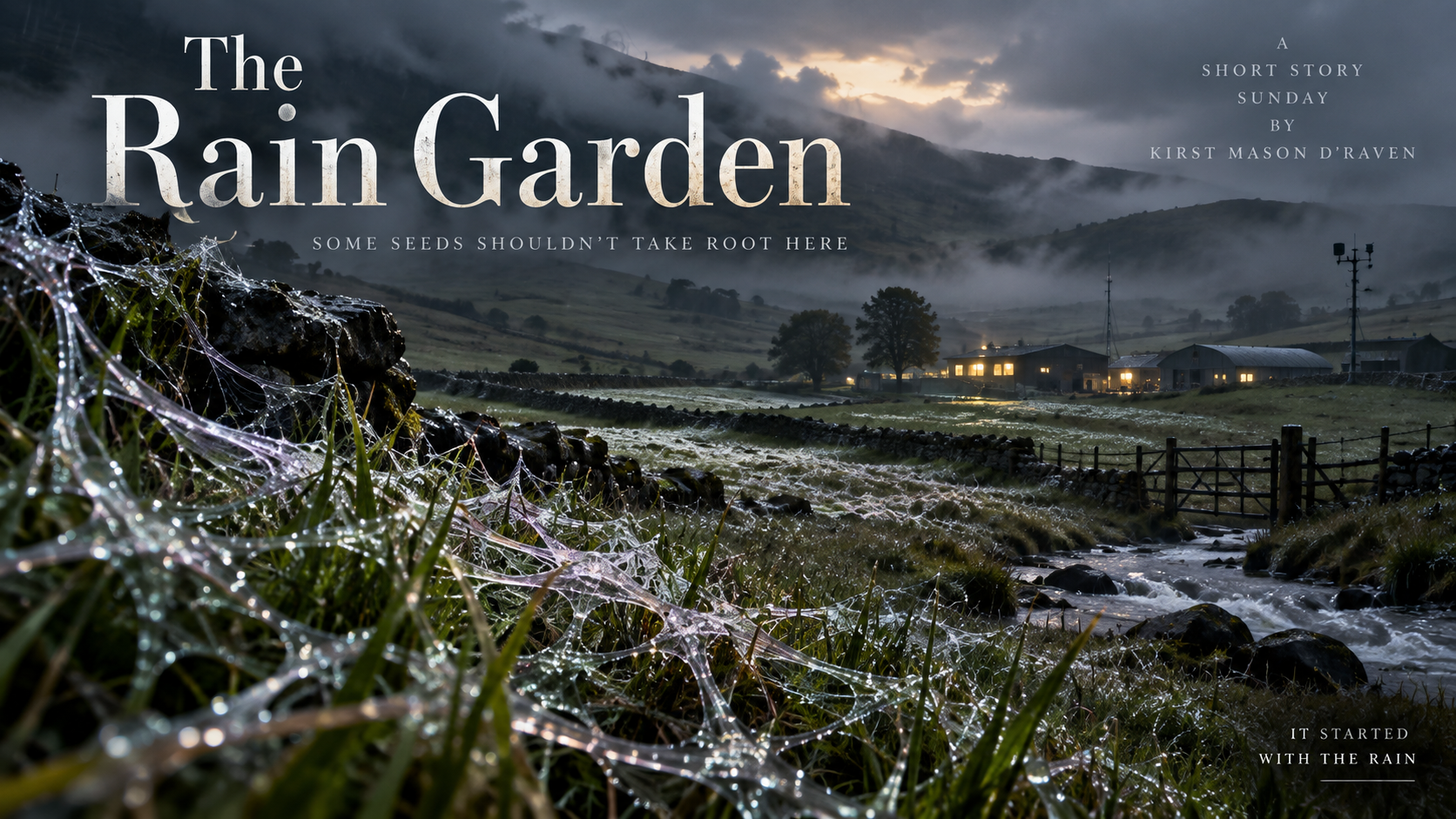
It covered perhaps two square metres beside the drainage ditch. Her first thought was fungal mycelium. her second was that mycelium usually had the decency to stay where mycelium belonged.
Cerys crouched, groaning as her knees popped and crackled. Fine translucent threads stretched between the blades of grass, almost invisible until she moved her head and they caught the light. Rain hung from them in perfectly spaced droplets. They were beautiful. That was the first thing she thought. Beautiful. The second thing she thought was that none of the droplets were falling. Rain struck the grass around them hard enough to flatten it, but the droplets on the silver threads didn’t move. Cerys took out her phone. She took one photograph. Then another. She used her pen to lift a filament.
The filament tightened around the plastic.
Cerys froze. It wasn’t much, barely anything at all. A tiny contraction. The kind of movement that could have easily been surface tension. She lifted the pen and the thread came with it.
“Come on.”
The thread stretched, and for one brief, unpleasant moment Cerys had the ridiculous impression that something beneath the grass was holding the other end. Then the thread snapped. Cerys stared at the pen. The broken end of the filament curled slowly around the nib. She dropped it and the pen landed in the grass. She stood.
“Right.” A scientist did not run away from something because it behaved oddly. A scientist collected a sample. So that was what she did.
But she used forceps this time.
A twelve seventeen she stopped eating her sandwich. At twelve nineteen she increased the magnification. At twelve twenty-two she rang Aberystwyth University. When nobody answered, she tried another number and got voicemail.
“Hi. It’s Cerys at Dyffryn Glas. I’ve got something odd in one of the trial fields. Probably nothing, but if someone from microbiology could ring me -“
She looked through the eyepiece again and paused.
“- fairly soon.” She hung up.
The filament wasn’t a filament. At least it wasn’t like any filament Cerys had even seen. It was composed of thousands of structures joined end to end. They vaguely resembled cells, except Cerys knew cells. She knew all of them – plant, animal, fungal, bacterial. These had membranes. Internal structures. Something that appeared to be performing approximately the function of a nucleus. But everything was slightly wrong. Not dramatically wrong, that would have been easier. It was wrong in the way a face is wrong when the eyes are just slightly too far apart. Everything repeated in threes.
Three chambers. Three branching structures. Three smaller bodies circling a central mass.
Cerys adjusted the focus. One of the structures changed and she leaned closer. It didn’t divide, it opened. Three sections peeled away from each other like the petals of a flower. Inside each was another complete structure. One became three. Cerys sat back.
“No.”
She prepared another slide. The same happened. Another one. Same again. She checked the soil. pH 5.1. Cerys frowned and checked yesterday’s sample. pH6.4. She checked the calibration solution. Perfect. Tested again. pH 5.1. She stared through the window towards the ditch.
“Oh, you little bastard.”
By three o’clock the silver patch covered most of the drainage channel. By four it had reached the fence.
Cerys set her phone on a tripod and filmed one post for twenty minutes. Nothing moved. She almost felt stupid until she dragged the footage backwards and the silver retreated down the wood. She sat, moving the footage backwards and forwards, watching as the silver climbed and retreated. She watched it three times. Then she put the phone down.
At five thirty she called Huw.
“Your sheep are acting strange.”
“And hello to you too,” he laughed, “What do you mean, ‘Strange’? They’re sheep.”
“They won’t come near the lower field.”
“Well, perhaps they’ve finally developed standards.”
“Huw.”
There was a pause. Cerys could hear the rain drumming on the roof outside.
“What?”
“I’ve got some kind of biological growth.”
“You’ve always got some kind of biological growth, I’ve heard. That’s why nobody drinks tea at your place.” He chuckled at his own joke.
“This is different.”
“How?”
Cerys looked through the window. The bottom wire of the western fence had disappeared. Not beneath the silver, into it.
“I don’t know yet.”
“Want me to move them?”
“Yes.”
That silenced him.
“Alright. I’ll come up soon.”
“Today.”
“Cerys -“
“Today, Huw.”
Another pause.
“Right.”
The rain became heavier at six.
Huw never arrived.
At seven twenty she rang him. There was no answer.
She rang again at seven forty. Still no answer.
At eight, Cerys put on her waterproofs, took the big torch from beside the door and crossed the yard.
The sheep had moved again. They were packed against the top gate now, all twenty-three of them. Some were climbing over the backs of the others in their effort to get further away from the bottom of the field.
Cerys climbed over the gate.
“Easy.”
Twenty-three heads turned towards her. Not one animal made a sound. Cerys took another step.
“Come on then.”
Nothing.
That was when she noticed the silence properly. There were no insects, no evening birds, no sheep noises. Even the stream seemed quieter. There was only rain.
Cerys swept the torch beam across the grass and saw silver, everywhere. It had spread across the ditch, across the tussocks and breached the lower fence, covering the path she had just walked.
“Oh, shit.”
As she backed towards the gate something cracked beneath her boot. She looked down. A beetle. As she moved her foot another shell broke. Then she saw them. Dozens. Hundreds of dead insects lay beneath the grass. Beetles, midges, a moth with it’s wings plastered open. Earthworms lay half out of the soil. Cerys crouched despite herself and picked up a worm. It wasn’t dead. It’s front half moved weakly. The back half was silver.
Cerys held the worm in the light from her torch and looked closer. A silver filament seemed to disappear into it’s skin and emerge further along. She stood so quickly that she almost fell.
Then, she ran.
At nine fourteen Dr Aryan Sharmah finally answered. He sounded half asleep.
“You’re telling me it’s spreading?”
“I’m telling you it’s covered approximately one point eight hectares in nine hours.”
“Fungus?”
“No.”
“Cyanobacteria?”
“No.”
“Slime mould then?”
“No!”
“How sure are you?”
“Enough that I’ve stopped enjoying this conversation.”
She sent the microscope slides and waited in the ensuing silence.
Then:
“What the fuck is that?”
“Thank you.”
“Have you sequenced it?” Sharmah’s voice had grown higher.
“I’ve started.”
“Contamination?”
“From what?”
“I don’t know.”
“Neither do I. That’s the issue.”
The computer chimed. Atmospheric analysis complete. Cerys opened the results. Oxygen and carbon dioxide down. Methane unchanged. Sulphur compounds elevated. And something else, a peak she did’t recognise.
“Aryan?”
“What?”
“It’s altering the air.”
Silence.
“How much?”
“Locally? Not enough to matter.” She looked towards the external monitor. 19.4%. Her mouth went dry. “Yet.”
“Cerys?”
Silver had reached the yard.
“I’ll call you back.” She disconnected.
Yesterday’s rainwater sample came from cold storage. It was clear, ordinary, nothing unusual. Today’s sample next. Cerys put a drop beneath the microscope. At first she saw nothing, then three tiny structures opened. She held her breath as another appeared at the edge of the field. Then another. One became three. Three became nine.
Cerys lifted her head. Rain tapped against the laboratory window.
She looked towards the broken weather sensor lying on the bench.
Zero point zero millimetres.
“Oh.”
It hadn’t malfunctioned. It had measured the rain perfectly. Whatever had fallen afterwards wasn’t water.
She called Aryan.
“It came down in the rain.”
“What did?”
“The organism.”
“You don’t know it’s an organism.”
“Fine. The thing currently eating Huw’s fence.”
“What?”
Cerys turned. The post she’d photographed earlier had begun to bend. The silver wasn’t covering the wood anymore. It had entered it. The post sagged as fibres separated and the whole thing folded silently into the grass.
Cellulose. It was metabolising cellulose.
“Cerys?”
“I’m ringing emergency planning.”
“What are you going to tell them?”
She watched the silver move into the fallen timber.
“The truth.”
The truth went badly.
Chemical spill?
No.
Known hazardous pathogen?
No.
Anyone injured?
No.
Immediate threat to human life?
“I don’t know.”
Apparently that was the wrong answer. She was transferred twice and somebody promised to contact Natural Resources Wales. Then her phone lost signal. Eleven minutes later the internet went with it. Cerys stood alone in the laboratory as outside the rain continued. She became aware of her own breathing.
She pulled the whiteboard from the wall and wrote:
WHAT DOES IT WANT?
She stared at the words then crossed out want. Organisms didn’t want. They exploited.
WHAT CONDITIONS DOES IT REQUIRE?
Water. Acidic soil? Carbon? Temperature?
WHAT IS IT DOING?
Consuming cellulose. Reducing CO₂. Reducing O₂. Producing unknown sulphur compound. Killing insects?
She stopped. No. Not necessarily killing them. The beetles might simply have suffocated.
External oxygen: 19.4%
at six that morning:
20.8%.
“Too fast.”
She pulled the historical readings. She calculated. Calculated again. If the rate remained linear—
It wouldn’t. Biological growth wasn’t linear. She changed the model. Exponential. The curve rose. Cerys stared at it.
“No.”
She changed the assumptions. It was still bad. Again. Still bad. At the current rate it would reach Nant y Gors before dawn. From there, the Wye catchment. She didn’t model beyond that. There was no point. She sat very still. She had been thinking about it wrongly. The rain wasn’t an invasion. Nothing had attacked them. Nothing had chosen Dyffryn Glas. The rain had been germination. A seed had landed somewhere that the chemistry happened to suit it.
That should have been comforting but wasn’t. Because if it hadn’t come looking for Earth, then one of two things was true. They had been catastrophically unlucky. Or Earth wasn’t particularly special.
Cerys looked through the glass. Silver covered the field.
“Not having it.”
The station had lime. Four tonnes. Agricultural lime would raise soil pH. If the organism required acidic conditions, she could stop it. Maybe.
The tractor started on the third attempt. At midnight she drove into the western field.
The sheep were still pressed against the gate. Cerys made her way through the warm, woolie bodies to open it. They didn’t move.
“Go!”
Nothing. Cerys slapped the nearest ewe and it stumbled through into the next field. Another followed. Then instinct finally overwhelmed terror and the flock surged towards higher ground. Cerys ran back to the tractor and drove downhill, the headlights turned the rain white. Silver webbing covered everything. She activated the spreader and lime erupted behind her.
The effect was immediate. The filaments began to curl and wither. Cerys leaned forward, straining her eyes through the pouring rain.
“Yes.”
Another strip. The silver darkened then collapsed.
“Come on.”
Another, then another. The rain hammered the cab relentlessly as Cerys drove the tractor through strip after strip, spraying lime in her wake. At the ditch the growth was thicker. Not threads anymore. Sheets. Layer upon layer of translucent material pulsing faintly beneath the water. Cerys spread lime and the whole surface contracted. She laughed. Actually laughed out loud.
“Don’t like that, do you?”
Then the tractor suddenly stopped and Cerys’s smile vanished. She turned the key. Nothing. She turned it again, but still nothing. The headlights dimmed and flickered as something whispered across the bonnet. Cerys looked through the windscreen. Silver threads were crawling over the metal.
“No.”
She grabbed the emergency bag and jumped down. Her boots sinking strangely. She looked at the rear wheel. The tyre hadn’t punctured, it was sagging. Soft black rubber hanging from the rim like cooked skin. The silver had entered it. It had digested it.
Cerys ran uphill. Behind her, rain washed the lime towards the ditch. The grey filaments lay curled and dead for a while. Then one lifted. Straightened and opened. One became three.
At two seventeen the treated soil measured pH 7.8. Alive. At 8.0, alive. 8.2. Still alive. At 8.4 the structures began to rupture. Cerys stared at the slide. There it was. A limit.
For the first time all night she felt something dangerously close to hope. The twelve bags of hydrated lime in the storeroom would not be enough. The sodium hydroxide would be too dangerous.
Ammonia. That might work.
Cerys looked through the laboratory window, her eyes raking through the darkness.
The irrigation system. That would definitely work.
She had twenty thousand litres of stored water. Pumps. Sprinklers. Fertiliser injectors.
Cerys smiled.
“You’re going to hate this.”
At three ten she started the pumps. at three twelve, sprinkler heads rose from the eastern plots. At three thirteen, Dyffryn Glas began making its own rain.
The alkaline spray struck the silver and the growth collapsed.
Field one.
Field two.
Orchard.
Polytunnels.
Drainage strip.
8.0.
8.2.
8.4.
The filaments stopped opening.
8.6.
They burst.
Cerys watched one section after another turn grey as for the first time in eighteen hours, the silver stopped spreading. She stood in the yard with alkaline water raining around her and laughed.
Then she heard the ditch.
Running water.
Her laughter stopped.
“No.”
She ran. Silver had filled the channel. It had already reached the stream. She followed. Fifty metres and the torch caught threads beneath the water. One hundred they were still there. Two hundred. Then—
nothing.
Cerys stopped and crouched. She shone the light downstream.
The water was clear. She tested it.
pH 7.9.
Again.
7.9.
Then she understood.
Limestone. The stream crossed a limestone band beneath the valley. Naturally alkaline groundwater entered here.
Cerys sat in the mud. The rain striking her hood. For several minutes she couldn’t do anything except breathe. Then she laughed.
“You picked the wrong bloody valley.”
Something silver moved past her boot.
Cerys didn’t see it.
The helicopters arrived at nine thirty. People in sealed suits taking samples while other people erected barriers. Someone from Cardiff asked Cerys seventeen questions she’d already answered in the report she’d sent before the network went down.
Huw appeared shortly before eleven. He looked at the field. Then at Cerys. Then at the field again.
“Nineteen.”
“What?”
“Nineteen sheep.”
Cerys stared towards the temporary pen. She’d thought all twenty-three had escaped. She hadn’t counted.
“What happened to the other four?”
Huw didn’t answer.
Later she found out.
They’d discovered three near the lower fence. Or what was left of them. Nobody found the fourth. The official statement described an unidentified biological contamination event associated with unusual atmospheric conditions. Nobody used the word extraterrestrial. Neither did Cerys. There wasn’t proof.
Sequencing produced nothing matching terrestrial databases. But absence of a match wasn’t proof. The cellular structures were unlike anything known, but unlike wasn’t alien. The isotope ratios made several physicists extremely excited and several government departments extremely quiet.
Still not proof.
Dyffryn Glas closed for six months. Cerys went home and slept for fourteen hours. Three months later she accepted a position at Aberystwyth. She kept one photograph from Dyffryn Glas on the wall of her office.
Silver threads between blades of grass.
Beautiful.
People sometimes asked what it was.
“Long story,” Cerys said.
By November the rain had become relentless. At least, that was what everybody called it.
One Sunday morning Cerys stood in her kitchen making tea while the radio talked about flooding in Carmarthenshire. The presenter called it the wettest November on record. Cerys wasn’t really listening. She was reading an email from Aryan.
Need you to look at something. Call me.
Beneath it was an attachment.
She opened it.
It was a spreadsheet. Weather data. Cerys frowned and nearly closed it again.
Then she saw the dates.
Dyffryn Glas. The week of the incident.
Rainfall.
Monday: 14.2 mm.
Tuesday: 0.0 mm.
Wednesday: 0.0 mm.
Thursday: 0.0 mm.
Cerys scrolled.
Friday: 0.0 mm.
Saturday: 0.0 mm.
Her mug clattered against the worktop.
“No.”
She called him. Aryan answered immediately.
“Tell me the equipment was damaged.”
“It wasn’t.”
“Then the data’s corrupt.”
“No.”
“Aryan.”
“I checked the other stations.”
Cerys looked towards the window. Rain streamed down the glass.
“What other stations?”
“All of them.”
Something in his voice made her put the phone on speaker. She opened the attachment again. A second tab.
Wales. Dozens of stations. Rows of zeros. Her throat tightened.
“That isn’t possible.”
“I know.”
“It rained for four days.”
“I know.”
“I was standing in it.”
“I know.”
She looked at the window. A drop reached the bottom of the pane and joined another.
“What are you saying?”
“I’m saying I’ve checked radar.”
Cerys waited.
“There was cloud over Dyffryn Glas on Monday night.”
“And Tuesday?”
“No precipitation.”
She laughed once. It sounded wrong.
“Don’t be stupid.”
“Cerys—”
“I was wet.”
“I know.”
“My clothes were soaked.”
“I know.”
“I collected rainwater.”
Silence.
Cerys stopped.
The sample. Today’s sample. The three structures unfolding beneath the microscope. One becoming three. She had called it rainwater because she’d collected it from the rain gauge. Nobody had established that it was water. Her eyes moved towards the window.
“What was falling, Aryan?”
“I don’t know.”
His answer came too quickly.
“You do.”
Another silence. Then:
“We analysed the archived sample.”
“And?”
“Cerys, it isn’t mostly water.”
She stared at the glass. Rain ran down it.
“What do you mean, mostly?”
“By mass, about twelve per cent is H₂O.”
Her stomach tightened.
“The rest?”
“The organism.”
Cerys didn’t speak. Outside, the street shone black beneath the November sky. Water – or something that looked exactly like it – poured from the gutters.
“That’s impossible.”
“Yes.”
“There’s too much of it.”
“I know.”
She stepped towards the window. A droplet struck the glass.
Another.
Another.
“What about the rain now?”
Aryan didn’t answer.
“Aryan.”
“We checked this morning.”
The radio continued behind her. Flood warnings. Road closures. Three inches expected before nightfall. Cerys looked at the liquid streaming down her window.
“The gauges?”
“Zero.”
She closed her eyes. For one moment she was back at Dyffryn Glas. One glove, yesterday’s jumper. Rain dripping from her nose.
RAINFALL: 0.0 mm
Liar.
Except it hadn’t been lying. Not once.
“Oh God.”
“Cerys, stay inside.”
She almost laughed.
“Inside what?”
A sound came from the garden. A soft, familiar bleat.
Cerys froze.
“Cerys?”
Another bleat. Closer this time. She moved towards the back door.
“Cerys, don’t go outside.”
She ignored him. There was something beyond the glass, standing beside the shed.
A sheep.
Cerys stared at it. Rain streamed from its wool. It was completely still.
“Huw?”
“What?”
“Huw’s missing sheep.”
“What are you talking about?”
“We only found three.”
The sheep turned its head, slowly. Cerys’s hand tightened around the phone. There was no blue mark on its shoulder. There should have been. She knew that ewe. The old one. The one that liked digestives.
“That’s not her.”
“Cerys?”
The sheep took one step towards the house. Its front leg bent strangely. Not at the knee. Higher. The skin along its shoulder opened. Not tore. Opened. Three pale sections unfolded from beneath the wool.
Cerys stumbled backwards.
One became three.
The phone slipped from her hand. The sheep came closer. Then another shape moved behind it. And another. Cerys stared beyond the garden. The field behind the houses was full of them.
Sheep.
Dozens.
Standing silently in the rain.
All facing her house.
The radio presenter laughed at something his colleague had said. Then gave the latest forecast. Rain continuing throughout the week.
Cerys looked at the liquid crawling down the outside of the glass. Not falling now. Climbing across the window. Across the frame. Searching.
Her phone lay on the floor. Aryan was shouting her name. Cerys backed into the kitchen.
The kettle clicked off.
For the first time she noticed the mug beside it. She had filled the kettle from the tap. She looked down. Her tea was perfectly still.
Something silver moved beneath the surface. Cerys stopped breathing.
A tiny thread rose from the tea.
It touched the inside of the mug.
Climbed.
Reached the rim.
And opened.
One became three.
Cerys looked towards the sink. Towards the tap.
Then slowly towards her own wet hand. She had washed it when she came downstairs. Between her thumb and forefinger, something moved.
Very slightly.
Cerys stared.
The skin opened.
Not tore.
Opened.
Three pale lines unfolded beneath it.
And from the garden came the sound of a woman laughing.
Cerys knew that laugh.
It was hers.