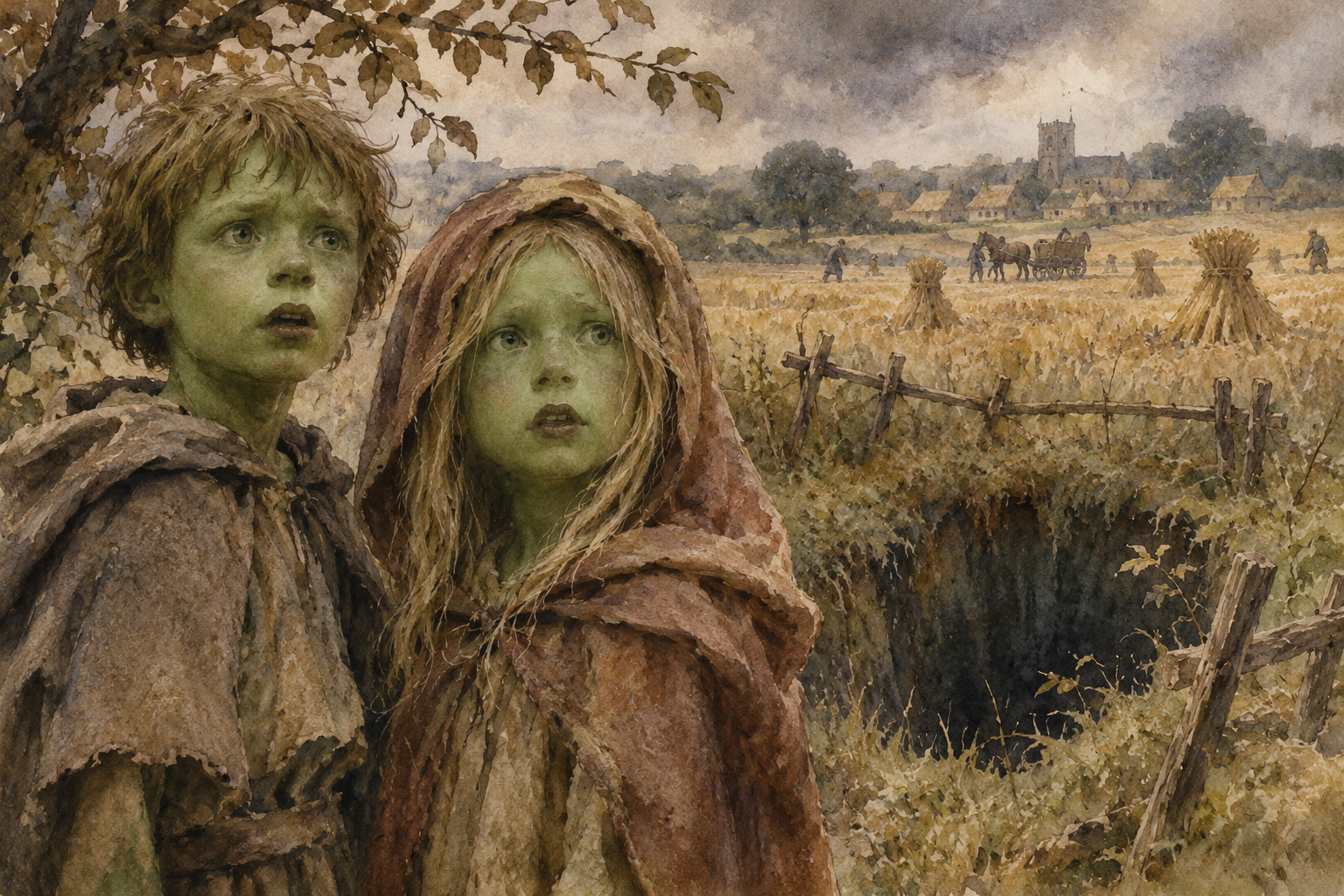
Somewhere in twelfth-century Suffolk, two children appeared beside a wolf pit. Their skin was green, their clothes were unfamiliar and nobody could understand a word they said. One would die, the other would grow up among the people who found her. But where had they come from? More than eight centuries later, the Green Children of Woolpit remain one of England’s most extraordinary medieval mysteries.
There are plenty of strange things to be found in the English countryside, particularly if you know where to look. Ancient earthworks, forgotten burial grounds, ruined chapels and the occasional village whose inhabitants have been arguing about the same peculiar incident for the better part of a thousand years.
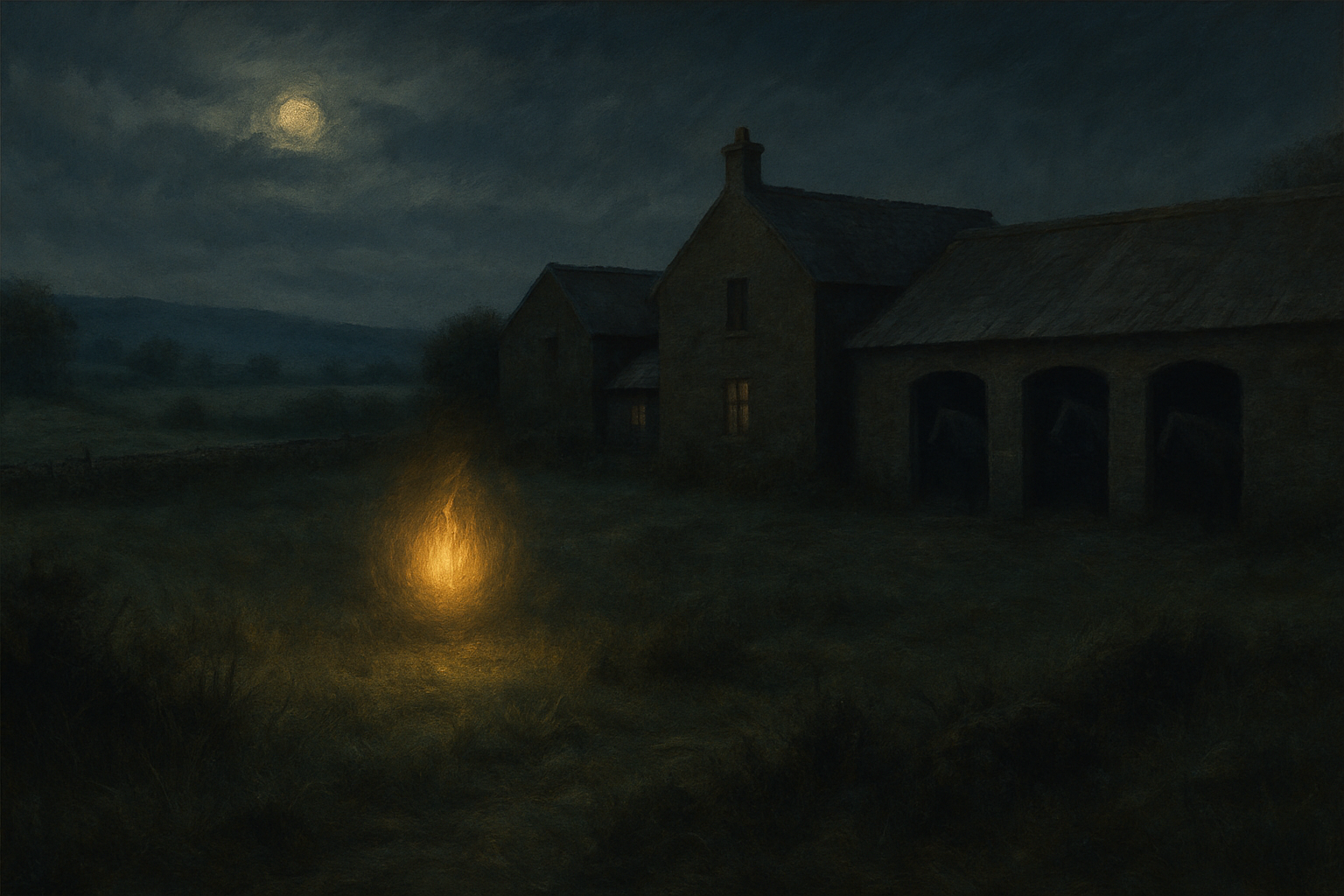
Woolpit, in Suffolk, belongs firmly in that last category. It’s a perfectly ordinary-looking village, with its church, old houses and pleasant countryside. But sometime during the twelfth century, according to two medieval chroniclers, something happened there that was anything but ordinary. Two children appeared in the fields. A boy and a girl, apparently brother and sister, wearing clothes nobody recognised and speaking a language nobody understood. And both of them were green. Not green with envy, or merely looking a little unwell. Their skin, the chroniclers insisted, was actually green.
Now, before we get carried away with fairy kingdoms, subterranean civilisations and visitors from outer space, we ought to establish where this remarkable story comes from. Because, unusually for a medieval mystery of this sort, we have two substantial early accounts. One was written by William of Newburgh, an Augustinian canon living in Yorkshire, whose Historia rerum Anglicarum was composed towards the end of the twelfth century. The other comes from Ralph of Coggeshall, a Cistercian chronicler in Essex, whose Chronicon Anglicanum preserves a slightly different version. Neither man claimed to have witnessed the children’s arrival. Nevertheless, both treated the story as something worth recording, and Ralph even identified a man from whom he said he had heard it. That makes the Green Children considerably more interesting than the usual village legend whose earliest discoverable appearance turns out to be a Victorian guidebook.
According to William, the incident took place during the reign of King Stephen, between 1135 and 1154. It was harvest time, and the villagers were busy gathering their crops when the two children were discovered near one of the pits from which Woolpit was said to take its name. These were wolf pits, traps intended to catch wolves, although we should be careful about assuming that the children actually climbed out of one. Being found beside a pit and emerging from beneath the earth are not necessarily the same thing. The children were frightened, bewildered and unable to explain themselves. Their clothing was strange, their language incomprehensible and their appearance sufficiently alarming to attract the attention of the entire neighbourhood. Someone took them to the household of Sir Richard de Calne, a local knight, where attempts were made to feed them. And here the story takes another peculiar turn.
The children refused everything they were offered. Bread, meat and the ordinary food of an English household apparently held no attraction for them. Whether they did not recognise it, could not stomach it or were simply too distressed to eat, we cannot know. Then somebody brought in some freshly gathered beans. The children became tremendously interested. In William’s account, they initially struggled to discover the edible beans inside their pods. Once someone showed them, however, they ate eagerly. For a time, beans were apparently the only food they would accept.
It is one of those wonderful little details that makes the story feel oddly human. Whatever else was strange about these children, they were hungry, frightened and desperately trying to make sense of an unfamiliar place.
Eventually, they began to accept other foods. And as their diet changed, something else happened. Their green colour gradually faded.
The boy, unfortunately, did not recover. He remained weak and sickly and died after baptism, although the accounts differ slightly in their descriptions of his decline. His sister survived. She grew stronger, learned to speak English and, according to William, eventually married a man from Lynn. Ralph tells us that she remained for some time in Richard de Calne’s household, although he was rather less complimentary about her character. Medieval chroniclers were not always generous towards young women who failed to behave as they thought young women ought. But the most extraordinary part of the story came after the girl learned enough English to explain where she and her brother had come from. And what she described was a world quite unlike Suffolk.
According to William of Newburgh, she said that they came from a place called St Martin’s Land. It was a Christian country, she explained, with churches and religious observances, but the sun did not shine there as it did in England. Instead, the land existed in a sort of perpetual twilight. Beyond it lay a brighter country, separated from their own by a broad river. The people of St Martin’s Land were green, just as the children had been when they arrived.
How had they travelled from this strange place to Woolpit? That was the difficult part.
The girl said that she and her brother had been tending their father’s animals when they heard the sound of bells. Following the sound, they entered a place from which they eventually emerged into the unfamiliar brightness of the English countryside. Ralph’s version describes the journey rather differently, with the children entering a cavern and wandering through it before emerging into the daylight. The noise of people working in the fields frightened them, and they were unable to find their way back. Imagine, for a moment, that the story is being told exactly as the girl remembered it. Two children hear bells in the distance, follow the sound into darkness, and emerge somewhere so strange that even the sunlight seems wrong. They cannot speak to anybody. They do not recognise the food. Their clothes are different, and everyone stares at them. One child dies. The other must learn to live among strangers. Strip away the green skin and the mysterious underground country, and it becomes a rather heartbreaking story. Of course, the green skin and the mysterious underground country are precisely why people have been talking about it for eight hundred years.
So what are we to make of it?
One popular explanation is that the children were suffering from some form of illness or malnutrition. A condition historically called chlorosis, sometimes associated with iron-deficiency anaemia, has often been suggested as an explanation for their unusual colouring. There are difficulties with this theory. Anaemia can cause pallor and changes in complexion, but it does not ordinarily turn people the vivid green of a leaf. Nor do we have medical descriptions precise enough to diagnose children who may or may not have existed more than eight centuries ago. Still, the detail about their colour fading as their diet improved is interesting. If there was a real incident behind the story, illness, hunger or nutritional deficiency might have influenced the way the children looked to the people who found them.
Another suggestion is that they were foreign children who had become separated from their family. The twelfth century was a turbulent period in England. King Stephen’s reign was marked by civil conflict, and eastern England was not isolated from the movement of people across the North Sea. Some writers have proposed that the children were Flemish refugees, perhaps displaced by violence, whose unfamiliar language and appearance confused the villagers. It is an appealing explanation in some respects. Two frightened children arrive in a strange community, unable to communicate and unwilling to eat unfamiliar food. One dies, while the other gradually adapts. But there is no contemporary document identifying the children as Flemish, no securely established route by which they reached Woolpit, and no proof that their supposed homeland was a misunderstood description of an actual settlement. It remains a hypothesis, not a solution.
Then there is the possibility that the story belongs to folklore rather than history. And here things become particularly interesting. The idea of entering another world through a cave, hollow hill or opening in the earth is familiar throughout European folklore. So is the notion of a country where ordinary time behaves differently, where the light is strange and where the inhabitants are not quite like ourselves. The children follow a mysterious sound, pass through an underground opening and find themselves unable to return. Those are all ingredients we might recognise from stories of fairyland. The beans are curious, too. Food is frequently important in tales about journeys between worlds, although we should resist the temptation to declare every bean, bell and cave an ancient pagan symbol simply because it makes the story sound more mysterious.
A medieval chronicler recording a wonder was not necessarily documenting an actual encounter with fairies. Nor was he necessarily inventing everything. William of Newburgh himself acknowledged that the tale was difficult to believe. He said that he had initially been sceptical but had been persuaded to include it by the testimony of people he considered trustworthy. That is worth remembering. He was not presenting himself as someone who had discovered the entrance to an underground kingdom. He was recording an extraordinary report and admitting that he could not explain it. Ralph’s account is interesting for a different reason. He said he had heard the story from Richard de Calne himself and from members of his household. If that claim is accurate, Ralph was at least closer to the supposed witnesses than William, writing far away in Yorkshire.
But even a named informant does not establish that every detail happened as described. People misremember. Stories change in the telling. Unusual events acquire explanations, embellishments and meanings that may not have been present at the beginning. And medieval writers had their own reasons for preserving marvels. An extraordinary story could illustrate the limits of human understanding, the wonders of God’s creation or the moral dangers of encountering something unfamiliar.
Modern scholarship has also examined the Green Children as a story about difference and belonging. Two outsiders arrive in a community, one cannot survive, and the other gradually becomes part of it, losing the physical characteristic that marked her as different. Read that way, the tale is not simply about where the children came from. It is about what happens when strangers arrive somewhere they do not belong.
Perhaps the most revealing detail is that the surviving girl apparently stopped being green. Whatever the colour meant to the people who first told the story, it was not permanent. She learned their language, ate their food and lived among them. In William’s account, she eventually married. The extraordinary child became an ordinary woman. Or at least, ordinary enough that the chronicler lost interest in telling us what happened next.
There have, naturally, been more extravagant explanations.
The children have been described as extraterrestrials, inhabitants of another dimension and survivors of a hidden civilisation beneath the earth. Such ideas tell us rather more about the interests of modern mystery writers than they do about twelfth-century Suffolk. There is no evidence of a spacecraft, a portal to another dimension or an undiscovered subterranean population. The medieval accounts do not require any of those things. They are strange enough without them.
What we can say is that a story about two green children was circulating by the late twelfth century and was considered remarkable enough to be preserved by two chroniclers. We can also say that their versions agree on the essential outline while differing in some important details. What we cannot establish is whether two such children actually appeared at Woolpit, whether their unusual colouring had a medical explanation, or whether the entire account developed as a tale of wonder. There is no surviving contemporary parish record identifying them, no confirmed grave for the boy and no independently verified identity for the girl. Even the often-repeated suggestion that she was named Agnes Barre cannot be securely established from the two original chronicles.
And perhaps that is where we ought to leave the mystery.
Not solved, not dismissed, but properly understood for what it is. An extraordinary medieval story with an unusually interesting documentary history. Woolpit itself has never entirely let the children go. Their legend remains part of the village’s identity, remembered long after the chroniclers who recorded it have been forgotten.
I rather like that.
Because somewhere beneath the centuries of speculation, theories and increasingly elaborate retellings, there is still a simple image. Two frightened children standing in a Suffolk field at harvest time. The villagers staring at them. The children staring back. And nobody, on either side, knowing quite what to say. Perhaps they were strangers from another country. Perhaps they were characters in a story that had already been told many times before William and Ralph put pen to parchment. Or perhaps something genuinely unusual happened in Woolpit all those centuries ago, and the explanation disappeared with the people who witnessed it. Whatever the truth, the Green Children have managed something remarkable.
They have kept us wondering for more than eight hundred years.
And that, for a couple of children who apparently only wanted something to eat, is quite an achievement.
Sources:
William of Newburgh, Historia rerum Anglicarum, Book I, Chapter 27.
Ralph of Coggeshall, Chronicon Anglicanum, edited by Joseph Stevenson (1875), pp. 118–120.
John Clark, The Green Children of Woolpit: Chronicles, Fairies and Facts in Medieval England (2023). JSTOR
Michał Madej, “The Story About the Green Children of Woolpit According to the Medieval Chronicles of William of Newburgh and Ralph of Coggeshall,” Res Historica 49 (2020), pp. 117–132. bc.umcs.pl