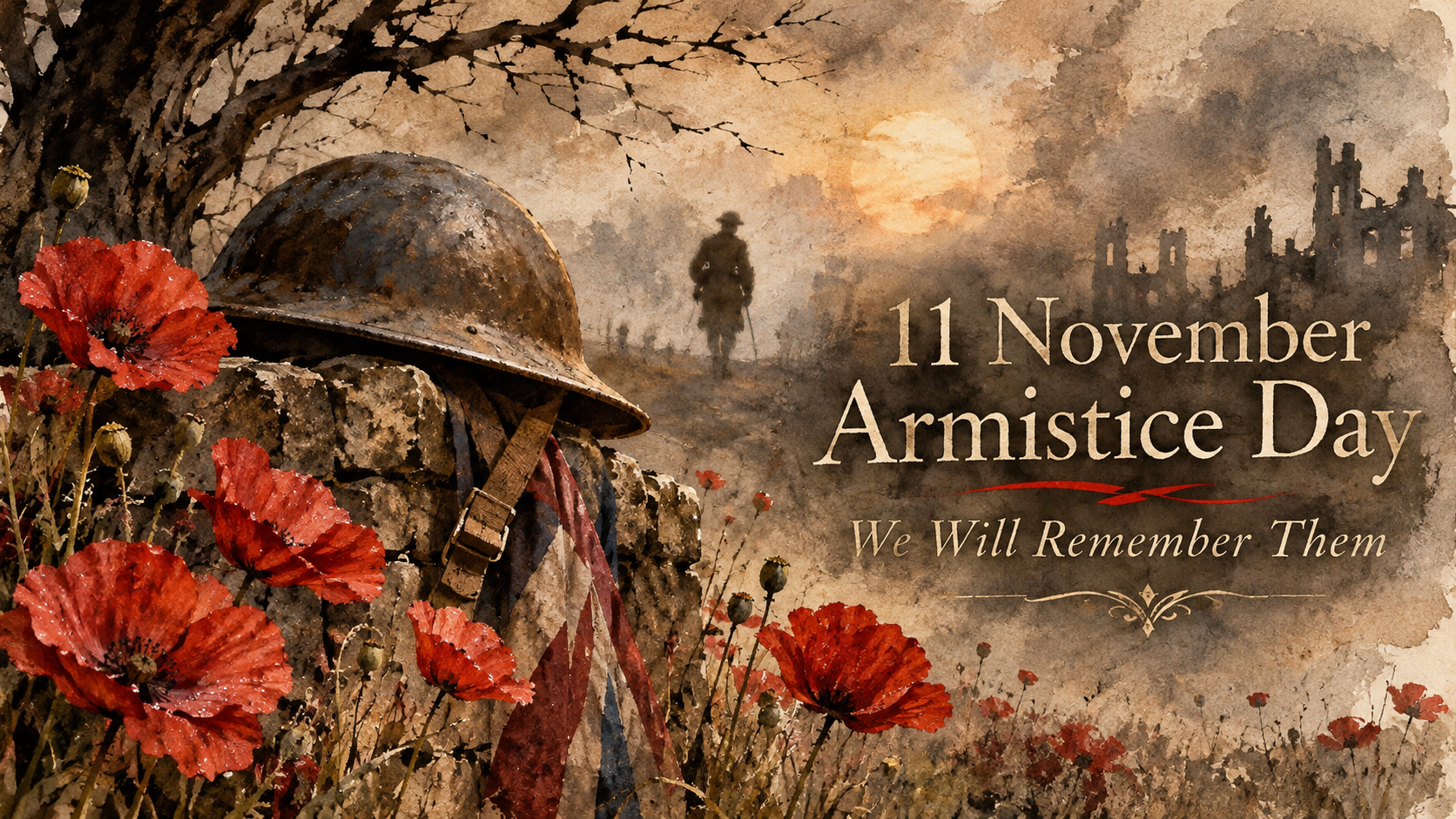
Every year, at the eleventh hour of the eleventh day of the eleventh month, Britain falls silent. Traffic pauses, conversations cease and people stand quietly in remembrance of those who lost their lives in war. But where did the two-minute silence come from? The answer takes us from the battlefields of the First World War to South Africa, Australia and a rather remarkable argument about whose idea it was.
At eleven o’clock on the morning of 11 November 1919, something extraordinary happened.
Britain stopped.
In London, traffic came to a halt. People stood silently in the streets, men removed their hats, and crowds gathered around the Cenotaph in Whitehall. Across the country, factories, offices, shops and schools suspended their ordinary activities. For two minutes, a nation that had spent four years listening to the terrible noise of war stood in silence. There were no speeches to listen to, no hymns to sing and no grand declarations to make.
Just silence.
It was a simple idea, and perhaps that was precisely why it worked.
The First World War had ended one year earlier, when the Armistice between Germany and the Allies came into effect at eleven o’clock on 11 November 1918. The fighting on the Western Front had finally ceased, although the formal peace settlement would not follow until the Treaty of Versailles in June 1919. But peace had not brought an end to suffering. Across Britain, families were still mourning sons, husbands, brothers and fathers who would never come home. Others were caring for men whose wounds, both visible and invisible, would remain with them for the rest of their lives.
The influenza pandemic had added its own dreadful toll, and the country was struggling to understand what the previous four years had cost. There were victory celebrations, certainly, but there was also an overwhelming sense of loss. How could an entire nation remember so many dead? And how could it do so in a way that belonged equally to everybody, regardless of wealth, rank or religion? The answer, rather wonderfully, was to do nothing at all. For two minutes.
But the story of how that tradition began is considerably more complicated than it first appears. To find its origins, we must leave London and travel several thousand miles south, to Cape Town.
In May 1918, six months before the Armistice, the South African city introduced a daily pause for remembrance. At noon, a signal would sound and the people of Cape Town would observe a period of silence. The custom was associated with the city’s mayor, Sir Harry Hands, and the grief caused by the war, particularly the losses suffered by South African troops.
The Battle of Delville Wood in July 1916 had been devastating for the South African Brigade. The fighting became one of the defining tragedies of South Africa’s participation in the war. Harry Hands had also suffered a personal loss. His son, Reginald, died in France in 1918. The daily silence gave the people of Cape Town an opportunity to remember those who had died and to think of those still serving. It was a public ritual that required no special equipment, no elaborate organisation and no distinction between rich and poor. When the signal sounded, everybody could take part. And the idea began to travel.
Meanwhile, in Australia, a journalist named Edward George Honey was thinking along similar lines. Honey had been born in Melbourne and was working in London when, on 8 May 1919, his letter appeared in the Evening News. He suggested that the anniversary of the Armistice should be marked by a period of silence.
His proposal was for five minutes rather than two.
Honey believed that a quiet, collective act of remembrance would be more meaningful than noisy celebrations. In the aftermath of a war that had taken so many lives, he wanted a moment in which people could think privately about those who had been lost.
It was a remarkably simple suggestion.
Five minutes in which the living could remember the dead.
But Honey was not the only person advocating such an observance.
Another important figure was Sir Percy FitzPatrick, a South African author and politician, who had also lost a son during the war.
FitzPatrick was familiar with the Cape Town silence and believed that a similar observance should be introduced throughout the British Empire.
In October 1919, he put his proposal before the British authorities, and it eventually reached King George V.
The King approved.
On 7 November 1919, Buckingham Palace issued a message announcing that the first anniversary of the Armistice would be marked by a two-minute silence.
The King’s request was clear. At eleven o’clock on 11 November, the ordinary activities of daily life should be suspended so that people could give their thoughts to those who had made the ultimate sacrifice.
The idea was not confined to Britain.
The observance was intended to extend across the Empire, allowing communities separated by thousands of miles to participate in a shared act of remembrance.
And so, on the morning of 11 November 1919, the experiment began.
Imagine what that must have felt like.
London was a city of noise. Motor vehicles, horse-drawn carts, trams, street traders, factory machinery and the constant movement of people filled its streets.
Yet at eleven o’clock, much of that activity stopped.
People stood where they were.
Some bowed their heads. Others looked straight ahead. Many were remembering someone whose face they would never see again.
The silence was particularly moving because it was shared.
A wealthy businessman standing outside his office might be remembering a son killed at Ypres. A shop assistant might be thinking of a brother who had disappeared on the Somme. A mother might be remembering the boy whose last letter was still tucked away in a drawer.
For two minutes, their grief occupied the same public space.
And nobody was expected to explain it.
The observance was widely reported as a success.
It was repeated the following year and gradually became one of the most recognisable traditions associated with Armistice Day.
But the question of who deserved credit for the idea remained.
Was it Edward George Honey, whose published suggestion appeared in May 1919?
Was it Percy FitzPatrick, whose proposal was instrumental in securing royal approval?
Or should the credit belong to Cape Town, where a public two-minute silence had already been observed during the war?
The answer depends rather on what we mean by inventing a tradition.
Honey certainly proposed an Armistice anniversary silence in print before FitzPatrick’s approach to the King.
FitzPatrick played an important role in bringing the proposal to the attention of the authorities and helping to secure its adoption.
And Cape Town had already demonstrated that a community could come together through a daily act of collective silence.
None of these contributions cancels out the others.
Rather than one person suddenly inventing the entire custom, the evidence suggests that a number of people, separated by geography but united by the experience of war, recognised the value of the same simple gesture.
Silence.
Not because there was nothing to say, but because there was far too much.
Over the following decades, Armistice Day became firmly established in British public life.
The Cenotaph, originally a temporary structure designed by Sir Edwin Lutyens for the Peace Day celebrations of July 1919, became the focus of national remembrance.
Its permanent replacement was unveiled on 11 November 1920.
On the same day, the Unknown Warrior was buried in Westminster Abbey, representing the countless servicemen whose bodies had never been identified or whose graves were unknown.
The ceremonies gave physical form to a grief that was shared by millions.
The Cenotaph was an empty tomb, a monument to those buried elsewhere.
The Unknown Warrior was one unidentified man who could stand for all the others.
And the two-minute silence gave everybody, wherever they happened to be, an opportunity to remember.
Following the Second World War, the national ceremony of remembrance became associated with Remembrance Sunday, the Sunday nearest 11 November.
The distinction is worth remembering.
Armistice Day marks the anniversary of the cessation of fighting on the Western Front in 1918.
Remembrance Sunday provides a wider national occasion to honour those who have died in military service and conflict.
The two are closely connected, but they are not quite the same thing.
The silence itself has survived changes in government, society, technology and the way Britain understands its military history.
It has been observed in crowded city centres, quiet village churches, football grounds, schools, railway stations and workplaces.
Sometimes the Last Post is played.
Sometimes wreaths are laid.
Sometimes there is nothing more than a clock striking eleven and a few moments of stillness.
And perhaps that is what makes the tradition so enduring.
It does not demand that everybody remembers the same person, or even that everybody experiences remembrance in the same way.
For one person, the silence may bring memories of a grandfather who fought in the Second World War.
For another, it may be a friend killed in Afghanistan.
For somebody else, it may be an opportunity to think about civilians caught in war, or the enormous human cost of conflicts that continue today.
And for many people, it is simply a moment to acknowledge that peace should never be taken for granted.
There is something particularly affecting about the fact that this tradition began not with a great military victory or a political declaration, but with ordinary people trying to find a way to express their grief.
A mayor in Cape Town.
A journalist in London.
A South African father who had lost his son.
Different people, different circumstances, but the same understanding.
Sometimes the most powerful thing we can offer the dead is our attention.
Just two minutes of it.
And so, more than a century after the first national observance, the clocks will strike eleven once again.
Somewhere, a shop assistant will stop serving a customer. A railway worker will stand beside a platform. A child will lower their head in a school assembly.
For a brief moment, the noise of ordinary life will give way to something older and deeper.
Memory.
And perhaps, in that silence, we will remember not only those who died, but also the extraordinary number of people who loved them.
Because the dead are not the only ones whose lives are changed by war.
The living carry its consequences for generations.
And that, surely, is worth two minutes of our time.