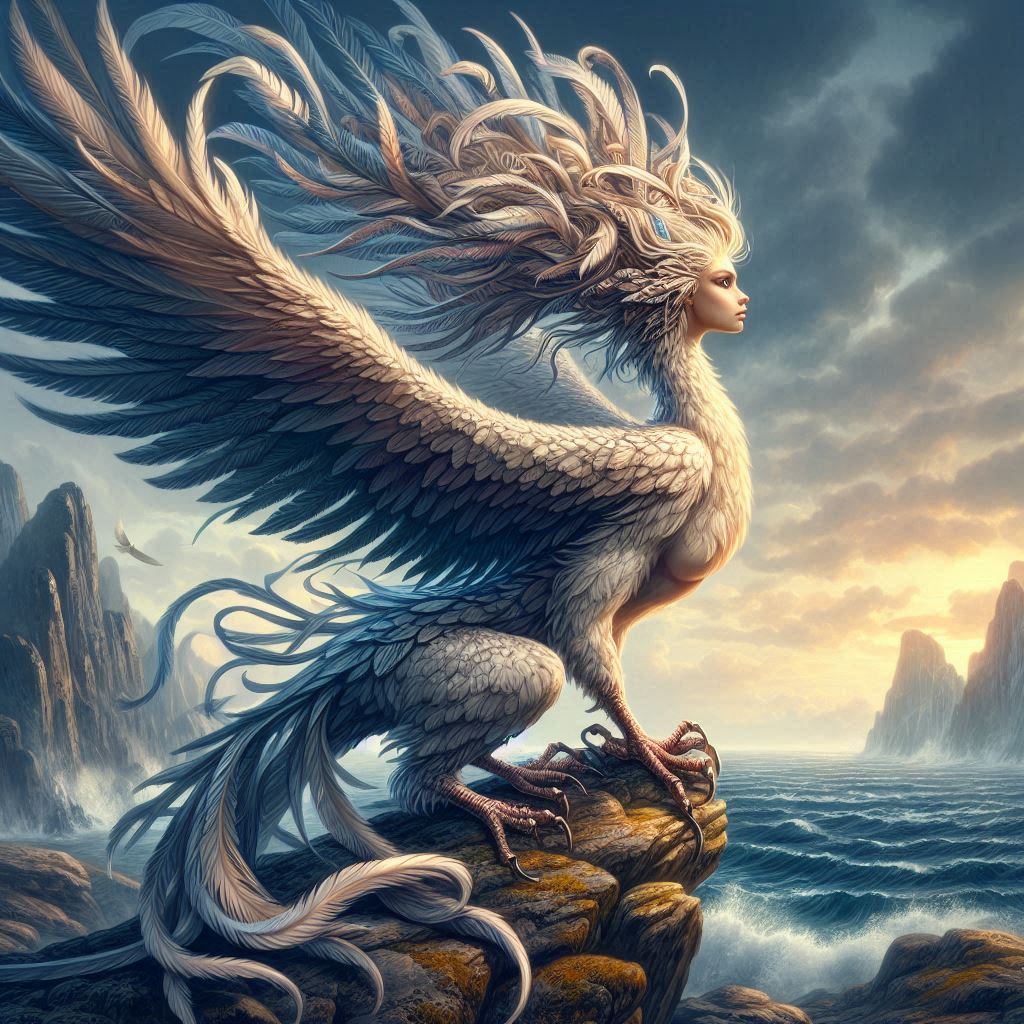
Harpies are one of the more fascinating and unsettling figures from ancient mythology. They originate from Greek mythology, though similar creatures appear in other cultures as well. Harpies are often depicted as half-bird half-woman monsters, combining the form of a vulture or other bird of prey with a woman’s face and upper body.
The term “harpy” itself comes from the Greek word “harpazein” which means “to snatch” or “to seize.” This etymology speaks to their primary role in myth as creatures that steal and abduct.
In their earliest appearances, harpies were not always seen as malevolent. In some early myths they were simply wind spirits who carried souls to the underworld, acting more as agents of divine will than as the cruel beings they would later become known as. They were said to be the daughters of Thaumas, a sea god, and Electra, one of the Oceanids. Their siblings were the rainbow goddess Iris and several other divine figures associated with the sea and the winds. In this early role, harpies were more neutral in character, acting as divine messengers or enforcers.
However, as time went on their role in myth darkened. Harpies came to be seen as instruments of punishment, sent by the gods to torment wrongdoers. One of the most famous stories involving harpies is that of King Phineus of Thrace.
According to myth, Phineus had the gift of prophecy but abused this power, angering the gods, particularly Zeus. As punishment, Phineus was struck blind and exiled to a remote island. To add to his suffering, Zeus sent the harpies to torment him. Every time food was brought to Phineus, the harpies would swoop down and snatch it away, leaving him constantly hungry and frustrated. They would either steal the food or defile it with their foul stench so that it was inedible.
This constant torment was only ended when the Argonauts, led by Jason, arrived at the island. Two of the Argonauts, Calais and Zetes, who were the sons of the North Wind, were able to chase the harpies away as they were swift enough to keep up with the winged creatures. In some versions of the story, the harpies were not killed but driven off and made to swear never to trouble Phineus again.
The harpies in this tale reflect their later depiction as symbols of greed and destruction. They became synonymous with the concept of retribution and punishment from the gods. Their terrifying appearance and association with storms and the wind likely helped cement this more sinister portrayal. Their birdlike nature gave them a swift and relentless quality, as though they could appear out of nowhere to steal or ruin without warning.
In terms of physical appearance, the description of harpies varies. In early mythological depictions they were not described as hideous but more as swift and powerful beings with beautiful, almost ethereal features. However, as the stories became darker, so too did their portrayal.
Later representations of harpies in art and literature showed them as grotesque creatures, with emaciated bodies, ragged wings, sharp talons, and faces twisted in rage or malice. Their human features were often distorted, with wild hair and grotesque expressions, reflecting their cruel nature. This transformation in their depiction is significant as it shows how they shifted from being more neutral wind spirits to agents of divine punishment and symbols of ugliness and horror.
The harpy’s association with storms and winds was another important aspect of their mythological role. In ancient times, before the advent of modern meteorology, people often attributed the sudden onset of storms or destructive winds to supernatural forces. Harpies, with their bird-like wings and their ability to move swiftly and erratically, were perfect embodiments of the dangers of the wind. In many myths, harpies were said to live in remote areas such as islands or caves, often near the sea, from where they would emerge to wreak havoc.
Harpies also played a role in the wider symbolic language of myth and legend. They were often seen as embodiments of the untamed forces of nature, destructive and uncontrollable. This connection with the natural world, particularly the wild and stormy aspects of it, made them powerful symbols of chaos. At the same time, they also came to represent the darker sides of human nature, particularly greed and gluttony. Their role in punishing Phineus, for example, can be seen as a reflection of divine justice aimed at those who are selfish or abuse their power.
Despite their negative connotations, harpies were not universally reviled. Like many mythological creatures, they occupied a dual role. On the one hand, they were terrifying and destructive, but on the other hand, they were still instruments of the gods, acting on divine orders. In this sense, they were not evil in the same way that demons or other malevolent creatures might be viewed. Instead, they were more like natural disasters- terrifying and dangerous, but not evil for its own sake. Their actions served a purpose, even if that purpose was often to punish or torment.
In later centuries, harpies continued to appear in art and literature, though their role became more firmly entrenched as malevolent creatures. During the Renaissance, for example, they were often depicted as grotesque symbols of chaos or greed. Dante’s Divine Comedy features harpies in its description of Hell, where they torment souls in the seventh circle, those who had committed suicide. In this context, the harpies are not just physical tormentors but also symbols of the inner torment and despair that led the souls to take their own lives. Here, we see how the myth of the harpy had evolved over time to encompass not just physical suffering but psychological and emotional torment as well.
In modern times, harpies have continued to captivate the imagination, though often in a more symbolic or metaphorical sense. The word “harpy” is sometimes used to describe a greedy or shrewish woman, showing how the myth has lingered in the cultural imagination. Harpies also appear in fantasy literature, films, and games, where their terrifying appearance and destructive powers make them ideal antagonists or symbols of danger. In these modern interpretations, harpies are often portrayed as fearsome and relentless, echoing their classical roots but sometimes with a more nuanced or complex characterization.
Ultimately, harpies are one of those mythological creatures that encapsulate many of the themes and fears that run through ancient mythology. They represent the unpredictable and sometimes cruel forces of nature, as well as the darker aspects of human nature such as greed and cruelty.
Their role as divine instruments of punishment reflects the ancient belief in a universe where the gods could intervene in human affairs, sometimes in ways that were terrifying or incomprehensible. At the same time, the evolution of their portrayal – from neutral wind spirits to grotesque punishers – reflects broader changes in how people viewed the world around them and the forces that shaped their lives.
For more stories about how women have been demonized by men in mythology, my book ‘Dark Goddesses of Power and Peril’ is available on Kindle, Kindle Unlimited and as a paperback 🙂