Trigger Warning:
This article discusses themes of sexual violence, victim-blaming, and trauma. While written with compassion and care, some readers may find the content distressing. Please read at your own pace and prioritise your wellbeing.
She never stood a chance.
That much is clear when you begin to peel back the layers of her myth, scrape away the snake scales and stone-eyed stares, and look at what really happened.
What was done to her.
Not the monster. The maiden, the victim, the woman discarded. Long before she was feared, she was forsaken.
People love to talk about her as a cautionary tale. A Gorgon. A monster. That thing that turns men to stone with one look. She’s there in fashion, on t-shirts and jewellery, graffitied across club walls, her face snarling from the labels of perfume bottles.
She’s been reclaimed by women’s groups and rage-fuelled protestors as a symbol of defiance – and rightly so – but for centuries, she was whispered about as if she’d done something wrong.
That she had it coming. The same tired tale women have been handed since time began.
Medusa wasn’t born a monster. The earliest versions of the myth say she was a beautiful mortal woman, a priestess of Athena – dedicated, devout, sworn to chastity and service. In that alone, she had already given up so much. We don’t know her thoughts on that life. No records of her voice. Just the aftermath.
She was serving in the temple of the goddess when Poseidon came to her. There are different versions, as there always are. Some say seduction. Most say rape. The fact it happened in Athena’s temple, on sacred ground, is the turning point – and it was not Poseidon who bore the punishment.
Athena turned her priestess into a monster. Cursed her. Snakes for hair, eyes that petrified, a face no one could look at without dying. She exiled Medusa to a lonely island, cast her out like garbage, like a broken thing. The very goddess she had worshipped, served, sacrificed for – abandoned her. Blamed her. Isn’t that just the way of it?
Women are punished for the crimes committed against them. Burned for tempting. Shunned for surviving. And Medusa, in the hands of the ancient poets, became the villain.
Her story was rewritten by the victors, the Olympians, the men who told tales of conquest and glory. Perseus, the shining hero, is sent to slay her. With mirrors and stealth, he beheads her while she sleeps. Not even given a fighting chance.
And yet, even in death, Medusa refuses to be erased. Her severed head is powerful – so powerful, in fact, that Athena mounts it on her shield. The same goddess who cursed her now wields her remains as a weapon. As protection. As divine wrath. There’s a cruelty in that, yes, but also a strange reverence. Medusa’s power didn’t die with her. It only changed form.
In witchcraft, that kind of transformation is understood. The alchemy of pain into strength. The way rage becomes resistance. And it’s why Medusa has become something sacred once again. Modern witches, especially those drawn to shadow work, to trauma healing, to the reclamation of feminine fury turn to Medusa not as a monster, but as a protector. An avenger.
She who sees too much. She who warns.
Her image is etched into amulets, altars, and sigils. She is called upon in spells of warding and justice. She stands beside those who have been violated and blamed, guiding their hands as they carve boundaries into stone.
You’ll find her in protection jars, coiled in iron nails and serpent skin, watching over survivors and whispering ‘You were never to blame’.
In some circles, her name is invoked before entering courtrooms, or during rituals to reclaim power after abuse. She’s woven into meditations that face the parts of the self that have been turned to stone – frozen by fear, by trauma – and in her gaze, there is thaw. Not death, but transformation.
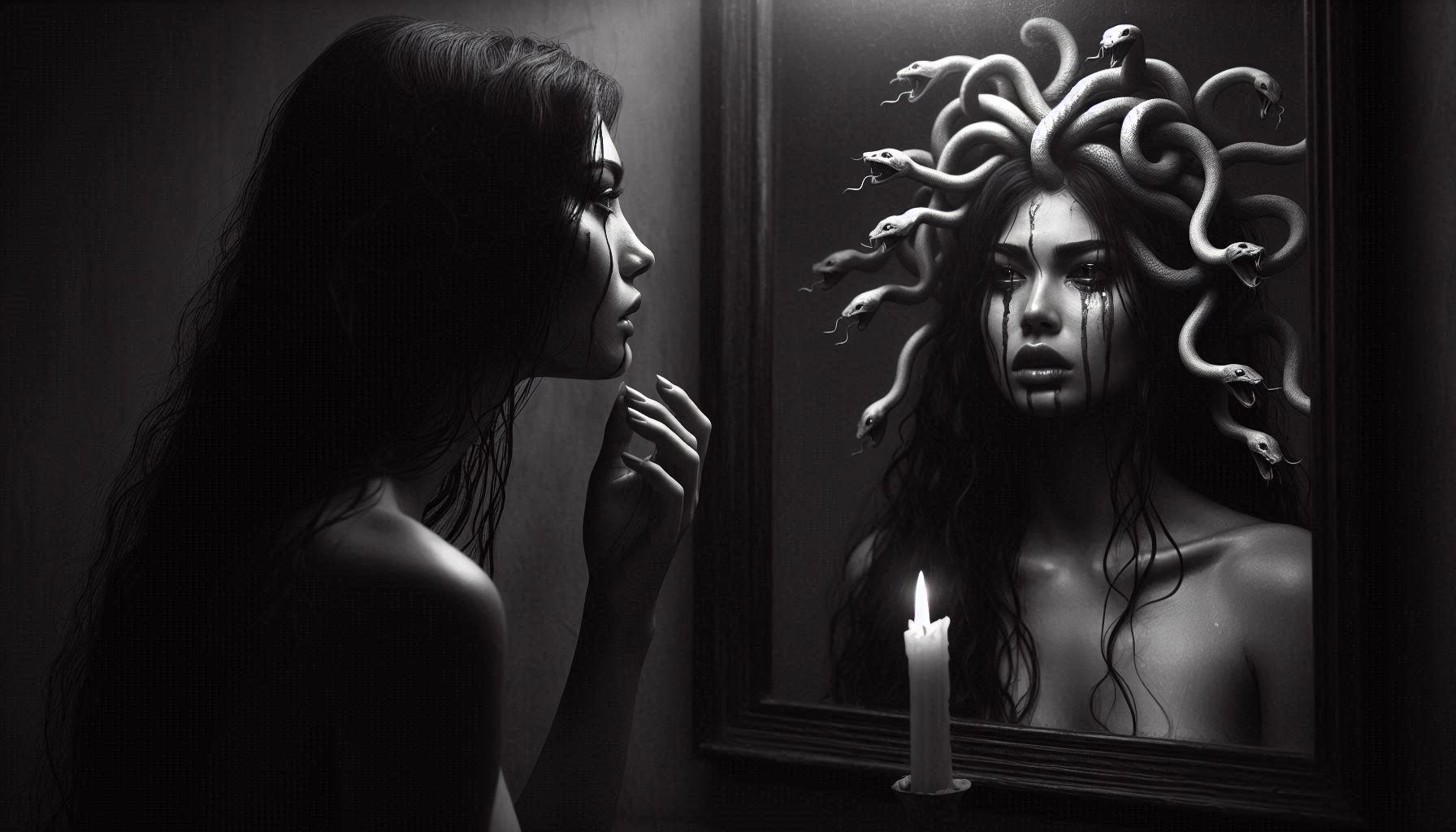
Some say she appears in dreams, her snakes hissing softly like lullabies. Some find her in the mirror when they are at their lowest, wretched, broken and weeping. And they find that she does not look away. She stares back, unflinching. Unafraid. In a world where victims are silenced, Medusa roars.
She has become a goddess in her own right. Not worshipped in grand temples, but in bedrooms and bathrooms, whispered to by candlelight and scribbled into journals. She is especially beloved by neurodivergent witches, trauma survivors, and those whose minds refuse to bend to neatness. Those who feel monstrous simply for existing.
Medusa does not ask for apology. She does not require neatness. She invites the chaos, the shadow, the jagged edges.
To work with Medusa is to reclaim the power that was taken from you. To scream when the world wants you silent. To confront injustice, even if your knees shake. To recognise that sometimes your power is dangerous – and that’s not a flaw. It’s a warning. It’s teeth.
And maybe that’s what makes her so terrifying to those who still cling to the patriarchal myths. She survived. She thrived in her exile. She made her pain into poison and her silence into a shriek. She wasn’t docile. She wasn’t pretty.
She was never the villain – just the scapegoat.
So yes, today you might see her on Instagram, paired with hashtags like #DivineFeminine or #WitchWound. You might light a candle beneath her image or wear her as a pendant resting near your throat. But know this – every time you speak her name with reverence, every time you carve her symbol into a spell or whisper her truth into your own healing you are rewriting the myth. You are undoing the curse.
Medusa deserved more. She still does. And every time she is remembered with compassion instead of fear, she turns not men, but lies, to stone.