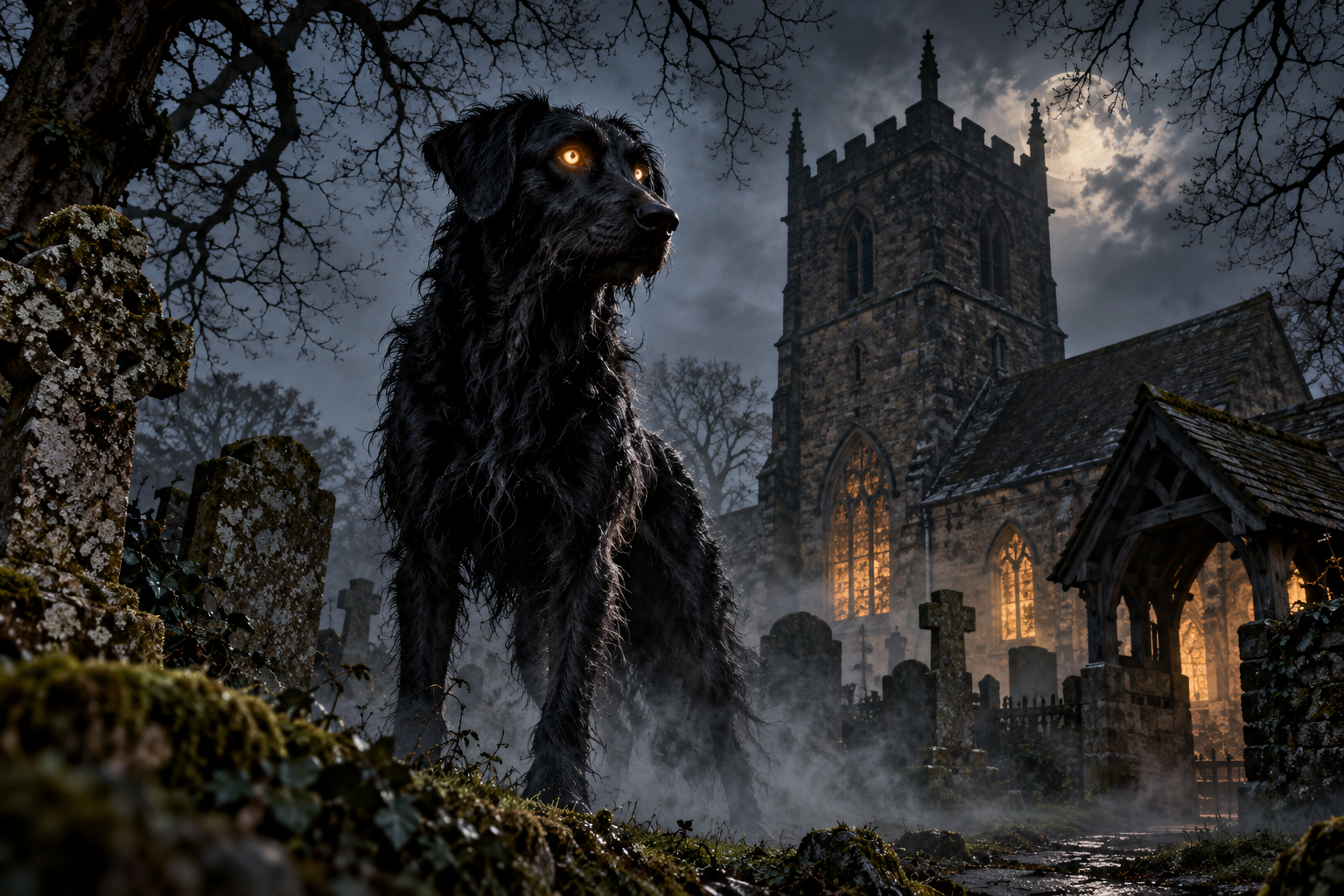
There are worse things to meet in a churchyard after dark than the dead.
Across the folklore of northern England, particularly Yorkshire and the surrounding counties, there are stories of a great black dog that belongs not among the graves, but to them. It walks the boundary of the churchyard, watches the church and keeps unwelcome visitors away from consecrated ground.
This is the Church Grim, sometimes called the Kirk Grim.
Unlike many of Britain’s spectral black dogs, the Grim is not simply something encountered on a lonely road before disaster strikes. It has a job. It is a guardian, bound to a particular church and its dead.
Unfortunately, according to some versions of the story, it did not volunteer.
William Henderson recorded the tradition in his 1879 Notes on the Folk-Lore of the Northern Counties of England and the Borders. He wrote of an old belief that a dog, or sometimes a boar, had been buried alive beneath the cornerstone of a church. Its ghost would then haunt the churchyard and drive away anyone who intended to profane it, including witches and warlocks.
It is a wonderfully grim explanation for the Grim, but it needs treating with a little caution.
Henderson was recording folklore in the nineteenth century. His account is valuable evidence that the belief existed, but it is not evidence that burying dogs alive beneath English churches was once a routine practice. The idea of a foundation sacrifice is widespread in European folklore, and later folklorists frequently interpreted traditions through that lens. Somewhere between an old belief, a remembered custom and a Victorian explanation for an older story, things can become decidedly muddy.
There is another version of the Church Grim tradition that makes rather more sense of why a dog might have become involved.
The first person buried in a newly opened churchyard was said to have an unenviable responsibility. Their spirit would be required to remain behind and guard the burial ground against the Devil.
Being first in apparently came with considerably more duties than anyone had mentioned.
To spare a human soul the job, folklore said that a black dog could be buried first, traditionally in the northern part of the churchyard. The animal took the watch instead.
Whether anybody actually did this is another matter. What matters to the folklore is the logic behind it. A graveyard required a guardian, and something had to be first.
The idea is not uniquely English.
Henderson compared the tradition with the Swedish Kyrkogrim. In Scandinavian folklore the guardian was not necessarily a dog. A lamb was associated with Swedish church foundations, while Danish tradition knew a Kirkegrim that might appear in other animal forms. Later folklorist Katharine Briggs also noted the Scandinavian parallels, including the Danish ‘grave-sow’.
The animal changes. The job remains remarkably familiar.
Something dead guards the sacred place.
In Yorkshire, however, the Church Grim acquired talents beyond keeping undesirable visitors away from the graves.
It could also announce death.
Tradition held that the Grim might toll the church bell at midnight shortly before somebody in the parish died. At a funeral, the clergyman could supposedly see the creature looking from the church tower and, from its appearance, know something of the fate awaiting the soul of the deceased.
That puts the Church Grim into much more familiar black-dog territory.
Britain is infested with supernatural dogs. Black Shuck stalks East Anglia. Barguests belong particularly to northern England. Other nameless black dogs haunt roads, bridges, gates, lanes and lonely stretches of countryside. They can foretell death, accompany travellers, terrify witnesses or, occasionally, protect them.
It is tempting to throw them all into one enormous kennel.
But the Church Grim deserves its own cage.
Black Shuck and the many roadside black dogs are primarily encountered. The Church Grim belongs somewhere. Its identity is tied to the church, churchyard and the dead entrusted to it. Even when it behaves as a death omen, it remains the guardian of a particular sacred boundary.
And that boundary matters.
Old churchyards are peculiar places in folklore. They are consecrated ground, yet filled with corpses. They are supposed to keep evil out, while simultaneously containing generations of the dead. Churchyard walls, gates, lychgates and paths therefore become thresholds between categories: living and dead, sacred and profane, inside and outside.
Put a supernatural watchdog there and suddenly the Church Grim begins to look almost inevitable.
There is an interesting echo in Scottish burial folklore. A tradition known as the graveyard watch held that the spirit of the most recently buried person could be required to watch over the churchyard until the next burial relieved them.
Again, someone has to keep watch.
Perhaps that is the heart of the Church Grim.
We have a tendency to describe spectral black dogs as frightening because they appear before death. The Grim is rather more complicated. If you are the person sneaking into a churchyard with unpleasant intentions, then yes, a gigantic supernatural dog appearing among the gravestones is probably a significant deterioration in your evening.
But if you are one of the dead?
The black dog is on your side.
It guards the graves from disturbance. It protects the church from profanation. It keeps watch while everybody else sleeps.
That makes the Church Grim one of the more sympathetic creatures in Britain’s enormous collection of supernatural dogs. Terrifying, certainly. Possibly an omen of death. Born, perhaps, from stories of sacrifice that we can no longer separate neatly from later folkloric interpretation.
But evil?
Not particularly.
The Church Grim isn’t waiting in the churchyard for you.
It’s waiting for whoever shouldn’t be there.
Sources and Further Reading
William Henderson, Notes on the Folk-Lore of the Northern Counties of England and the Borders (1879).
Eliza Gutch, County Folk-Lore, Vol. II: Examples of Printed Folk-Lore Concerning the North Riding of Yorkshire, York and the Ainsty (1901).
Elizabeth Mary Wright, Rustic Speech and Folk-Lore (1913).
Katharine Briggs, An Encyclopedia of Fairies (1976), entry on the Church Grim.