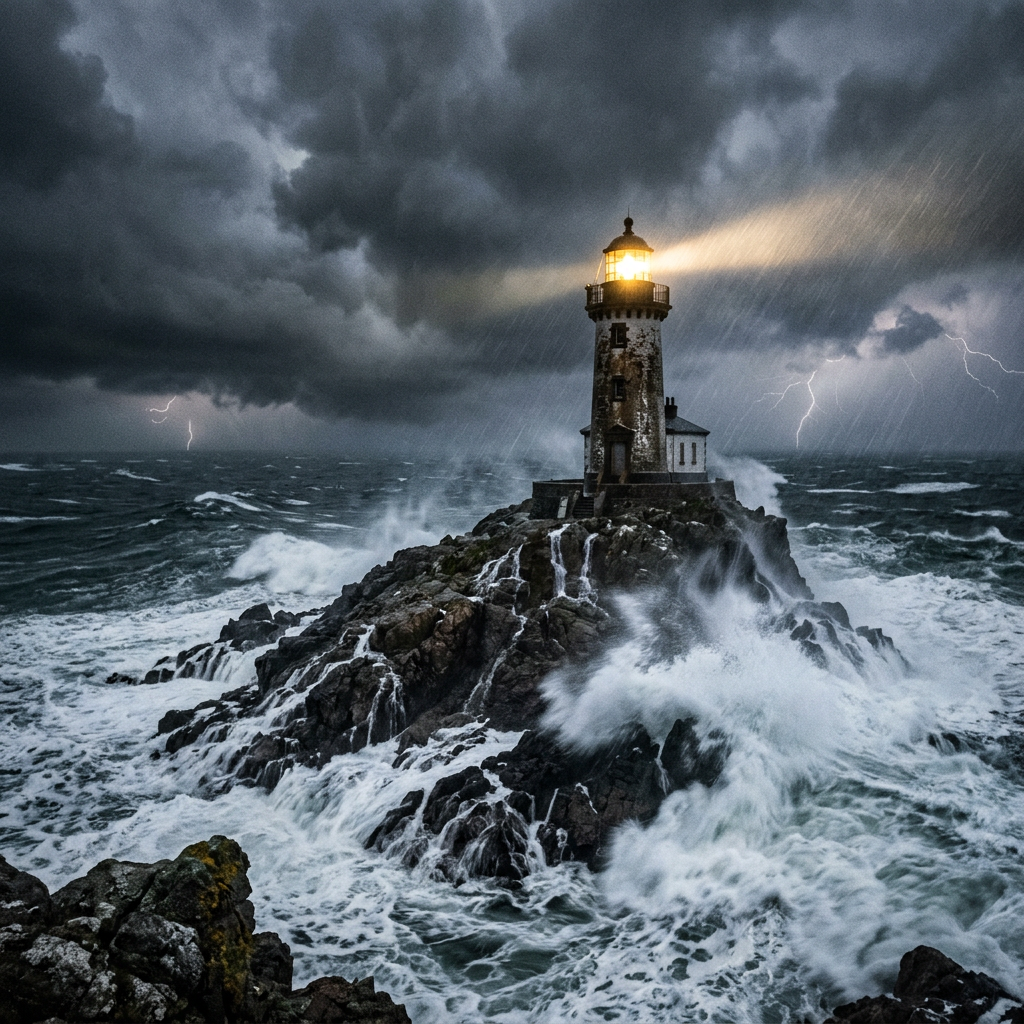
There are places where the sea rules the land. So a remote Island surrounded by crashing waves seems an appropriate place to start Mysterious Times Unsolved Mysteries Week.
Pull up a dinghy, let me tell you the tale of the Flannan Isles Lighthouse Keepers…
The Flannan Isles lie out in the Atlantic, west of the Isle of Lewis. it’s a lonely scatter of rock and weather sometimes known as the Seven Hunters. The largest of them, Eilean Mòr, is only around thirty-eight acres, but it rises sharply from the ocean, bare, treeless and exposed to everything the Atlantic chooses to throw at it and the lighthouse there was designed by David Alan Stevenson and first lit in December 1899.
It was a new light, built for safety, with a beacon that flashed two white signals every thirty seconds and could be seen for around twenty miles. [1]
For a little over a year, it did exactly what it had been built to do. Then, in December 1900, the light suddenly went out. The three men on duty were Principal Keeper James Ducat, Second Assistant Thomas Marshall and Occasional Keeper Donald McArthur, who was standing in for William Ross while Ross was on sick leave. They were not foolish men, nor inexperienced ones. They knew lighthouses. They knew weather. They knew the sea. [2] Which is what makes the story so difficult to leave alone.
On 15 December 1900, the steamer ‘Archtor’ passed by the Flannan Isles and reported that the light was not operating. But, because of bad weather, the relief vessel ‘Hesperus’ did not reach Eilean Mòr until 26 December, and by then whatever had happened was already more than a week old. [3]
As the ‘Hesperus’ approached, the crew noticed the first small signs that something was wrong. There was no flag was flying. No provision boxes had been set out for restocking and, perhaps most unnerving of all, no keeper came down to the landing to greet the relief crew.
Captain James Harvey sounded the ship’s whistle and fired a flare, and when there was no answer [3], relief keeper Joseph Moore was sent ashore.
Moore climbed the rocky headland towards the lighthouse and found the entrance closed. On entering, he found the lighthouse empty. The men were gone. The lamps had been cleaned and refilled and the clocks had stopped, having run down. Further investigation revealed the beds were unmade, and one set of oilskins remained inside, suggesting that at least one man had gone out without proper waterproof clothing. [3]
There was no blood, no sign of a fight and no bodies. Only absence. The island was searched, but nothing was found. The missing men had vanished from a place where there were very few places to vanish.
The official investigation was led by Northern Lighthouse Board Superintendent Robert Muirhead, who knew the men personally. His attention turned to the west landing, where there was serious storm damage. Ropes, railings and equipment had been disturbed or broken, and Muirhead believed the evidence pointed towards an overwhelming sea. His conclusion was that the men had most likely gone to secure or inspect equipment and had tragically been swept away by a powerful wave. [3] – And this is still the most sensible explanation, but sensible does not always mean satisfying.
Why did all three leave the lighthouse?
Why was one set of oilskins still inside?
Why was the light left unattended, against rules?
And how did the sea take three experienced keepers so completely that not a single body was ever recovered?
Of course, those questions left room for legend to creep in. Over the years, the story gathered details that may not belong to the original evidence at all.
The famous claims of an overturned chair, an untouched meal and terrifying logbook entries describing strange storms and frightened men are now treated with caution. Some of these details appear to have been popularised later, particularly through retellings and poetry, rather than from the official record.
The National Records of Scotland and lighthouse historians continue to point back to the official explanation: the men were probably lost to the sea. [4] And yet the folklore remains. Because that is what lonely places do. They attract stories.
The Flannan Isles already had an atmosphere long before the lighthouse was built. Remote islands, storm seas, ruined chapels, seabirds crying over black cliffs – it is not difficult to understand why people imagined presences there.
Once three men disappeared without trace, the island became something more than a workplace. It became a riddle. Some spoke of madness. Some of murder. Some of sea monsters, ghost ships, spies or supernatural forces. Of course none of those theories has evidence behind it, but the mystery does not need monsters.
The truth, or the most likely version of it, is eerie enough.
Three men went out into the weather. The lighthouse waited. The sea came in. And when the relief keeper arrived, there was nothing left but a clean lamp, an empty station and the sound of the Atlantic beating itself against the rocks.
Today, Flannan Isles Lighthouse is automated. No keepers live there now. The light still shines, but the human routine that once gave the place life has gone. No footsteps on the stair. No meal prepared after duty. No watch kept through the long winter night. Only the beam, the wind and the question – What did happen to Ducat, Marshall and McArthur?
Maybe the answer is exactly what the official report suggested. Maybe the Atlantic took them in one terrible moment and kept them, as it has kept countless sailors before and since. You see, that is the trouble with the sea. It can give you an explanation without giving you peace, and sometimes it gives nothing back at all.
Sources used:
National Records of Scotland, Northern Lighthouse Board, and official/archival summaries of the 1900 investigation.
[1]: https://blog.nrscotland.gov.uk/2023/12/12/flannan-isles-lighthouse-keepers-the-disappearance/ “Flannan Isles Lighthouse Keepers: The disappearance”
[2]: https://www.nlb.org.uk/history/flannan-isles/”Flannan Isles”
[3]: https://en.wikipedia.org/wiki/Flannan_Isles_Lighthouse “Flannan Isles Lighthouse”
[4]: https://www.nrscotland.gov.uk/learning-and-events/research-guides/lighthouses/?section=the-mystery-of-the-flannan-islands-lighthouse “Lighthouses – National Records of Scotland (NRS)”

Leave a Reply