Hot on the heels of my little foray into the Battle of the Beanfield I decided to dig a little deeper into another important and largely forgotten nugget of social history. This one incorporates a couple of my favourite subjects, neither of which is politics. It does, however, have women standing up together and achieving the seemingly impossible. And witches.
Pull up a chair… 🙂
There are moments in history when politics, folklore and belief collide in ways that seem almost impossible to imagine. One such moment unfolded on the windswept perimeter fences of Greenham Common during the final decades of the Cold War, when thousands of women gathered to oppose the presence of American nuclear missiles on British soil. Among the banners, songs and acts of civil disobedience was something few journalists expected to find at the heart of a major political protest. Witches.
For nearly two decades, Greenham Common became one of the most significant centres of peace activism in modern British history. It was a place of arrests, demonstrations, campfires and confrontation. It was also a place where ancient symbols found new life. Women danced in circles, wove webs across military fences, invoked goddesses, cast symbolic spells and drew upon centuries of folklore to challenge one of the most powerful military alliances in the world.
To understand why, we must first return to a Britain gripped by fear.
The early 1980s were shadowed by the threat of nuclear war. Relations between East and West had deteriorated. The Soviet Union and NATO were engaged in a dangerous arms race. Television viewers watched films such as Threads and The Day After, which depicted the horrific consequences of nuclear conflict. Schoolchildren grew up with the knowledge that a single political miscalculation could end civilisation in an afternoon.
Against this backdrop, the British government agreed to host American cruise missiles at RAF Greenham Common in Berkshire. To supporters, the deployment was a necessary deterrent. To opponents, it made Britain a target and increased the likelihood of nuclear confrontation.
In September 1981, a small group of Welsh women marched from Cardiff to Greenham Common. Their intention was straightforward. They wanted a public debate about nuclear weapons. When their concerns were ignored, some chose to remain.
Few could have imagined that their decision would create one of the most influential protest movements in modern British history.
The Greenham Common Women’s Peace Camp became a permanent presence outside the military base. Women arrived from every corner of Britain and beyond. Some stayed for days. Others remained for years. Grandmothers camped alongside students. Teachers shared fires with artists, nurses, activists and travellers. The camp developed its own culture, traditions and rituals.
Media coverage was often hostile. Newspapers portrayed the women as scruffy, eccentric or dangerous. Politicians dismissed them as naïve. Yet Greenham continued to grow. By December 1982, around 30,000 women joined hands around the nine-mile perimeter fence in one of the largest demonstrations Britain had ever seen.
As the movement evolved, some participants began drawing upon folklore, mythology and spiritual traditions to express their opposition to nuclear weapons.
For many women involved in the peace camp, the figure of the witch held profound significance.The witch has never been simply a character from fairy tales. Across European history she has represented independence, resistance and the refusal to conform. She is the village healer, the wise woman, the outsider and the scapegoat. She embodies knowledge that exists beyond accepted authority.
Many women at Greenham recognised parallels between historical witch hunts and contemporary attempts to dismiss or marginalise female voices. The image of the witch became a powerful symbol of protest.
Some protesters identified as pagans or practitioners of modern witchcraft. Others were not religious at all but embraced the symbolism. Together they transformed folklore into a political language.
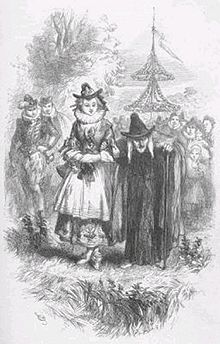
At various demonstrations, women dressed as witches, carrying besoms and wearing pointed hats. They conducted symbolic rituals outside the base gates. Circles were formed. Chants were spoken. Songs echoed through the Berkshire countryside.
Perhaps most striking were the webs.Women frequently attached ribbons, wool, photographs, toys and personal objects to the military fences. These creations resembled enormous spider webs stretching across the perimeter. They symbolised connection, community and the fragile threads linking humanity together. Military planners saw security barriers. The women transformed them into canvases for storytelling.
One protest became known as the “Embrace the Base” demonstration, during which thousands of women encircled Greenham Common. The act itself echoed ancient traditions of protective circles and boundary rituals found throughout British folklore.In many folk traditions, circles create sacred space. They mark a distinction between the ordinary and the extraordinary. Whether consciously or unconsciously, Greenham’s protesters drew upon symbolism that would have been recognised by generations of cunning folk, ceremonial magicians and village communities.
There were also reports of symbolic spell-casting directed not at individuals but at the weapons themselves.
These actions were largely theatrical and symbolic. Yet symbolism has always been one of humanity’s most powerful tools. Flags, crowns, crosses and national monuments derive their power from collective belief. Greenham’s witches understood this. They recognised that ritual could attract attention, build solidarity and create memorable images capable of travelling far beyond the camp itself.Photographs from the period remain remarkable. Women dance beneath military floodlights. Costumed protesters stand before coils of razor wire. Sacred imagery appears alongside anti-nuclear slogans. Ancient archetypes confront modern technology.
The contrast could hardly have been more dramatic.
Behind the spectacle lay a serious philosophical question. How should ordinary people respond when faced with systems that appear too vast to challenge?
For some, the answer lay in petitions or political lobbying. For others, it involved direct action. At Greenham, many women chose creativity. They responded to missiles with songs, fences with artwork and military authority with myth.
It is tempting to dismiss such actions as eccentric. Yet history suggests otherwise.Throughout the centuries, folklore has often emerged during periods of uncertainty and upheaval. Communities create stories to explain fears, express hopes and challenge power structures. Ballads mocked landlords. legends criticised rulers. Folk customs strengthened communities during times of hardship.
Greenham Common followed the same pattern.The camp generated its own folklore almost immediately. Stories circulated among protesters. Songs were composed. Rituals evolved. Shared symbols developed meaning through repetition. What began as a political protest became something resembling a living folk tradition.
Even the landscape itself absorbed these stories.
Greenham Common is now remembered not only as a military site but as a place of resistance. The fences have gone. The missiles have long since been removed. Yet the stories remain. Visitors still encounter traces of the movement in memorials, artworks and local memory.
The protest ultimately achieved far more than many observers predicted. Cruise missiles were removed from Greenham Common in 1991 following the Intermediate-Range Nuclear Forces Treaty. The peace camp remained for several years afterwards before finally closing in 2000.
Whether Greenham alone changed government policy remains a matter of debate. Few historians would argue that it was the sole cause. Yet its influence on public discourse is undeniable. The movement helped shape conversations about nuclear weapons, gender, protest and citizenship. It inspired campaigns around the world and demonstrated the power of sustained grassroots activism.
The witches of Greenham Common occupy a particularly fascinating place within that story.
They remind us that folklore is not confined to dusty books or distant centuries. It remains a living force, capable of adapting to new circumstances and addressing modern concerns. Ancient symbols continue to resonate because they speak to enduring human experiences.
The women who danced around Greenham’s fences were not attempting to retreat into the past. They were using the past to imagine a different future.
In an age dominated by military technology, political rhetoric and the machinery of the Cold War, they answered with stories, songs, rituals and symbols that had survived for centuries.
Whether one believes in magic is ultimately beside the point.
The real magic of Greenham Common lay in its ability to transform fear into action, isolation into community and protest into legend.
More than forty years later, the image remains unforgettable. A line of women standing beneath winter skies, facing one of the most formidable military establishments on Earth armed with banners, determination and the enduring power of folklore.
History remembers the missiles.
Folklore remembers the witches.
Further Reading
Common Women, Uncommon Practices by Sasha RoseneilGreenham Women Everywhere by Rebecca Mordan
Peace Camps: A Study of Greenham Women by Lynne Jones
The archives of the Greenham Common Women’s Peace
CampRecords held by the Women’s Library at the London School of Economics
Imperial War Museum collections relating to Greenham Common
Oral history projects documenting former Greenham residents
Copyright Notice:
© 2026 Mysterious Times. All rights reserved.This article is published exclusively for Mysterious Times. No part may be reproduced, stored or transmitted in any form without prior written permission, except for brief quotations used for review, commentary or educational purposes with appropriate attribution.