Pull up a chair. The fire is lit; the kettle is on and outside the wind is worrying at the windows. Tonight, we’re heading out onto the Staffordshire Moorlands, where the roads twist through lonely hills and the mist has a habit of turning familiar shapes into something altogether stranger…
There are places where ghost stories feel out of place. Tell a tale of a phantom hitchhiker in central Manchester and most people will shrug and carry on with their day. Speak of haunted castles and spectral monks in the tourist packed streets of York and you’ll likely be met with a smile and a nod. The Staffordshire Moorlands are different. Out there, among the heather and peat, the old stories seem somehow more at home.
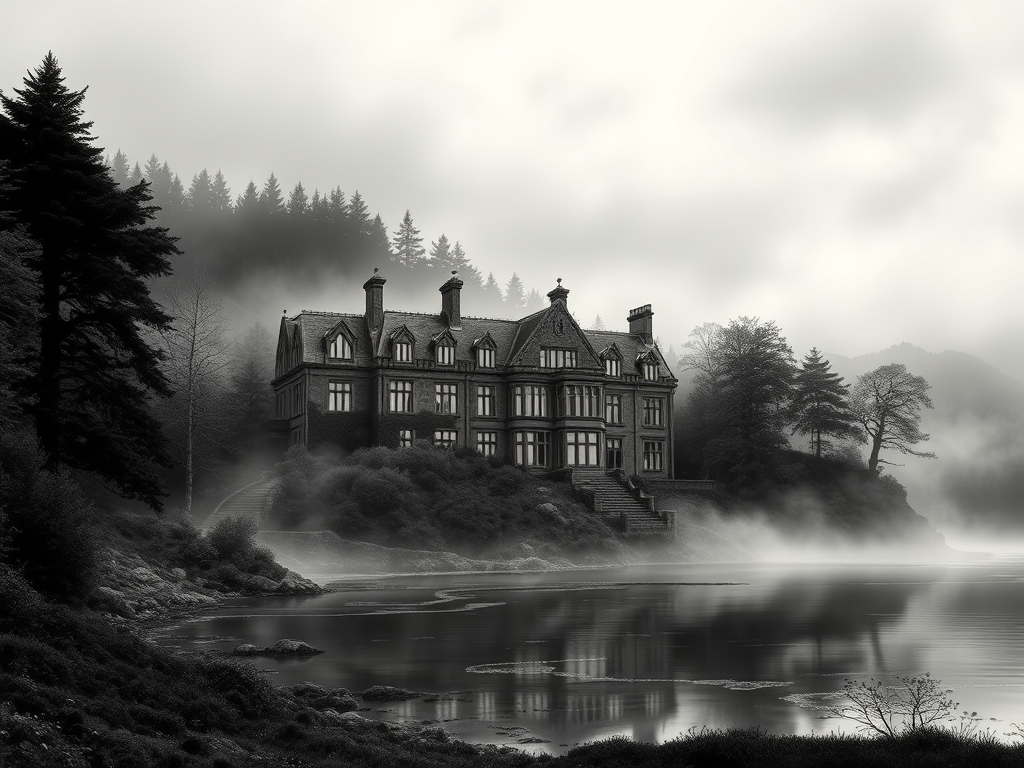
Maybe it’s the landscape itself. The hills roll away in every direction, broken by drystone walls, lonely farms and twisting roads that vanish into folds of mist. Even today there are stretches where you can travel for miles without seeing another soul. On winter evenings the darkness settles early and thick. The wind moans through the valleys and rattles at gates that have stood for generations.
It is easy to imagine that if anything supernatural were to roam the English countryside, it would choose somewhere like this. And for centuries, local people have claimed that something does. They call him the Headless Horseman.
Not the American Headless Horseman of Sleepy Hollow, immortalised by Irvine Washington and countless films and television adaptations. The Staffordshire apparition is older, rougher and altogether more unsettling. His story belongs to the moors.
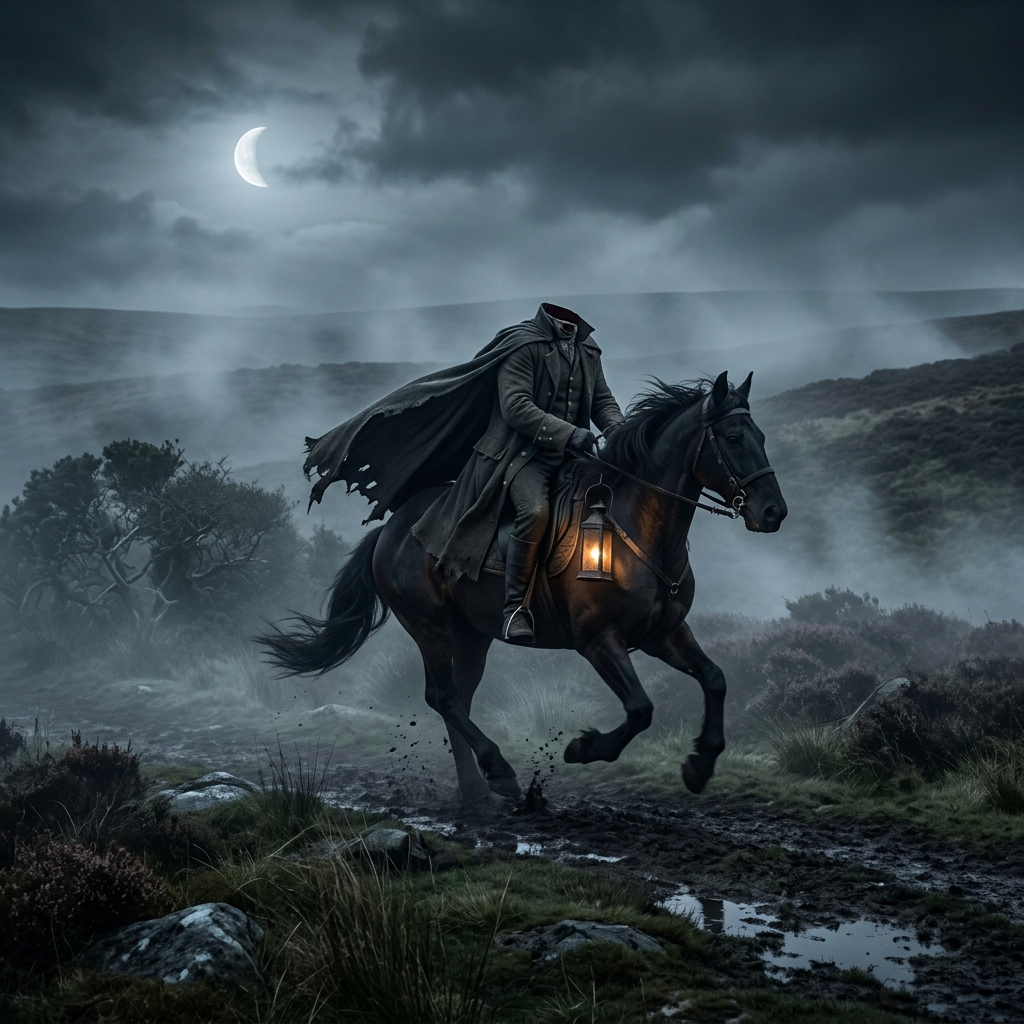
The tale is most often associated with the country around Butterton, Onecote, Warslow and the wild uplands beyond Leek. Here, generations of local folk told of a phantom rider who appeared without warning on lonely roads and moorland tracks. Witnesses describe a black horse with a rider cloaked in darkness and then, usually at the worst possible moment, the dreadful realisation that the figure in the saddle had no head.
In some versions he carried it tucked under his arm. In others there was simply nothing above the shoulders at all. Perhaps unsurprisingly (given that he has no head) the horseman never seemed interested in conversation. He rarely spoke. He merely rode. Yet his appearance was regarded as a terrible omen. To encounter him was said to bring misfortune. To follow him was foolish. To ride with him?
Well dear reader – that was potentially fatal.
One of the oldest and most frequently repeated tales concerns a farmer returning home after an evening spent drinking at a local inn. The story varies depending on who is telling it and where they heard it, but the essentials remain remarkably consistent.
The farmer had stayed longer that intended. Maybe you’ve known evenings like that yourself? One more pint becomes two. One last story becomes another. Before long, the fire is burning low, and the landlord is reminding everyone that closing time was some while ago.
The night was cold when the farmer set off for home. Mist drifted across the moor and the road stretched empty beneath a pale moon. Then, in the silence, the farmer heard hoofbeats. A horse and rider approaching from behind him.
Relieved at the prospect of some company, the farmer hailed the rider and asked if he might share the journey. The figure did not reply, but the horse slowed to a halt. The farmer took this as permission and climbed aboard. He was, after all, very, very drunk…
For a while all was well. The horse moved steadily along the road, the rider remained silent. But then the farmer began to feel uneasy. Maybe it was the unnatural stillness of his companion. Maybe it was the way the horse seemed to move faster and faster despite the rough terrain. Maybe it was just instinct. Whatever the reason, he craned his neck to look at more closely at the man in front of him. And realised there was no head to look at. Where there should have been a face there was only darkness. The rider sat upright in the saddle, guiding the horse with invisible eyes.
The terrified farmer tried to jump free. Some versions say that he was thrown violently from the horse. Others say he leapt into a ditch and lay there until dawn. A few darker tellings insist he never fully recovered from the encounter and died soon afterwards.
The horseman rode on. Untroubled, silent, vanishing into the mist.
Like many folk tales, the story grows richer the deeper you dig. By the Victorian period, local antiquarians and historians were recording the legend as something already ancient. John Sleigh, writing in the nineteenth century, noted accounts of the phantom rider and treated the story as part of the established folklore of the district rather than a recent invention. This is significant. Victorian collectors were often speaking to people whose grandparents and great-grandparents had known the same stories. By the time these tales reached print, they had frequently been circulating orally for centuries.
The obvious question, of course, is whether there was ever a real horseman.
Folklore often preserves fragments of history. A murder becomes a ghost. A battle becomes a fairytale. A criminal becomes a bogeyman. Some researchers suggest that the Headless Horseman may represent a distant memory of a death on the moors. One theory connects the legend to a medieval rebel known as John de Warton. The details are uncertain and the evidence is far from conclusive, but the possibility is intriguing.
Imagine a violent death. A beheading. A body left exposed as a warning. The event shocks the community. The stories spread. Generations come and go. The facts fade from living memory, yet the image remains. A rider without a head. A restless spirit patrolling the hills. Such transformations are not uncommon in folklore. The truth, if ever there was a truth, may have long since disappeared beneath layers of storytelling.
There is another possibility.
Not every ghost begins with a ghost.
In the nineteenth century some local accounts suggested that criminals may have exploited belief in the horseman. The moors were isolated. Travellers often carried money, livestock payments or goods for market. A highwayman dressed as a supernatural apparition would possess a powerful advantage. Most victims would be too terrified to offer resistance. I mean, who would challenge a headless horseman emerging from the fog? Who is brave enough to stick around long enough to discover the trick?
Whether this explanation is true or not, it illustrates something important about folklore. Ghost stories are not simply stories about ghosts. They tell us about what people feared. Loneliness. Violence. Strangers. The darkness beyond the firelight. The headless horseman embodies all of those fears. He belongs to the same family of legends as the Black Dog, the Wild Hunt and countless phantom riders said to haunt Britains roads.
These are not spirits who linger in houses or rattle their chains in castles. They belong to the landscape itself. They move and travel. They appear suddenly and disappear just as quickly. You encounter them not in places of safety, but in places of transition. Crossroads, tracks, bridges and moorland roads. The places between one destination and another.
Anyone who has crossed the Staffordshire Moorlands on a winter night will tell you how strange the landscape can become. Mist rolls in without warning, road signs emerge and vanish, shapes appear at the edge of your vision. Your headlights catch a gatepost or a standing stone and for a split second it resembles a waiting figure. The rational mind quickly supplies an explanation. Most of the time. But folklore thrives in the brief moments before reason catches up. Those moments when your imagination gets there first.
And so, the Headless Horseman continues to ride. Not because everyone believes in him. Not even because every sighting is genuine. But because some stories become part of a landscape. They settle into the hills like the mist itself.
The Staffordshire Moorlands have changed enormously over the centuries. Roads have improved, villages have grown, cars have replaced horses. Yet on a lonely evening, when the clouds hang low over Butterton Moor and the wind whispers across the heather, it is still possible to understand why generations of travellers glanced nervously over their shoulders.
After all, if you heard hoofbeats approaching from behind on an otherwise empty road…
Would you look back?
And if the rider offered you a lift…
Would you accept?
Sweet dreams, travellers. Keep to the road. And if you see a horseman emerging from the mist?
Count the heads before you climb aboard.
Further Reading:
John Sleigh – A History of the Ancient Parish of Leek (1883)
Local Staffordshire Moorlands Collections
Comparative studies of British Phantom Rider traditions and the Wild Hunt